
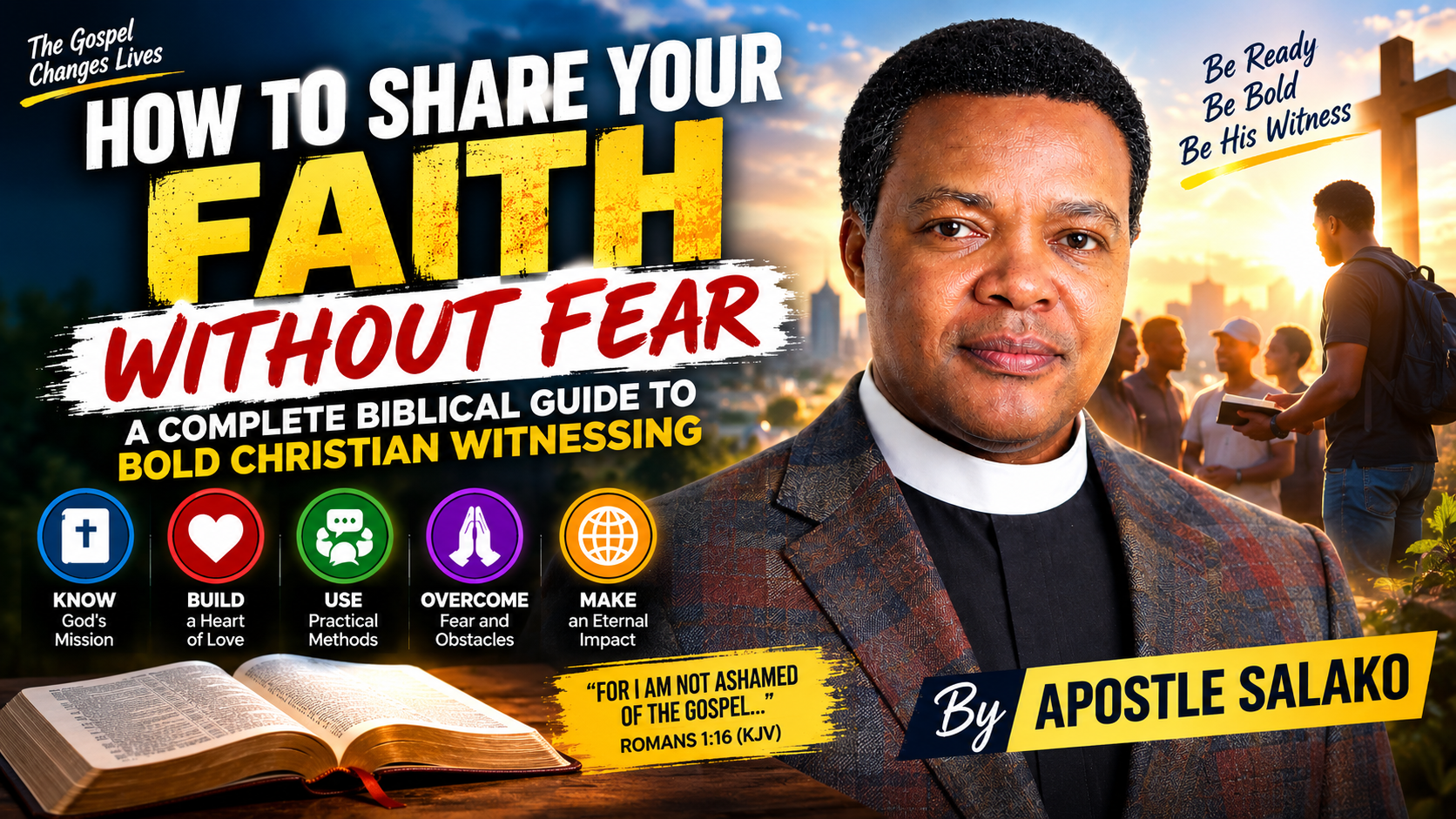
Introduction: You Can Share Your Faith Without Fear
Have you ever wanted to tell someone about Jesus Christ but suddenly felt nervous?
Perhaps you were sitting beside a colleague, talking with a friend, meeting someone for the first time, or having a conversation with a family member. You sensed an opportunity to mention your faith, but fear stopped you.
You may have thought:
“What will they think of me?”
“What if they reject me?”
“What if they ask me a question I cannot answer?”
“What if I say the wrong thing?”
“What if they become angry?”
These questions are common. Many sincere Christians love Jesus, believe the gospel, and desire to see others saved, yet struggle to speak openly about their faith.
The problem is often not a lack of love for Christ. It is fear.
Fear of rejection.
Fear of embarrassment.
Fear of criticism.
Fear of not knowing enough.
Fear of being called religious.
Fear of being unable to answer difficult questions.
Fear can make a believer silent when God is calling that believer to become a witness.
But the good news is this: you do not have to be fearless before you can become a faithful witness.
Biblical courage does not mean that you never feel nervous. It means that you trust God enough to obey Him even when you feel nervous.
The disciples themselves needed courage. Jesus told them in Acts 1:8:
“But ye shall receive power, after that the Holy Ghost is come upon you: and ye shall be witnesses unto me…” — Acts 1:8, KJV
The responsibility to witness was connected with the power of the Holy Spirit.
Likewise, 1 Peter 3:15 teaches believers to be ready to give an answer concerning the hope within them, while doing so with meekness and reverence. (Bible Gateway)
This means Christian evangelism is not about being aggressive, argumentative, or unnecessarily confrontational.
It is about faithfully representing Jesus.
It is about loving people.
It is about communicating the gospel clearly.
It is about telling the truth with grace.
It is about allowing the Holy Spirit to work through an available believer.
In this comprehensive guide, we will examine how to share your faith without fear, how to overcome common evangelism fears, how to start spiritual conversations naturally, how to share your testimony, how to explain the gospel, how to respond to difficult questions, and how to become a more confident Christian witness.
What Does It Mean to Share Your Faith?
Sharing your faith means communicating what you believe about God, Jesus Christ, salvation, the gospel, and the Christian life with another person.
It can happen in many different ways.
You can share your faith through:
A personal conversation
Your testimony
A Bible study
A sermon
A prayer
A social media post
A Christian article
A video
A conversation with a colleague
Encouragement during someone's difficult season
Inviting someone to church
Explaining why you believe in Jesus
Demonstrating Christlike love through your conduct
Evangelism is not limited to standing behind a pulpit.
A person may never enter a church building but may encounter Christ's message through a Christian colleague, friend, neighbor, family member, video, article, or personal testimony.
The Great Commission gives the Church a clear mandate to make disciples and teach people to follow Christ. Matthew 28:18–20 presents this commission as a continuing responsibility of Christ's followers. (Bible Gateway)
Therefore, sharing your faith is not merely an optional activity for pastors, missionaries, evangelists, or theological scholars.
Every believer can become a witness.
You do not have to know everything before you can tell somebody what Jesus has done in your life.
Why Christians Are Called to Share Their Faith
The first reason Christians share their faith is simple:
Jesus commanded His followers to make disciples.
Matthew 28:19–20 records the Great Commission.
Jesus did not say that only the most educated disciples should go.
He did not say that only professional preachers should go.
He commanded His followers to go and make disciples.
Acts 1:8 adds another dimension:
“Ye shall be witnesses unto me…” — Acts 1:8, KJV
A witness is someone who gives testimony concerning what he or she knows.
In a courtroom, a witness does not need to know everything about the entire legal system. The witness simply gives truthful testimony concerning what the witness has seen, heard, or experienced.
Similarly, Christians are called to testify about Jesus.
You may not know how to answer every philosophical question.
You may not understand every theological debate.
You may not know the historical details behind every passage of Scripture.
But you can say:
“This is what Christ has done in my life.”
You can explain:
“This is why I believe Jesus is Lord.”
You can tell someone:
“I once lived without understanding God's grace, but Christ changed my life.”
Your testimony can become an opening door for the gospel.
Why Are Christians Afraid to Share Their Faith?
Fear is one of the greatest obstacles to personal evangelism.
There are several common reasons.
Fear of Rejection
Nobody likes rejection.
When you share your faith, someone may disagree with you.
Someone may laugh.
Someone may ignore you.
Someone may challenge your beliefs.
Someone may say they are not interested.
That possibility can be uncomfortable.
But rejection does not mean that you have failed.
Your responsibility is faithfulness.
God is responsible for the final result.
The apostle Paul described Christian ministry using the imagery of planting and watering, while recognizing that God gives the increase.
This is an important principle:
You are called to witness; you are not called to control people's responses.
Once you understand this, evangelism becomes less intimidating.
Fear of rejection often becomes exaggerated in our minds.
We imagine the worst possible response before the conversation has even begun.
You might think:
“They will think I am strange.”
“They will never talk to me again.”
“They will insult my religion.”
But sometimes the person is actually interested.
Sometimes they have questions.
Sometimes they are secretly searching for hope.
Sometimes they have been praying for someone to talk to them.
Sometimes a person who appears uninterested today may remember your words months or years later.
Therefore, do not allow an imagined rejection to prevent a possible divine appointment.
At the same time, Christian evangelism should never involve harassment or coercion.
Sharing your faith means presenting the truth faithfully while respecting the dignity of the other person.
Fear of Not Knowing Enough
Another common fear is:
“What if they ask me a question I cannot answer?”
This fear can be especially strong among new Christians.
Perhaps someone asks:
“Why does God allow suffering?”
“Why should I believe the Bible?”
“How do you know Jesus really rose from the dead?”
“Why are there different Christian denominations?”
“What about people who have never heard the gospel?”
You may not immediately know how to answer.
That does not disqualify you from witnessing.
A mature response can simply be:
“That is a good question. I don't want to give you an answer I am not sure about, but I can study it and come back to you.”
There is humility in saying, “I don't know.”
It is better than inventing an answer.
Christian maturity includes intellectual honesty.
Your goal is not to win every argument.
Your goal is to faithfully represent Christ.
Fear of Being Judged
Some Christians fear being labeled:
Too religious
Extreme
Old-fashioned
Narrow-minded
Fanatical
Different
Jesus never promised that everyone would approve of His followers.
Romans 1:16 declares that Paul was not ashamed of the gospel of Christ.
This is an important spiritual principle.
If your identity depends entirely on people's approval, you will struggle to witness.
But if your identity is rooted in Christ, you can love people without needing their approval.
You can remain respectful while standing firmly on your convictions.
Fear of Offending People
Christians should not intentionally offend people.
However, we must distinguish between being offensive and speaking truth that someone finds uncomfortable.
There is a difference.
A rude Christian can make the gospel look unattractive because of poor behavior.
But a loving Christian may communicate a biblical truth that someone does not want to hear.
The solution is not to hide the gospel.
The solution is to communicate it with grace.
Colossians 4:6 teaches believers to let their speech be gracious and appropriately seasoned.
The biblical pattern is therefore:
Truth + Love + Wisdom + Gentleness.
We should never use the gospel as a weapon.
We should present it as the good news of God's saving grace.
Understanding Biblical Boldness
Biblical boldness is frequently misunderstood.
Some people think boldness means shouting.
Others think it means arguing.
Some believe a bold Christian must dominate every conversation.
That is not biblical boldness.
Biblical boldness means having the courage to speak truth faithfully despite fear.
The early believers prayed for boldness.
In Acts 4:29, the disciples asked God to enable them to speak His word with boldness.
Notice something important.
They did not merely pray:
“Lord, make us persuasive.”
They prayed for boldness.
This demonstrates that Christian courage is ultimately spiritual.
You can prepare your message.
You can study Scripture.
You can improve your communication.
But you also need the help of the Holy Spirit.
The Role of the Holy Spirit in Evangelism
Acts 1:8 connects witnessing with the power of the Holy Spirit.
This is essential.
Evangelism is not merely a communication exercise.
It is spiritual ministry.
The Holy Spirit gives believers power to become witnesses.
He can give you wisdom about what to say.
He can remind you of Scripture.
He can convict hearts.
He can open opportunities.
He can give you courage.
He can help you recognize moments that may become spiritual conversations.
This does not mean Christians should wait passively for a supernatural feeling before witnessing.
We should prepare ourselves and remain available.
Pray.
Study.
Listen.
Speak.
Trust God.
A powerful prayer before evangelism is:
“Holy Spirit, give me wisdom, courage, love, and the right words to represent Jesus today.”
Prepare Your Heart Before You Share Your Faith
Effective evangelism begins before the conversation.
It begins with your relationship with Christ.
If you want to speak confidently about Jesus, spend time with Jesus.
Prayer prepares the heart.
Bible study prepares the mind.
Worship prepares the spirit.
Obedience strengthens your testimony.
You should regularly ask:
Is Christ truly Lord of my life?
Am I walking in obedience?
Am I growing in Scripture?
Do I genuinely love people?
Am I praying for the lost?
Is my lifestyle consistent with my message?
People may forget a sermon.
They may forget a Bible verse.
But they often remember how a Christian treated them.
Your life is part of your witness.
Know the Gospel You Are Sharing
One of the most important ways to overcome fear is to understand the gospel clearly.
The gospel is not simply:
“Go to church.”
It is not merely:
“Be a good person.”
It is not simply:
“God wants you to prosper.”
The gospel centers on Jesus Christ.
The basic message includes:
1. God created humanity for relationship with Him.
Genesis presents God as Creator and humanity as His creation.
2. Sin separated humanity from God.
Romans 3:23 teaches that all have sinned and come short of the glory of God.
3. Sin has consequences.
Romans 6:23 explains the seriousness of sin while also presenting God's gift of eternal life through Jesus Christ.
4. Jesus Christ came to save sinners.
Christ's death and resurrection are central to the Christian gospel.
5. Salvation is received through faith in Christ.
The gospel calls people to repent, believe, and follow Jesus.
6. The believer receives new life.
Christianity is not simply changing religious affiliation.
It is reconciliation with God and a new life in Christ.
When you understand these truths, you will become more confident in explaining Christianity.
Learn to Share Your Testimony
Your testimony is one of your most accessible evangelism tools.
You do not need a theological degree to tell your story.
A simple testimony can have three parts:
Before Christ
What was your life, understanding, or spiritual condition like?
Encounter With Christ
How did you come to understand the gospel?
Life With Christ
How has your relationship with Jesus changed your life?
For example:
“Before I truly understood Christ, I was trying to live life through my own strength. As I encountered the gospel, I came to understand my need for God's grace and salvation through Jesus. Since following Christ, I have discovered a new purpose, hope, and desire to live according to God's Word.”
Your testimony does not need to be dramatic.
Some people have spectacular conversion stories.
Others grew up in Christian homes and gradually developed a personal relationship with Christ.
Both testimonies are valuable.
Do not exaggerate your story to make it sound more impressive.
Tell the truth.
How to Start a Conversation About Jesus
One of the hardest parts of evangelism is knowing how to begin.
You do not have to begin with a thirty-minute sermon.
Start naturally.
You could ask:
“Do you have any spiritual beliefs?”
Or:
“What gives you hope when life becomes difficult?”
Or:
“Do you believe there is a purpose behind life?”
Or, when appropriate:
“Would you mind if I shared something that has helped me personally?”
Another approach is to listen for opportunities.
If someone says:
“I have been going through a very difficult time.”
You might respond:
“I'm sorry you're going through that. Would you mind if I prayed for you?”
That can create a natural opening.
Evangelism is often relational rather than mechanical.
Ask Questions and Listen
Effective evangelism involves listening.
Many Christians make the mistake of preparing their response while the other person is still speaking.
Do not do that.
Listen.
Ask questions.
Understand the person's worldview.
Discover what they believe.
Find out what concerns them.
If someone says:
“I don't believe in Christianity.”
Instead of immediately arguing, ask:
“Can I ask what led you to that conclusion?”
The answer may reveal a painful church experience.
It may reveal misinformation.
It may reveal philosophical concerns.
It may reveal personal disappointment.
It may reveal intellectual questions.
You cannot address the real concern if you do not understand it.
Jesus frequently asked questions.
He engaged individuals personally.
Christian witness should therefore involve both speaking and listening.
Share Your Faith Without Being Pushy
There is a major difference between boldness and pressure.
Boldness says:
“I am willing to tell you what I believe.”
Pressure says:
“You must agree with me immediately.”
Christian evangelism should be bold but loving.
First Peter 3:15 specifically connects readiness to give an answer with meekness and reverence. (Bible Gateway)
Therefore:
Do not insult people.
Do not manipulate people.
Do not threaten people emotionally.
Do not manufacture testimonies.
Do not use fear to control people.
Do not deliberately provoke arguments.
Do not treat unbelievers as enemies.
Remember that Jesus died for people you are trying to reach.
You are not speaking to an enemy.
You are speaking to a person created in God's image.
Use Your Personal Testimony
Your testimony can be especially powerful when combined with Scripture.
For example:
“I believe Jesus gives genuine hope because I have experienced His transforming work in my own life. One Scripture that has become important to me is…”
Then share a relevant verse.
Your testimony makes the message personal.
Scripture provides biblical authority.
Together, they can make your conversation both authentic and grounded.
However, remember that your experience is not a replacement for Scripture.
Christianity is ultimately based on Christ and the gospel, not merely on personal experiences.
Use Scripture Wisely
You do not need to quote dozens of verses during every conversation.
Sometimes one well-chosen Scripture is better than twenty disconnected verses.
Important passages to become familiar with include:
John 3:16
Romans 3:23
Romans 6:23
Romans 10:9–10
Romans 10:13–15
Romans 1:16
2 Corinthians 5:17
2 Corinthians 5:20
Ephesians 2:8–9
Acts 1:8
Matthew 28:18–20
1 Peter 3:15
Mark 5:19
Colossians 4:5–6
Do not merely memorize verses.
Understand their meaning and context.
The goal is not to overwhelm someone with Bible quotations.
The goal is to help them encounter the truth of the gospel.
How to Respond When Someone Rejects the Gospel
Rejection can hurt.
But remember:
Someone rejecting your message is not necessarily rejecting you personally.
They may be rejecting an idea.
They may need more time.
They may have experienced religious abuse.
They may have questions.
They may not be ready.
They may simply disagree.
Do not become angry.
Do not insult them.
Do not attempt to force conversion.
Respond with grace.
You might say:
“I respect your position. If you ever want to discuss it again, I would be happy to talk.”
Then continue treating the person with love.
Sometimes your conduct after the conversation becomes more influential than the conversation itself.
How to Respond When You Do Not Know the Answer
This is worth repeating because it is one of the greatest fears among Christians.
You do not have to know everything.
Say:
“I don't know the answer to that yet.”
Then investigate.
Study the Bible.
Read reliable theological resources.
Ask mature Christian leaders.
Return to the conversation if appropriate.
This demonstrates integrity.
Never feel pressured to invent an explanation.
A Christian who says “I don't know” can still have strong faith.
Faith does not require pretending to possess unlimited knowledge.
Sharing Your Faith in the Workplace
The workplace provides many opportunities for Christian witness.
However, wisdom is essential.
Do your work well.
Be honest.
Keep your word.
Treat colleagues respectfully.
Avoid gossip.
Demonstrate integrity.
Do not use your position to pressure people into religious decisions.
Look for natural opportunities.
If someone asks:
“Why are you always so hopeful?”
You have an opening.
You can say:
“My relationship with Jesus has changed how I approach life.”
That is a simple statement.
You can continue if they show interest.
Your professional excellence can also reinforce your testimony.
Christian witness is not merely what you say at work.
It is also how you work.
Sharing Your Faith With Family and Friends
Family members may be some of the hardest people to reach because they already know you.
They have seen your weaknesses.
They know your history.
They may remember your mistakes.
Therefore, do not rely solely on words.
Live consistently.
Apologize when necessary.
Demonstrate humility.
Serve them.
Love them.
Pray for them.
When appropriate, share what Christ means to you.
Do not repeatedly lecture them.
Build trust.
Some family members may need to see transformation over time.
Remember the principle of 1 Peter 3:15: your hope should be visible enough that people have reason to ask about it.
Sharing Your Faith on Social Media
Social media has created an extraordinary opportunity for Christian witness.
A believer can potentially communicate biblical truth to people across different cities, countries, and cultures.
You can share:
Bible teaching
Short devotional videos
Testimonies
Scripture explanations
Christian encouragement
Prayer content
Gospel messages
Christian music
Personal reflections
Evangelistic articles
However, social media evangelism requires wisdom.
Do not make every post an argument.
Do not attack people.
Do not create unnecessary controversy simply for engagement.
Do not spread unverified claims.
Do not use sensational religious headlines merely to attract clicks.
Instead, create content that is:
Biblical.
Helpful.
Truthful.
Relevant.
Compassionate.
Original.
Christ-centered.
A Christian creator can use digital media to plant seeds of truth while maintaining integrity.
How Your Lifestyle Supports Your Witness
Your words and lifestyle should agree.
Jesus taught about letting one's light shine before others.
A person who constantly speaks about Christ but consistently behaves dishonestly creates confusion.
This does not mean Christians must be perfect.
We are not perfect.
But we should be growing.
When you fail, repent.
When you offend someone, apologize.
When you make a mistake, take responsibility.
When people see humility and transformation, your testimony becomes credible.
Christianity does not teach that believers never fail.
It teaches that Christ transforms sinners and continually works in His people.
Practical Ways to Become a More Confident Witness
Confidence grows through practice.
Here are practical steps.
1. Pray for opportunities
Every morning pray:
“Lord, give me an opportunity today to encourage someone and point them toward Christ.”
2. Memorize key Scriptures
Learn a manageable number of gospel passages.
3. Practice your testimony
Write your testimony in 100 words.
Then summarize it in 30 seconds.
4. Practice explaining the gospel
Try explaining the gospel simply to yourself.
5. Start with conversations, not sermons
Ask questions.
Listen.
Respond.
6. Read evangelism resources
Continue learning.
7. Spend time around mature believers
Observe how they communicate.
8. Stop trying to impress people
Your job is to represent Jesus, not yourself.
9. Learn from unsuccessful conversations
Not every conversation will go well.
Review what happened.
Improve.
Continue.
10. Trust God with the results
You cannot control another person's decision.
Faithfulness is your responsibility.
A Simple Gospel Presentation
If someone asks you directly:
“What exactly do Christians believe?”
You should be able to explain the gospel clearly.
Here is a simple framework.
God
God created humanity and desires relationship with us.
Sin
Humanity has sinned and become separated from God.
Jesus
Jesus Christ came into the world, lived a sinless life, died for our sins, and rose again.
Faith
God calls us to repent and place our faith in Jesus Christ.
New Life
Those who come to Christ receive forgiveness and new life.
Follow Christ
Salvation begins a lifelong relationship of discipleship.
You can then invite the person to consider the message personally.
Do not force a decision.
Present the truth clearly.
Encourage honest reflection.
Pray with the person if they are willing.
A 30-Day Faith-Sharing Challenge
If you want to become more confident in evangelism, try this 30-day challenge.
Days 1–5: Prepare
Pray daily for five people who do not currently follow Christ.
Write their names down.
Ask God to give you opportunities to demonstrate Christ's love.
Days 6–10: Prepare Your Testimony
Write your testimony.
Practice sharing it in three minutes.
Then practice explaining it in one minute.
Days 11–15: Begin Conversations
Have intentional conversations with people.
Do not force religious discussions.
Practice asking meaningful questions.
Days 16–20: Share Your Faith
Look for opportunities to explain what Jesus means to you.
Share one Scripture.
Tell your testimony.
Invite questions.
Days 21–25: Serve
Demonstrate practical Christian love.
Encourage someone.
Help someone.
Pray for someone.
Visit someone who is discouraged.
Offer support.
Days 26–30: Become Intentional
Share the gospel with someone who is genuinely open.
Follow up with people you have spoken with.
Continue praying.
Invite someone to Bible study or church where appropriate.
At the end of the 30 days, evaluate your growth.
Ask:
Am I less afraid?
Am I more prepared?
Am I listening better?
Do I understand the gospel more clearly?
Have I become more compassionate?
Am I trusting God more?
Common Mistakes to Avoid in Evangelism
Mistake 1: Trying to win every argument
Evangelism is not a competition.
Mistake 2: Talking too much
Sometimes the best witness is a good listener.
Mistake 3: Using complicated theological language
Use language people understand.
Mistake 4: Attacking other religions
Present Christ faithfully without insulting people.
Mistake 5: Making promises God did not make
Do not promise that following Jesus means someone will never experience difficulties.
Mistake 6: Manipulating emotions
Give people space to make sincere decisions.
Mistake 7: Using fear as your primary evangelism strategy
The gospel should be presented truthfully and responsibly, not as emotional intimidation.
Mistake 8: Pretending to know everything
Humility increases credibility.
Mistake 9: Having a poor lifestyle
Your conduct matters.
Mistake 10: Giving up too quickly
Some seeds take time to produce visible results.
Frequently Asked Questions About Sharing Your Faith
Do I need to be a pastor to share my faith? No. Every Christian can testify about Jesus Christ. Pastors and evangelists have specific ministry responsibilities, but ordinary believers can share the gospel in their relationships and daily lives. Acts 1:8 describes believers as witnesses of Christ.
What if I am naturally shy? You can still share your faith. Shyness does not disqualify you. Start with small conversations. Share your testimony with one person. Ask someone about their beliefs. Offer to pray for someone. Confidence can develop through practice.
What if someone laughs at me? Remain calm. Do not retaliate. You can respectfully say: “I understand that my beliefs may sound different from yours, but they are important to me.” Then continue treating the person with dignity.
What if someone becomes angry? Do not escalate the situation. You can respectfully end the conversation. Christian boldness does not require unnecessary confrontation. Wisdom includes knowing when to speak and when to step away.
What if someone asks a question I cannot answer? Say that you do not know. Offer to research it. Then follow up if appropriate. Never invent an answer.
Should I memorize Bible verses? Yes. Scripture memorization is extremely valuable for Christian life and evangelism. Begin with a manageable set of gospel passages. Understand them rather than merely memorizing words.
Can I share my faith through social media? Absolutely. Social media can provide opportunities for biblical teaching, testimony, encouragement, prayer, and gospel proclamation. Use wisdom and integrity.
How can I share my faith without offending people? Speak truthfully and respectfully. Listen. Avoid insults. Avoid unnecessary arguments. Do not manipulate. Follow the biblical principle of communicating with gentleness and respect.
What if the person says they are not interested? Respect their response. You can say: “I understand. If you ever want to talk about it, I'm happy to listen.” Then continue treating them kindly.
How do I overcome fear of evangelism? Pray. Study Scripture. Understand the gospel. Practice your testimony. Remember Christ's commission. Depend on the Holy Spirit. Start with small conversations. And trust God with the results.
What is the most important thing to remember when sharing my faith? Remember that you are representing Jesus. You are not trying to prove that you are smarter than someone else. You are not trying to win an argument. You are communicating the good news of Jesus Christ. Therefore: Speak truth. Show love. Listen carefully. Remain humble. Depend on the Holy Spirit. Trust God with the results.
Conclusion: Let Your Light Shine
Sharing your faith without fear does not mean you will never feel nervous.
It means fear does not control your obedience.
You may still feel your heart beating faster before beginning a spiritual conversation.
You may still wonder how someone will respond.
You may still encounter difficult questions.
You may still experience rejection.
But you can choose to trust God.
The Christian message is too important to remain hidden because of fear.
Jesus Christ has called His followers to be witnesses.
The Holy Spirit gives power for witnessing.
Scripture gives us the message.
Love gives us the right attitude.
Wisdom teaches us how to communicate.
And God's grace gives us courage.
Remember Paul's declaration in Romans 1:16:
“For I am not ashamed of the gospel of Christ…” — Romans 1:16, KJV
That should become the heartbeat of every Christian witness.
You do not need to be the world's greatest preacher.
You do not need to know every theological argument.
You do not need perfect communication skills.
You simply need to be available, prepared, truthful, loving, and willing to obey God.
The person sitting next to you may need encouragement.
The colleague working beside you may be searching for hope.
A family member may have questions they have never expressed.
A friend may be struggling privately.
A stranger may need to hear a message of hope.
You may be the person God uses to begin the conversation.
So pray.
Prepare.
Listen.
Speak.
Love.
Witness.
And leave the results in God's hands.
Do not let fear silence your faith.
Let your life testify.
Let your words testify.
Let your character testify.
Let your testimony testify.
Most importantly, let your witness point people to Jesus Christ.
The goal is not to make people admire us.
The goal is to help people see Christ.
The goal is not to win arguments.
The goal is to faithfully proclaim the gospel.
The goal is not to pressure people.
The goal is to lovingly invite them to consider the truth of Jesus Christ.
Therefore, wherever God has placed you, be willing to say:
“I am not ashamed of the gospel.”
And when fear comes, remember:
You are not witnessing in your own strength.
The Holy Spirit empowers the believer to become a witness, and Scripture calls Christians to be prepared to explain their hope with meekness and reverence. (Bible Gateway)
Go in faith.
Speak in love.
Walk in wisdom.
And share your faith without fear.
Key Bible Verses for Sharing Your Faith
For further study, meditate on these passages:
Matthew 5:14–16 — Letting your light shine.
Matthew 28:18–20 — The Great Commission.
Mark 5:19 — Telling others what the Lord has done.
Mark 16:15 — Preaching the gospel.
Acts 1:8 — Power to become witnesses.
Acts 4:29–31 — Prayer for boldness.
Romans 1:16 — Not being ashamed of the gospel.
Romans 10:13–15 — The importance of gospel messengers.
1 Corinthians 3:6–7 — God gives the increase.
2 Corinthians 5:17–20 — Ambassadors for Christ.
Colossians 4:5–6 — Walking wisely and speaking graciously.
1 Peter 3:15–16 — Giving an answer with meekness and respect.
Final Prayer for Boldness in Evangelism
Heavenly Father,
Thank You for the gift of salvation through Jesus Christ.
Thank You for calling me to be a witness of Your grace.
Forgive me for the times fear has prevented me from speaking when I should have spoken.
Give me courage to share my faith.
Give me wisdom to know what to say and when to say it.
Give me compassion for people who do not yet know You.
Help me listen carefully.
Help me speak graciously.
Help me represent Jesus with humility, truth, love, and integrity.
Holy Spirit, empower me to become an effective witness.
Open doors for gospel conversations.
Give me opportunities to encourage the discouraged, strengthen the weak, pray for those in need, and point people toward Jesus Christ.
When I face rejection, help me remain faithful.
When I do not know an answer, give me humility.
When I am afraid, give me courage.
When I am tempted to remain silent, remind me of the Great Commission.
Let my life and words bring glory to You.
Use me to reach my family, friends, colleagues, neighbors, community, city, nation, and the nations of the world.
May I never be ashamed of the gospel of Jesus Christ.
In Jesus' mighty name,
Amen.
About the Author
Apostle Salako Adedamola is a Christian preacher, teacher, mentor, and biblical communicator committed to helping people understand God's Word and apply biblical principles to everyday Christian life.
Through biblical teaching, Christian encouragement, discipleship, evangelism, and practical instruction, his goal is to help believers grow in faith, spiritual maturity, godly character, and their commitment to Jesus Christ.
Apostle Adedamola Salako
Founder of Apostle Salako Studios — pastor, recording artist, and teacher on faith, music, and stewardship.
Frequently Asked Questions
QHow can I share my faith without fear?
Pray, prepare your heart, know the gospel, practice your testimony, depend on the Holy Spirit, and start with small conversations. Courage grows as you obey, even while you feel nervous.
QWhat does the Bible say about sharing your faith?
Matthew 28:18–20, Acts 1:8, Romans 1:16, and 1 Peter 3:15 command and equip believers to witness with power, freedom from shame, and gentleness and respect.
QHow do I overcome fear of evangelism?
Pray, study Scripture, understand the gospel clearly, practice your testimony, begin with small conversations, and depend on the Holy Spirit rather than on your own confidence.
QHow can I talk to someone about Jesus?
Ask genuine questions, listen carefully, look for natural openings, share your personal testimony, and use Scripture wisely without pressure or argument.
QHow do I share my testimony effectively?
Keep it simple: your life before Christ, how you encountered the gospel, and how Jesus has changed your life. Be honest rather than dramatic.
QDo I need to be a pastor to evangelize?
No. Every Christian is called to be a witness (Acts 1:8). Pastors have specific duties, but ordinary believers can share the gospel in their daily relationships.
QHow can I share my faith without being pushy?
Be bold but loving. Do not argue, manipulate, or pressure. Speak truth with grace, meekness, and respect, as 1 Peter 3:15 teaches.
QWhat should I do if someone rejects the gospel?
Respect their response, do not become angry, continue treating them with love, and keep praying. Rejection is not failure; faithfulness is your responsibility.
QWhat if I do not know how to answer a question about Christianity?
Honestly say you do not know, offer to research it, and follow up if appropriate. Humility increases credibility; never invent an answer.
QHow does the Holy Spirit help Christians evangelize?
He gives power, wisdom, courage, and the right words; He convicts hearts and opens doors for gospel conversations, as promised in Acts 1:8.
Enjoyed this article?
Get the next one straight to your inbox. One thoughtful email a week.
Comments (0)
Comments are stored locally in your browser. For published responses, email us via the Contact page.
You may also like
Biblical Evangelism in Today's World: How Christians Can Share the Gospel Effectively
Biblical evangelism remains the mission of every Christian. Discover how believers can share the Gospel effectively in today's world through Scripture, prayer, love, personal testimony, relationships, compassion, social media, technology, and the power of the Holy Spirit.

Winning Souls Through Love and Compassion: A Biblical Guide to Effective Evangelism
Discover how to win souls through love and compassion. Learn biblical principles, practical evangelism strategies, prayer, discipleship, and how to reach people with the love of Christ.
When God Asks for the Whole Net
Why Jesus is not looking for your fish — He is looking for your heart.