
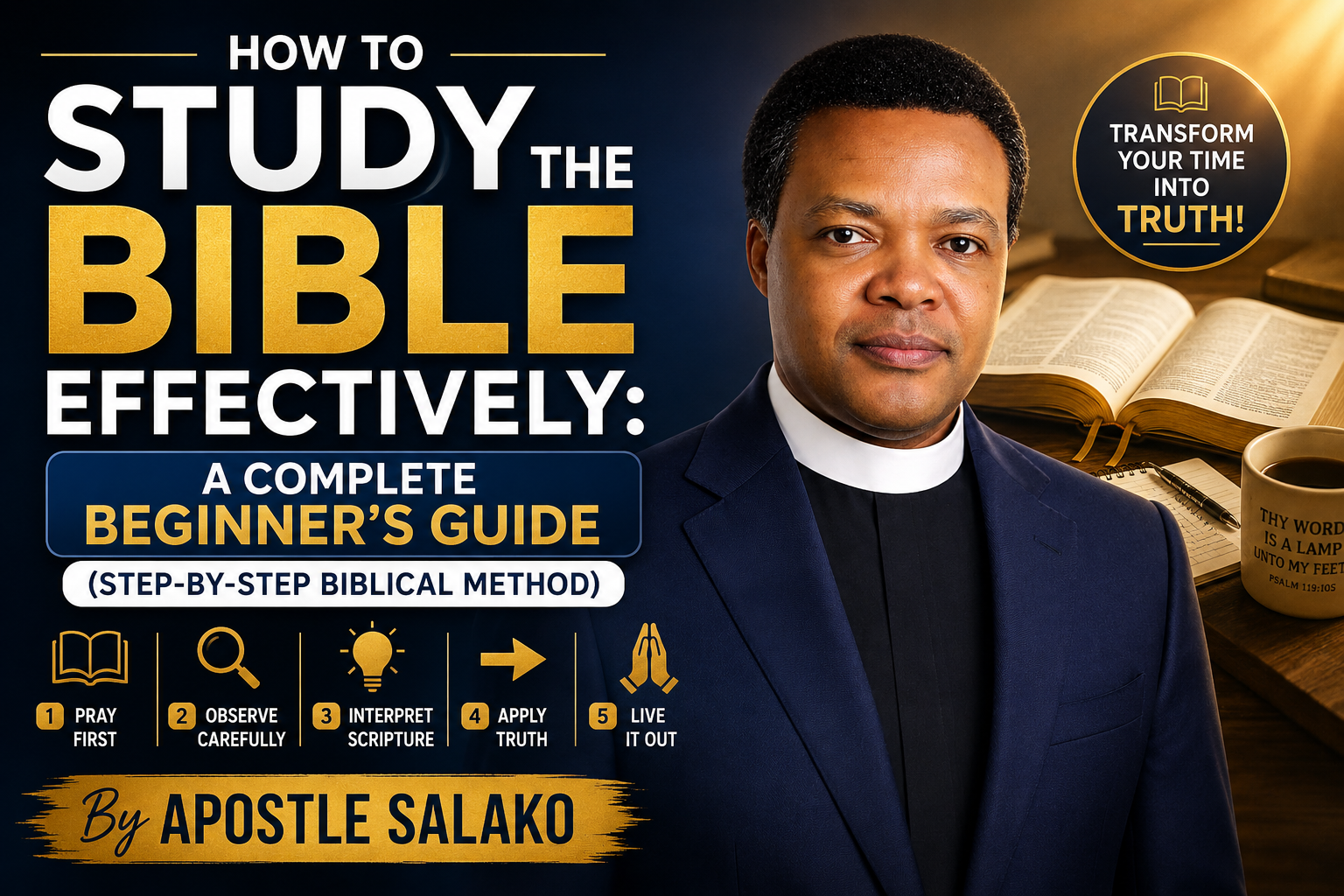
The greatest privilege given to every believer is not merely owning a Bible but understanding it. Millions of Christians possess several copies of the Scriptures, yet many struggle to know where to begin, how to interpret what they read, or how to apply God's truth to everyday life.
The Bible is far more than a religious book. It is the living revelation of God. Through its pages, God reveals His character, His will, His promises, His commandments, and His eternal plan of redemption through Jesus Christ.
Many believers become discouraged because they approach Bible study without guidance. They read randomly, misunderstand passages, or become overwhelmed by difficult books. However, God never intended His Word to remain mysterious to sincere seekers.
The purpose of this guide is to provide a practical, biblical, and easy-to-follow roadmap for studying the Scriptures effectively. Whether you have just become a Christian or have attended church for many years, these principles will help you move beyond casual reading into life-changing study.
Bible study is not merely an intellectual exercise. It is a spiritual encounter with God Himself. Every page has the potential to transform the heart, renew the mind, strengthen faith, and equip believers for victorious Christian living.
The Apostle Paul reminded Timothy:
"Study to shew thyself approved unto God, a workman that needeth not to be ashamed, rightly dividing the word of truth." — 2 Timothy 2:15 (KJV)
Notice that Paul did not encourage Timothy merely to read. He instructed him to study—to diligently handle God's Word with accuracy and reverence.
Likewise, the psalmist declared:
"Thy word is a lamp unto my feet, and a light unto my path." — Psalm 119:105 (KJV)
Without the light of Scripture, believers walk through life in spiritual darkness, confusion, and uncertainty. With it, every step is illuminated by divine wisdom.
This guide will teach you how to prepare spiritually for Bible study, how to understand difficult passages, proven methods used by mature believers, practical habits that make Bible study enjoyable, common mistakes to avoid, and a complete Bible study system anyone can follow.
Above all, my prayer is that this guide will ignite within you an insatiable hunger for God's Word. As Jesus Himself declared:
"Man shall not live by bread alone, but by every word that proceedeth out of the mouth of God." — Matthew 4:4 (KJV)
Why Every Christian Must Study the Bible
Many Christians ask, "Why is Bible study so important?" The answer is simple: because spiritual growth depends upon the Word of God. A believer cannot mature spiritually without consistent exposure to Scripture. Just as the body requires daily nourishment, the soul requires the life-giving truth of God's Word.
The Bible Reveals God. Without Scripture, people are left to imagine God according to their own ideas. The Bible corrects these misconceptions by revealing God's holiness, justice, mercy, love, and faithfulness. Jesus said:
"Search the scriptures... they are they which testify of me." — John 5:39 (KJV)
Every book of the Bible ultimately points to Christ.
The Bible Builds Faith. Faith is not produced by positive thinking or human optimism. Paul wrote:
"So then faith cometh by hearing, and hearing by the word of God." — Romans 10:17 (KJV)
The more believers hear, read, meditate upon, and study Scripture, the stronger their faith becomes.
The Bible Protects Against Deception. False teaching flourishes wherever biblical knowledge is absent. The Berean believers were commended because:
"...they received the word with all readiness of mind, and searched the scriptures daily, whether those things were so." — Acts 17:11 (KJV)
Every Christian should test every sermon, prophecy, and teaching against Scripture.
The Bible Produces Spiritual Growth. Peter compares God's Word to spiritual milk:
"As newborn babes, desire the sincere milk of the word, that ye may grow thereby." — 1 Peter 2:2 (KJV)
Healthy Christians are growing Christians, and growing Christians are students of Scripture.
The Bible Equips Believers. Paul summarized Scripture's purpose perfectly:
"All scripture is given by inspiration of God, and is profitable for doctrine, for reproof, for correction, for instruction in righteousness: That the man of God may be perfect, throughly furnished unto all good works." — 2 Timothy 3:16–17 (KJV)
The Bible teaches truth, exposes error, corrects sin, trains righteousness, and prepares believers for service.
The Bible Renews the Mind. The world constantly shapes people's thinking. Scripture transforms it.
"And be not conformed to this world: but be ye transformed by the renewing of your mind..." — Romans 12:2 (KJV)
Bible study replaces worldly thinking with God's perspective.
The Bible Gives Wisdom. Many seek wisdom from social media, philosophers, or influencers. Yet God's Word remains the highest source of wisdom. David testified:
"Thy testimonies also are my delight and my counsellors." — Psalm 119:24 (KJV)
The Bible Leads to Spiritual Victory. Jesus overcame Satan's temptations not by emotion or supernatural displays but through Scripture. Three times He declared, "It is written..." (Matthew 4). Victory belongs to believers who know God's Word.
Bible Reading vs. Bible Study
Many believers confuse reading the Bible with studying it. Both are valuable, but they serve different purposes.
Bible reading emphasizes familiarity. Its goal is to know the overall story of Scripture, build consistency, encourage daily devotion, feed the spirit, and develop love for God's Word. Reading often covers larger sections of Scripture quickly.
Bible study emphasizes understanding. Instead of asking, "What did I read?" Bible study asks, "What does this passage actually mean?" It requires slowing down to observe details, examine context, compare Scriptures, and apply God's truth personally.
Bible study involves asking questions, taking notes, looking up cross references, defining important words, discovering biblical principles, and applying truth. Reading informs. Study transforms.
Why you need both: Imagine eating a meal quickly every day. You receive nourishment, but you may never appreciate the ingredients, preparation, or richness of the food. Bible reading is like eating. Bible study is like learning how the meal was prepared. Healthy Christians do both consistently.
The Inspiration and Authority of Scripture
Before learning how to study the Bible, we must first understand why the Bible deserves our complete trust. The Bible is not merely a collection of ancient religious writings. It is God's inspired revelation to humanity. Peter explains:
"Knowing this first, that no prophecy of the scripture is of any private interpretation. For the prophecy came not in old time by the will of man: but holy men of God spake as they were moved by the Holy Ghost." — 2 Peter 1:20–21 (KJV)
Although God used approximately forty human authors over more than fifteen hundred years, the ultimate Author is the Holy Spirit. Paul writes:
"All scripture is given by inspiration of God..." — 2 Timothy 3:16 (KJV)
The phrase "given by inspiration of God" literally means "God-breathed." Scripture carries divine authority because it originates from God Himself.
Why this matters: If the Bible were merely human opinion, we could accept or reject its teachings according to preference. But because it is God's inspired Word, its commands are authoritative, its promises are trustworthy, its warnings must be heeded, its doctrine is true, its wisdom is timeless, and its message is sufficient for every generation.
Jesus affirmed the enduring authority of Scripture when He declared:
"Heaven and earth shall pass away, but my words shall not pass away." — Matthew 24:35 (KJV)
As believers, we do not stand above God's Word as judges. We stand beneath it as disciples, allowing it to shape our beliefs, correct our errors, and transform our lives.
How to Prepare for Bible Study
One of the greatest mistakes believers make is opening the Bible casually without preparing either their hearts or minds. The Bible is unlike any other book. It is God's living Word, and studying it is an act of worship. Proper preparation helps position your heart to receive divine truth. The prophet Samuel gave Israel this timeless instruction:
"Only fear the LORD, and serve him in truth with all your heart..." — 1 Samuel 12:24 (KJV)
Likewise, every Bible study session should begin with reverence, humility, and expectancy.
1. Pray Before You Read. Prayer invites the Holy Spirit to illuminate the Scriptures. While education and study are valuable, spiritual understanding ultimately comes from God. David prayed:
"Open thou mine eyes, that I may behold wondrous things out of thy law." — Psalm 119:18 (KJV)
Before opening your Bible, pray a simple prayer such as: "Lord Jesus, thank You for Your Word. Open my understanding through the Holy Spirit. Remove distractions, give me wisdom, and help me obey what You teach me today. In Jesus' name, Amen." Bible study without prayer often becomes academic. Bible study with prayer becomes transformational.
2. Choose a Quiet Place. Jesus often withdrew from the crowds to spend time alone with the Father.
"And in the morning, rising up a great while before day, he went out... and there prayed." — Mark 1:35 (KJV)
A quiet environment minimizes distractions and allows for deeper concentration. Whether it is early morning before others awaken or a peaceful corner of your home, create a consistent place where you can meet with God.
3. Set Aside Dedicated Time. Consistency matters more than duration. Studying the Bible for 30 minutes every day is far more fruitful than studying for three hours once a month. The psalmist declared:
"O how love I thy law! it is my meditation all the day." — Psalm 119:97 (KJV)
Aim for a regular schedule. Many believers find mornings especially beneficial because they begin the day with God's wisdom.
4. Remove Distractions. Turn off unnecessary notifications. Put your phone on silent or use it only for Bible study if it serves as your Bible. Remember Paul's instruction: "Redeeming the time..." (Ephesians 5:16 KJV). Your time in God's Word deserves your full attention.
5. Come with a Teachable Spirit. Bible study is not about proving your opinions but discovering God's truth. James exhorts believers:
"Receive with meekness the engrafted word, which is able to save your souls." — James 1:21 (KJV)
Pride resists correction. Humility welcomes it.
6. Bring the Necessary Materials. Having the right tools readily available keeps you focused. At a minimum, gather: a Bible, a notebook or journal, pens or highlighters, a Bible dictionary, a concordance or Bible app, a cross-reference Bible, a Bible commentary (used carefully), and a prayer journal. Organization helps establish a fruitful routine.
Choosing the Right Bible Translation
One of the most common questions beginners ask is: "Which Bible translation should I use?" The answer depends on your purpose.
For Devotional Reading, choose a translation that is accurate and easy for you to understand consistently. For Serious Study, compare several translations when possible, but always prioritize faithful translations that preserve the original meaning of the biblical text. Since this guide quotes the King James Version (KJV), all Scripture references follow that translation.
Why the KJV Remains Valuable: The King James Version has served the Church for centuries because of its literary beauty, formal translation philosophy, faithfulness to the traditional biblical text, rich theological vocabulary, and widespread acceptance among many conservative churches. Although some of its language is archaic, many believers appreciate its precision and reverence.
Comparing Translations: When studying difficult passages, comparing reputable translations can clarify unfamiliar wording without replacing careful study. Remember, no translation should replace diligent examination of the passage itself.
Essential Bible Study Tools
The Ethiopian eunuch asked Philip:
"How can I, except some man should guide me?" — Acts 8:31 (KJV)
Today, believers have access to many excellent study tools that assist in understanding Scripture. These resources should support the Bible—not replace it.
1. Study Bible. A quality study Bible includes introductions to each book, historical background, maps, cross-references, explanatory notes, and charts and timelines. Study notes are helpful, but remember they are written by humans and should always be tested against Scripture.
2. Bible Concordance. A concordance lists where words appear throughout the Bible. For example, if you want to study the word faith, a concordance helps you locate every major occurrence. This allows Scripture to interpret Scripture.
3. Bible Dictionary. Many biblical terms, customs, and names require explanation. A Bible dictionary helps you understand places, people, Jewish customs, ancient measurements, biblical festivals, and historical events. Understanding the historical setting often brings passages to life.
4. Bible Atlas. The Bible contains hundreds of geographical references. Seeing where events occurred makes narratives more understandable. Maps illuminate Paul's missionary journeys, Israel's wilderness wanderings, the kingdoms of Israel and Judah, and the locations of Jesus' ministry.
5. Bible Commentary. Commentaries explain passages based on scholarly research. Use them after you have studied the text yourself. Never let commentary replace personal discovery.
6. Notebook or Bible Journal. Writing reinforces learning. Record observations, questions, cross-references, personal applications, prayer requests, sermon ideas, and insights from the Holy Spirit. Habakkuk was instructed:
"Write the vision, and make it plain..." — Habakkuk 2:2 (KJV)
A Bible journal becomes a testimony of your spiritual growth over time.
7. Bible Highlighters and Color Coding. Develop a simple system such as yellow for God's promises, blue for commands, green for faith, red for warnings, purple for prophecies, orange for prayer, and pink for love. Color coding helps you quickly identify recurring themes during future study.
8. Digital Bible Resources. Bible apps and online tools can provide keyword searches, cross-references, reading plans, audio Bibles, original-language tools, and note-taking features. Technology is a blessing when it helps you engage more deeply with God's Word rather than distract from it.
The Complete 12-Step Bible Study Method
One reason many believers abandon Bible study is that they have no clear process. The following 12-step method provides a practical framework that can be used with any passage of Scripture.
Step 1: Begin with Prayer. Invite the Holy Spirit to guide your understanding. "If any of you lack wisdom, let him ask of God..." (James 1:5 KJV). Never rush into study without first seeking God's wisdom.
Step 2: Read the Passage Repeatedly. Read the selected passage at least three times—first for familiarity, second for details, third for deeper understanding. Repetition often reveals truths missed on the first reading.
Step 3: Observe Carefully. Ask: Who is speaking? To whom? What happened? Where did it happen? When did it happen? Why did it happen? How did it happen? Observation is the foundation of sound interpretation.
Step 4: Identify Key Words. Circle or underline repeated words, commands, promises, contrasts, and important themes. Pay attention to connecting words such as therefore, because, but, if, then, so, and yet, which reveal the flow of the author's argument.
Step 5: Examine the Context. Never isolate a verse from its surrounding verses. Study the immediate context (the surrounding chapter), the broader context (the entire book), and the biblical context (how the passage fits within all of Scripture). Context protects us from misunderstanding.
Step 6: Compare Scripture with Scripture. The Bible explains itself. If a passage seems difficult, search for other verses addressing the same topic. Study faith alongside Romans 10:17, Hebrews 11, and James 2. Study prayer alongside Matthew 6, Luke 11, and James 5. This principle guards against building doctrines on isolated verses.
Step 7: Study Historical Background. Understanding the original audience and setting helps clarify meaning. Ask: Who wrote this book? When was it written? Why was it written? What circumstances surrounded the recipients? Historical context enriches interpretation.
Step 8: Define Important Words. Some biblical words carry rich theological meaning—grace, justification, redemption, sanctification, covenant, mercy, faith. Consult a Bible dictionary to understand these terms in their biblical context.
Step 9: Discover the Main Lesson. Every passage communicates a central truth. Ask: What was God teaching the original audience? What timeless principle is revealed? What does this passage teach about God, humanity, sin, salvation, or Christian living? Resist the temptation to force personal ideas into the text.
Step 10: Apply the Truth Personally. Bible study is incomplete without application. James reminds us:
"But be ye doers of the word, and not hearers only..." — James 1:22 (KJV)
Ask yourself: Is there a sin to confess? A promise to claim? An example to follow? A command to obey? An attitude to change? Transformation is the goal.
Step 11: Record Your Insights. Write down key verses, lessons learned, personal reflections, questions for further study, and practical action steps. A written record helps reinforce learning and provides encouragement when you look back on your spiritual journey.
Step 12: Close in Prayer. End your study by responding to what God has shown you. Pray for obedience, wisdom, strength, spiritual growth, and opportunities to live out His Word. Bible study should always lead to worship, obedience, and a closer relationship with Christ.
As you begin to apply these principles consistently, remember that effective Bible study is not about mastering information—it is about being mastered by the truth of God's Word.
"Thy word have I hid in mine heart, that I might not sin against thee." — Psalm 119:11 (KJV)
The Inductive Bible Study Method
One of the most reliable and widely respected approaches to studying the Bible is the Inductive Bible Study Method. It is called inductive because it begins with the biblical text itself rather than preconceived ideas or theological opinions. Instead of asking, "What do I think this passage means?" the inductive approach asks, "What did God intend to communicate through this passage?" This method helps believers develop sound interpretation skills and protects against reading personal opinions into Scripture.
The Berean believers provide the biblical model for this approach:
"These were more noble than those in Thessalonica, in that they received the word with all readiness of mind, and searched the scriptures daily, whether those things were so." — Acts 17:11 (KJV)
They did not blindly accept teaching; they examined the Scriptures carefully to verify the truth. The inductive method consists of three primary steps.
Step 1: Observation — What Does the Passage Say? Observation requires careful attention to the details of the text without immediately trying to interpret it. Ask: Who is speaking? Who is being addressed? What events are taking place? When did this occur? Where did it happen? Why is this event or teaching significant? What words or ideas are repeated? Look for commands, promises, warnings, comparisons, contrasts, lists, cause-and-effect relationships, and questions and answers. Example (Philippians 4:6–7): note the repeated ideas — "be careful for nothing," "prayer," "supplication," "thanksgiving," and "peace of God." Good observation prevents careless interpretation.
Step 2: Interpretation — What Does It Mean? After observing the facts, determine the author's intended meaning. Ask: What was the original context? What problem was being addressed? What truth was communicated to the first audience? How does this passage fit within the rest of Scripture? Remember: there is one correct interpretation of a passage, though there may be many legitimate applications. Peter warned:
"Knowing this first, that no prophecy of the scripture is of any private interpretation." — 2 Peter 1:20 (KJV)
Interpretation should be guided by Scripture, not personal preference.
Step 3: Application — How Should I Respond? Every Bible study should lead to transformation. Ask: What does God want me to believe? What sin must I confess? What promise should I trust? What command should I obey? What example should I follow? What attitude should change? James reminds us:
"But whoso looketh into the perfect law of liberty, and continueth therein... this man shall be blessed in his deed." — James 1:25 (KJV)
Knowledge without obedience leads to spiritual pride. Genuine study produces Christlike living.
The SOAP Bible Study Method
For beginners looking for a simple and practical daily approach, the SOAP Method is highly effective. It is easy to remember and encourages both reflection and application. SOAP stands for Scripture, Observation, Application, and Prayer.
S — Scripture. Choose a passage and write it out in your journal. Writing slows you down and helps you notice details you might otherwise overlook. For example: "Trust in the LORD with all thine heart; and lean not unto thine own understanding." (Proverbs 3:5 KJV). Writing the verse by hand helps you meditate on every word.
O — Observation. Ask: What stands out? What does this teach about God? What does this reveal about people? Are there repeated words or themes? Example observation: "God desires complete trust, not partial dependence. Human understanding is limited, but God's wisdom is perfect."
A — Application. Ask how this truth should affect your daily life. Example: "I have been relying on my own plans regarding my career. Today I choose to trust God's guidance instead of depending solely on my own reasoning." Application turns biblical truth into practical obedience.
P — Prayer. Respond to God in prayer based on what you have learned. Example: "Father, help me trust You completely. Forgive me for leaning on my own understanding. Teach me to follow Your wisdom in every decision. In Jesus' name, Amen." This final step transforms Bible study into a personal conversation with God.
How to Interpret Scripture Correctly
One of the greatest responsibilities of every Christian is to handle God's Word accurately. Paul instructed Timothy:
"Study to shew thyself approved unto God... rightly dividing the word of truth." — 2 Timothy 2:15 (KJV)
Misinterpreting Scripture can lead to confusion, false doctrine, and spiritual harm. Sound interpretation requires humility, diligence, and dependence on the Holy Spirit.
Principle 1: Let Scripture Interpret Scripture. The Bible is its own best interpreter. If a verse is difficult to understand, compare it with clearer passages on the same subject. Study salvation by reading John 3, Romans 3–5, Ephesians 2, and Titus 3 together. Study the Holy Spirit by comparing John 14–16, Acts 2, Romans 8, and Galatians 5. Avoid building doctrine on a single isolated verse.
Principle 2: Interpret Literally Unless the Text Indicates Otherwise. The Bible contains figures of speech, poetry, symbols, and parables. However, unless the context clearly indicates symbolism, interpret the passage according to its normal grammatical meaning. When Jesus said, "I am the door" (John 10:9 KJV), He was using a metaphor, not claiming to be a literal wooden door. Context reveals when language is figurative.
Principle 3: Respect Grammar. Pay attention to verb tenses, pronouns, conjunctions, repeated phrases, and cause-and-effect statements. Small grammatical details often clarify the author's meaning.
Principle 4: Consider Historical and Cultural Background. Understanding first-century Jewish customs, Roman government, temple worship, and Old Testament practices can illuminate many passages. For example, knowing the role of shepherds in ancient Israel enriches Jesus' statement, "I am the good shepherd" (John 10:11 KJV). Historical context deepens appreciation without changing the meaning of the text.
Principle 5: Keep Christ at the Center. Jesus declared:
"Search the scriptures... they are they which testify of me." — John 5:39 (KJV)
From Genesis to Revelation, the Bible points to Christ. Whether studying the Law, the Prophets, the Gospels, or the Epistles, look for how each passage contributes to God's plan of redemption.
Understanding Context
One of the most quoted principles in Bible interpretation is: "A text without a context becomes a pretext." Context is essential because verses derive their meaning from the passages around them. There are several levels of context to consider.
1. Immediate Context. Read the verses before and after your chosen passage. Ask: What argument is being made? How does this verse connect to the surrounding verses? Is it answering a question or introducing a new idea? Never isolate a verse from its immediate setting.
2. Book Context. Understand the purpose of the entire biblical book. Ask: Who wrote it? To whom was it written? Why was it written? What is the main theme? For example, Romans emphasizes the righteousness of God and justification by faith; James emphasizes practical Christian living; Philippians focuses on joy in Christ; Hebrews presents the supremacy of Christ. Knowing the book's purpose helps interpret individual passages correctly.
3. Biblical Context. Every passage fits within the larger story of Scripture. The Bible tells one unified story: Creation, Fall, Redemption, Restoration. Individual verses should always be understood within this grand narrative.
4. Historical Context. Consider political conditions, religious practices, geography, customs, and social structures. For example, understanding the hostility between Jews and Samaritans adds depth to Jesus' conversation with the Samaritan woman in John 4.
Literary Genres of the Bible
God communicated His truth through various literary forms. Recognizing the genre of a passage helps determine how it should be interpreted.
1. Narrative. Narratives recount historical events—Genesis, Joshua, Ruth, 1 & 2 Samuel, the Gospels, and Acts. When reading narrative, observe what happened, and distinguish between description and prescription. Not every action recorded in Scripture is meant to be imitated.
2. Law. Books such as Exodus, Leviticus, Numbers, and Deuteronomy contain God's covenant laws for Israel. When studying these books, understand the historical covenant context, recognize moral principles that reveal God's character, and see how the Law points to Christ.
3. Poetry. Books including Psalms, Proverbs, Job, Song of Solomon, and portions of the Prophets use poetic language. Poetry often includes parallelism, imagery, symbolism, and emotional expression. Read poetry thoughtfully rather than mechanically.
4. Wisdom Literature. Wisdom books such as Proverbs, Ecclesiastes, and Job teach practical principles for godly living. These books emphasize discernment, reverence for God, and righteous living.
5. Prophecy. Major and Minor Prophets proclaim God's message to His people. Prophecy often includes calls to repentance, warnings of judgment, promises of restoration, messianic predictions, and future events. Interpret prophetic passages carefully, paying attention to historical and future fulfillments.
6. Gospels. Matthew, Mark, Luke, and John present the life, ministry, death, and resurrection of Jesus Christ from complementary perspectives. Read them with special attention to Jesus' teachings, His miracles, His fulfillment of Old Testament prophecy, and His mission to redeem humanity.
7. Epistles. The New Testament letters provide doctrinal teaching and practical instruction for churches and believers—Romans, Corinthians, Galatians, Ephesians, Philippians, Colossians, Hebrews, James, Peter's letters, and John's letters. When studying an epistle, remember it was written to address real churches and real situations.
8. Apocalyptic Literature. Books such as Daniel and Revelation contain symbolic visions, heavenly imagery, and prophetic revelations. When studying apocalyptic literature, avoid sensational speculation, interpret symbols in light of Scripture, and focus on the central message: God's sovereign victory over evil through Jesus Christ.
A Pastoral Word: As you grow in Bible study, remember that spiritual maturity is not measured by how many verses you can quote but by how faithfully you obey the truths you discover. The Holy Spirit delights to illuminate the Scriptures for believers who seek God sincerely and submit to His Word.
"The entrance of thy words giveth light; it giveth understanding unto the simple." — Psalm 119:130 (KJV)
Common Bible Study Mistakes
Even sincere believers can develop habits that hinder their understanding of God's Word. Recognizing these common mistakes will help you become a more faithful and discerning student of Scripture.
1. Studying Without Prayer. The Bible is a spiritual book that requires spiritual illumination. Paul writes:
"But the natural man receiveth not the things of the Spirit of God: for they are foolishness unto him: neither can he know them, because they are spiritually discerned." — 1 Corinthians 2:14 (KJV)
Never underestimate the ministry of the Holy Spirit in helping you understand God's Word.
2. Reading Random Verses Without Context. One of the most common mistakes is opening the Bible at random and treating isolated verses as personal messages without considering their original meaning. Sound Bible study always respects context.
3. Rushing Through Scripture. Many people read quickly simply to complete a Bible reading plan. However, spiritual growth comes from meditation, not speed.
"His delight is in the law of the LORD; and in his law doth he meditate day and night." — Psalm 1:2 (KJV)
Sometimes one verse studied deeply is more profitable than ten chapters read carelessly.
4. Ignoring Difficult Passages. Some believers avoid books like Leviticus, Ezekiel, Daniel, Hebrews, or Revelation because they seem difficult. Yet "all scripture is given by inspiration of God" (2 Timothy 3:16 KJV). Every book of the Bible has something valuable to teach. Difficult passages require patience—not avoidance.
5. Depending Only on Devotional Books. Christian books can encourage your faith, but they should never replace direct study of Scripture. Read books that point you back to the Bible rather than books that become substitutes for it.
6. Treating Commentaries as Final Authority. Commentaries are helpful servants but poor masters. No commentator is inspired. Always test every interpretation against Scripture itself, like the Bereans who "searched the scriptures daily, whether those things were so" (Acts 17:11 KJV).
7. Looking Only for Personal Blessings. Many people ask only, "What blessing can I receive?" Instead ask: What does this passage teach about God? What does it reveal about Christ? What sin does it expose? What command requires obedience? Bible study is about knowing God—not merely solving personal problems.
8. Neglecting Application. Knowledge alone produces pride if it is never practiced. James warns:
"But be ye doers of the word, and not hearers only, deceiving your own selves." — James 1:22 (KJV)
The goal is transformation, not information.
Lessons from Jesus and the Apostles
No one handled Scripture more perfectly than the Lord Jesus Christ. His life and the ministry of the apostles provide enduring lessons for every student of the Bible.
Lesson 1: Jesus Knew the Scriptures Thoroughly. Even as a young boy, Jesus demonstrated extraordinary understanding of God's Word. "And all that heard him were astonished at his understanding and answers" (Luke 2:47 KJV). His knowledge resulted from faithful engagement with Scripture.
Lesson 2: Jesus Used Scripture to Resist Temptation. When tempted by Satan in the wilderness, Jesus responded three times with the words, "It is written..." (Matthew 4:4, 7, 10 KJV). He did not argue emotionally, rely on personal opinions, or engage in philosophical debate. Instead, He stood firmly on the written Word of God. Believers who consistently study Scripture are better equipped to recognize and resist temptation.
Lesson 3: Jesus Explained the Scriptures Clearly. After His resurrection, Jesus walked with two discouraged disciples on the road to Emmaus. Luke records: "And beginning at Moses and all the prophets, he expounded unto them in all the scriptures the things concerning himself" (Luke 24:27 KJV). Jesus demonstrated that the entire Bible points ultimately to Him.
Lesson 4: The Apostles Grounded Their Teaching in Scripture. Peter quoted Old Testament prophecy at Pentecost. Paul reasoned from the Scriptures in synagogues. Stephen recounted Israel's history through Scripture. Their authority rested not in personal charisma but in the written Word.
Lesson 5: The Bereans Examined Everything. Acts 17:11 remains one of the finest models for Bible study. The Bereans received the teaching eagerly, examined Scripture daily, and verified everything they heard. Healthy believers do not reject teaching, but neither do they accept it uncritically.
A Practical 30-Day Bible Study Plan
If you are new to studying the Bible, the following plan provides a structured path for developing consistent habits. Read the assigned passages slowly, pray before you begin, take notes, and ask what each text reveals about God, Christ, and your own life.
Days 1–3: Psalm 1 (delighting in God's Word), Psalm 23 (the Lord as Shepherd), Psalm 119:1–24 (loving Scripture).
Days 4–7: John 1 (Jesus, the Living Word), John 3 (new birth), John 10 (the Good Shepherd), John 15 (abiding in Christ).
Days 8–10: Matthew 5 (kingdom character), Matthew 6 (prayer and trust), Matthew 7 (wise obedience).
Days 11–14: Romans 3 (humanity's need for salvation), Romans 5 (justification by faith), Romans 8 (life in the Spirit), Romans 12 (Christian living).
Days 15–19: Ephesians 2 (salvation by grace), Ephesians 6 (the armor of God), Philippians 2 (humility of Christ), Philippians 4 (peace and contentment), Colossians 3 (the new life).
Days 20–25: Hebrews 11 (faith), James 1 (trials and wisdom), James 2 (faith in action), 1 Peter 1 (living hope), 1 John 1 (fellowship with God), 1 John 4 (God's love).
Days 26–30: Proverbs 3 (trusting the Lord), Isaiah 53 (the Suffering Servant), Genesis 1 (creation), Revelation 21 (the new heaven and new earth), and Day 30 for review, journaling, thanksgiving, and prayer.
Tips for Success: Study at the same time each day. Keep a journal of observations and applications. Memorize one key verse each week. End every study session with prayer. Share what you learn with another believer. Consistency over thirty days can establish a lifelong habit of delighting in God's Word.
50 Key Bible Passages Every Christian Should Know
These foundational passages provide a strong framework for understanding the major themes of Scripture. Commit them to regular reading, meditation, and, where possible, memorization.
Salvation: John 3:16; Romans 3:23; Romans 5:8; Romans 6:23; Romans 10:9–10; Ephesians 2:8–9; Titus 3:5; Acts 4:12; 2 Corinthians 5:17; 1 John 5:11–13.
Faith: Hebrews 11:1; Romans 10:17; Mark 11:22–24; Proverbs 3:5–6; James 1:5–8.
Prayer: Matthew 6:9–13; Philippians 4:6–7; Jeremiah 33:3; 1 Thessalonians 5:17; James 5:16.
Christian Living: Romans 12:1–2; Galatians 5:22–23; Colossians 3:12–17; Ephesians 4:29–32; Micah 6:8.
God's Word: Psalm 119:11; Psalm 119:105; Joshua 1:8; 2 Timothy 3:16–17; Hebrews 4:12.
Holiness: 1 Peter 1:15–16; Hebrews 12:14; 1 John 1:9; Romans 6:11–14; 2 Corinthians 7:1.
Encouragement: Isaiah 41:10; Joshua 1:9; Psalm 46:1; Matthew 11:28–30; Romans 8:28.
Spiritual Warfare: Ephesians 6:10–18; James 4:7; 1 Peter 5:8–9; 2 Corinthians 10:3–5; Revelation 12:11.
Hope and Eternity: John 14:1–3; Revelation 21:1–5; 1 Corinthians 15:51–58; 1 Thessalonians 4:13–18; Psalm 23.
These passages cover the gospel, Christian growth, prayer, holiness, spiritual warfare, hope, and eternal life. Returning to them regularly will strengthen your understanding of the Christian faith.
A Pastoral Encouragement: Many believers become discouraged because they expect instant mastery of the Bible. Remember that spiritual maturity is cultivated over time. Just as a tree grows steadily by receiving sunlight and water, a believer grows through regular exposure to God's Word. Do not compare your progress with others. Focus instead on faithfulness. Even if you understand only a few verses today, the Holy Spirit will continue to deepen your understanding as you remain devoted to Scripture.
"Blessed is the man... his delight is in the law of the LORD; and in his law doth he meditate day and night." — Psalm 1:1–2 (KJV)
A life rooted in God's Word is a life that bears lasting fruit.
Conclusion
The Bible is not merely a collection of ancient writings—it is the living, enduring, and life-transforming Word of God. Every page reveals His character, unfolds His redemptive plan, and points us to the Lord Jesus Christ. To study the Scriptures is to sit at the feet of the greatest Teacher and to allow the Holy Spirit to shape our minds and hearts according to God's truth.
Throughout this guide, we have explored why every Christian should study the Bible, the difference between reading and studying Scripture, the inspiration and authority of God's Word, practical preparation for Bible study, trustworthy study tools, the 12-step study method, the Inductive and SOAP approaches, principles of sound interpretation, the importance of context, the literary genres of the Bible, common mistakes to avoid, lessons from Jesus and the apostles, a 30-day study plan, and foundational passages every believer should know.
The journey of Bible study is not completed in a week, a month, or even a lifetime. It is a lifelong pursuit of knowing God more intimately. As you remain faithful in opening the Scriptures day after day, you will discover that God uses His Word to strengthen your faith, correct your course, renew your mind, deepen your worship, and equip you for every good work.
Never become discouraged if you do not understand everything immediately. The same Holy Spirit who inspired the Scriptures delights to illuminate them for those who seek God with humility and perseverance. Remember the promise of the psalmist:
"The entrance of thy words giveth light; it giveth understanding unto the simple." — Psalm 119:130 (KJV)
May your Bible never become a neglected book upon a shelf but a treasured companion that guides every decision, shapes every conviction, and leads you into a richer relationship with Christ.
Closing Prayer
Heavenly Father, thank You for the priceless gift of Your holy Word. We acknowledge that the Scriptures are inspired by You and are profitable for teaching, correction, instruction, and training in righteousness. We ask that You would give us a deep hunger for Your truth and a steadfast commitment to study it diligently.
Open our eyes to behold the wonders of Your law. Grant us wisdom through the Holy Spirit so that we may rightly understand and faithfully apply Your Word. Guard us from error, pride, and distraction, and help us to approach the Bible with reverence, humility, and obedience.
May Your Word dwell richly within us, transforming our minds, strengthening our faith, and making us more like our Lord Jesus Christ. Let our lives bear witness to the truth we study, bringing glory to Your name and blessing to those around us. In the mighty name of Jesus Christ, we pray. Amen.
Call to Action
If this guide has encouraged and equipped you to study the Bible more effectively, don't stop here. Make a commitment today to spend time in God's Word every day. Start with the 30-day Bible study plan in this guide, keep a journal of what God teaches you, and allow the Holy Spirit to transform your life through the Scriptures.
If this article blessed you, share it with a friend, family member, or Bible study group. Bookmark it as your reference guide for personal Bible study. Leave a comment sharing what Bible study method has helped you the most. Explore our related articles on prayer, spiritual growth, discipleship, the Holy Spirit, and Christian living to continue growing in your walk with Christ.
"Study to shew thyself approved unto God, a workman that needeth not to be ashamed, rightly dividing the word of truth." — 2 Timothy 2:15 (KJV)
Article written by Apostle Salako Adedamola.
Apostle Adedamola Salako
Founder of Apostle Salako Studios — pastor, recording artist, and teacher on faith, music, and stewardship.
Frequently Asked Questions
QHow can a beginner study the Bible effectively?
Begin by praying for God's guidance, choose a manageable passage, observe what the text says, understand its meaning in context, and apply it to your life. Consistency matters more than the amount of Scripture covered.
QWhat is the best Bible study method for beginners?
The SOAP method (Scripture, Observation, Application, Prayer) is simple and practical. The Inductive method — observation, interpretation, application — develops deeper skills over time.
QHow long should I study the Bible each day?
Aim for 20–30 minutes of focused study each day. Short, consistent sessions produce more spiritual growth than occasional long ones.
QWhich Bible book should beginners start with?
The Gospel of John is an excellent starting point because it clearly presents the life, teachings, death, and resurrection of Jesus Christ.
QWhy is context important when studying the Bible?
Context reveals the author's intended meaning and prevents verses from being misunderstood or misapplied. A text without a context becomes a pretext.
Enjoyed this article?
Get the next one straight to your inbox. One thoughtful email a week.
Comments (0)
Comments are stored locally in your browser. For published responses, email us via the Contact page.
You may also like
25 Bible Study Methods Every Christian Should Know (Complete Biblical Guide for Spiritual Growth)
Discover 25 proven Bible study methods every Christian should know. Learn how to understand Scripture correctly, grow spiritually, and deepen your walk with Christ using practical, biblical techniques.
How to Interpret Scripture Correctly Without Taking Verses Out of Context (Complete Biblical Guide)
Learn sound biblical interpretation — context, hermeneutics, and Christ-centered principles for handling God's Word faithfully.

When God Asks for the Whole Net
Why Jesus is not looking for your fish — He is looking for your heart.