
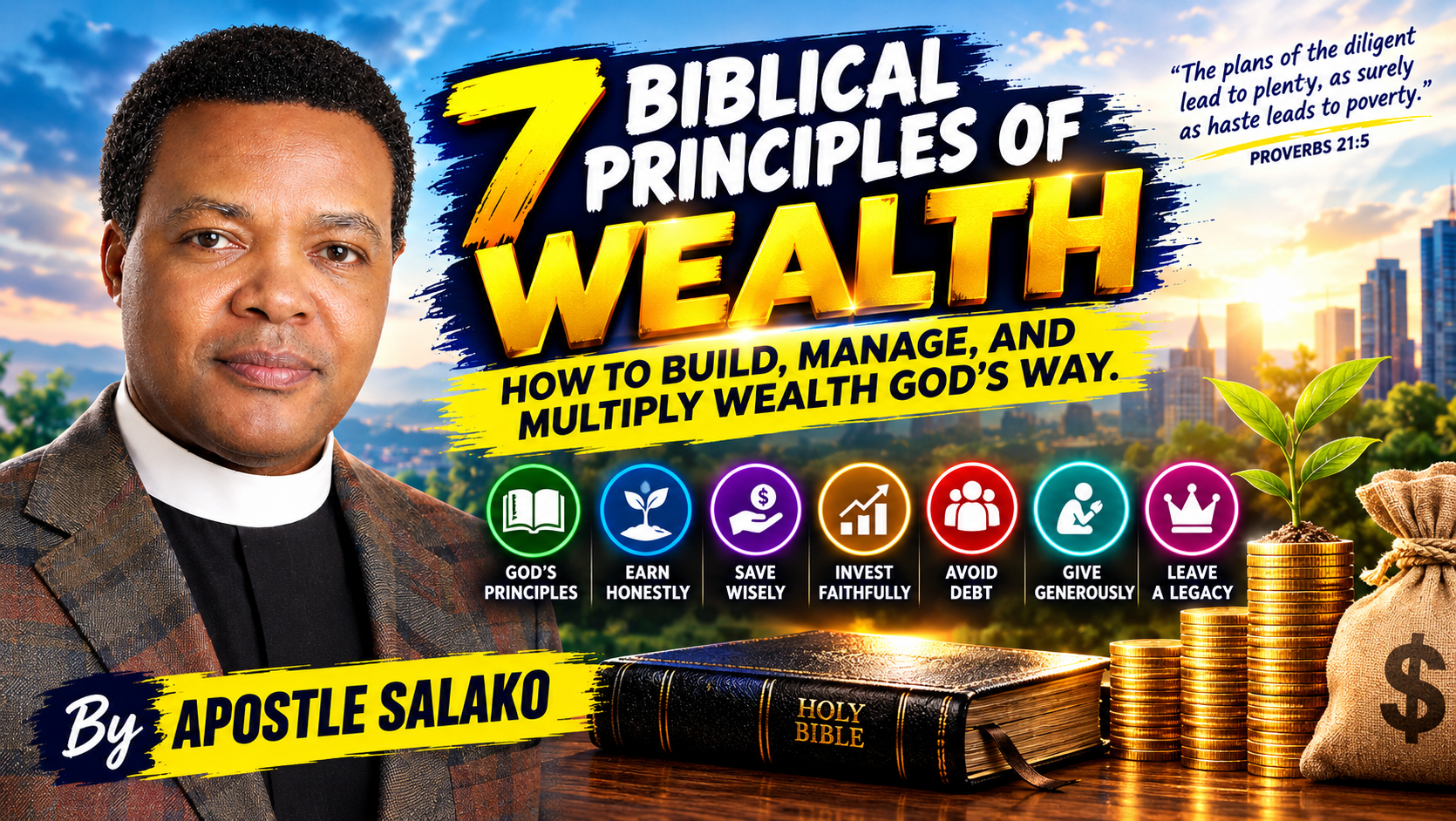
Introduction: What Does the Bible Really Teach About Wealth?
Money is one of the subjects people discuss constantly, yet it is also one of the subjects that can produce confusion, disagreement, fear, and misunderstanding.
Some people believe that wealth is automatically a sign of God's approval. Others believe that Christians should avoid financial ambition altogether. Some see money as something spiritually dangerous, while others see financial prosperity as the central evidence of God's blessing.
The Bible presents a more balanced picture.
Scripture does not teach that money itself is evil. Neither does it teach that possessing material resources automatically makes someone spiritually successful. Instead, the Bible repeatedly addresses the heart, purpose, stewardship, work, generosity, wisdom, contentment, and responsibility associated with wealth.
This distinction is extremely important.
The Christian question should not simply be:
How can I become rich?
A more biblical question is:
How can I handle resources faithfully so that my life, work, family, community, and God's kingdom are positively affected?
That question changes the entire conversation.
Proverbs 10:22 says in the King James Version:
The blessing of the LORD, it maketh rich, and he addeth no sorrow with it.
The verse points toward God's blessing, but biblical wealth should never be reduced to the pursuit of money. Scripture also teaches diligence, wisdom, stewardship, generosity, contentment, justice, responsibility, and care for others.
Deuteronomy 8:18 reminds Israel that it is God who gives the power to get wealth. That does not eliminate human responsibility. Instead, it places human ability within the larger framework of God's provision and purpose.
Therefore, biblical wealth involves more than accumulation.
Biblical wealth is about receiving, creating, managing, multiplying, and distributing resources in ways consistent with God's purposes.
This article presents seven principles that can help Christians develop a healthy and Scripture-informed approach to wealth.
These principles are:
Put God first in everything.
Develop diligence and excellence.
Practice biblical stewardship.
Gain financial wisdom and understanding.
Save, plan, and prepare for the future.
Practice generosity and Kingdom giving.
Create value through purposeful work.
These principles do not promise instant riches. The Bible does not present wealth as a mechanical formula where a person performs seven actions and automatically becomes wealthy.
Instead, they provide a framework for faithful financial living.
And that is where genuine Kingdom wealth begins.
Principle 1: Put God First in Everything
But seek ye first the kingdom of God, and his righteousness; and all these things shall be added unto you.
— Matthew 6:33, KJV
The first principle of biblical wealth is not investing.
It is not business.
It is not saving.
It is not networking.
It is not entrepreneurship.
It is putting God first.
This foundation matters because money can easily become a substitute for God.
A person can begin with the desire to provide for a family and gradually become consumed with accumulation. Someone may start a business to solve a problem but eventually become obsessed with status. Another person may begin investing wisely but eventually measure personal worth entirely by financial performance.
Jesus addressed this problem directly.
Matthew 6:24 teaches that no person can serve two masters. Christ specifically contrasts God and mammon.
The issue is not that money exists.
The issue is who occupies the throne of the heart.
Wealth must never become your god
Money is a useful servant but a terrible master.
When money becomes the master, people may compromise values to obtain it.
They may:
lie to customers;
manipulate people;
exploit employees;
engage in dishonest business;
accumulate unnecessary debt;
neglect family;
sacrifice integrity;
pursue status excessively;
become envious of others;
define success entirely by possessions.
Biblical wealth begins by establishing the correct order:
God first. Character second. Purpose third. Resources fourth.
Money should serve purpose rather than replace purpose.
God is the source, not money
Deuteronomy 8:18 provides an important theological foundation:
But thou shalt remember the LORD thy God: for it is he that giveth thee power to get wealth.
This verse does not encourage passivity.
The Israelites were still expected to work, cultivate the land, obey God, make decisions, and exercise responsibility.
The principle is that human ability exists under divine sovereignty.
Your intelligence, opportunities, skills, relationships, creativity, education, health, experience, and capacity to work are not things to worship. They are resources that can be stewarded.
Seek God before seeking wealth
There is nothing inherently wrong with desiring financial stability.
It is reasonable to want:
a secure home;
food for your family;
quality education for your children;
resources for ministry;
retirement preparation;
business capital;
emergency savings;
the ability to help others.
The danger begins when these goals replace God.
Jesus did not tell His followers to make wealth their first pursuit.
He said to seek the Kingdom of God and His righteousness.
This means that before asking:
How much money can I make?
we should also ask:
What kind of person am I becoming while pursuing it?
Wealth without character can become destructive
Imagine giving a person a powerful vehicle without teaching them how to drive.
The vehicle is valuable, but the lack of discipline creates danger.
Money can operate similarly.
Financial resources amplify decisions.
A generous person with resources may become increasingly generous.
A disciplined person may use money to create opportunities.
A dishonest person may use money to expand dishonesty.
A proud person may use wealth to increase pride.
Therefore, character must develop alongside capacity.
Practical application
Before beginning a new financial venture, ask:
Does this opportunity violate Scripture?
Can I pursue it with integrity?
Will it damage my family?
Will it make me a better steward?
Can I explain my motives honestly?
Does this opportunity create legitimate value?
Can I remain faithful to God if it succeeds?
Can I remain faithful to God if it fails?
These questions help put wealth in its proper position.
God should be the foundation of your wealth journey, not merely the person you remember after becoming wealthy.
Principle 2: Develop Diligence and Excellence
Biblical Wealth Requires Productive Effort
One of the clearest financial principles in Scripture is diligence.
Proverbs repeatedly contrasts diligence with laziness.
Proverbs 10:4 says:
He becometh poor that dealeth with a slack hand: but the hand of the diligent maketh rich.
This is not a guarantee that every hardworking person becomes financially wealthy.
Rather, Scripture presents diligence as a foundational characteristic of productive living.
Faith does not cancel responsibility
Sometimes Christians misunderstand faith.
They may think:
If God wants me to have money, He will simply give it to me.
But biblical faith is not an excuse for inactivity.
Noah had to build.
Joseph had to administer.
David had to work.
Ruth had to glean.
The Proverbs repeatedly commend diligence.
Paul also taught the importance of honest labor.
In 2 Thessalonians 3:10, Paul addressed the principle that those unwilling to work should not expect others to sustain their idleness.
The Christian life involves prayer and responsibility.
Faith and action.
Prayer and preparation.
Vision and execution.
Diligence is more than working hard
Diligence involves:
consistency;
discipline;
preparation;
attention to detail;
patience;
reliability;
perseverance;
learning;
responsible execution.
A person can work extremely hard at the wrong activity and remain unproductive.
Therefore, biblical diligence should be combined with wisdom.
Excellence creates trust
Consider two businesses.
One consistently delivers quality work.
The other frequently misses deadlines, communicates poorly, produces inconsistent results, and blames everyone else.
Which one is more likely to retain customers?
Excellence creates trust.
Colossians 3:23 teaches:
And whatsoever ye do, do it heartily, as to the Lord, and not unto men.
This principle transforms ordinary work.
Whether you are:
a teacher;
entrepreneur;
farmer;
engineer;
trader;
pastor;
designer;
technician;
employee;
consultant;
content creator;
your work can be approached as an expression of stewardship.
Build competence
Prayer is essential, but prayer should not become a substitute for learning.
If you want to build a business, learn business.
If you want to invest, learn investing.
If you want to manage money, learn budgeting.
If you want to become a better employee, develop relevant professional skills.
If you want to create content, study communication and your audience.
If you want to become an entrepreneur, understand customers, pricing, marketing, operations, taxation, cash flow, and risk.
Knowledge does not replace God.
It can become one of the tools through which responsible stewardship operates.
Stop looking for shortcuts
One of the greatest dangers in modern financial culture is the obsession with getting rich quickly.
People are constantly exposed to promises such as:
"Become wealthy overnight."
"Double your money instantly."
"Guaranteed returns."
"No risk."
"Secret wealth formula."
A biblical approach is more patient.
Proverbs 13:11 teaches that wealth gained through vanity or haste tends to diminish, while gathering gradually has a different outcome.
The principle is powerful:
Sustainable wealth generally requires time, discipline, patience, and wise decisions.
Excellence is a long-term wealth strategy
Do not simply ask:
How can I make more money?
Ask:
How can I become more valuable?
Improve your:
skills;
communication;
leadership;
technical knowledge;
financial literacy;
problem-solving ability;
customer service;
integrity;
reliability.
As your ability to solve legitimate problems increases, your economic opportunities can increase as well.
Principle 3: Practice Biblical Stewardship
Everything We Have Ultimately Belongs to God
Psalm 24:1 declares:
The earth is the LORD'S, and the fulness thereof; the world, and they that dwell therein.
This provides a foundational worldview for Christian stewardship.
We are not absolute owners.
We are stewards.
A steward manages something entrusted to him.
This distinction changes how we view money.
Instead of saying:
Everything belongs to me.
the Christian perspective becomes:
God has entrusted resources to me, and I am responsible for how I manage them.
Stewardship includes money
Stewardship applies to:
money;
time;
talents;
relationships;
opportunities;
influence;
possessions;
knowledge;
physical resources.
Financial stewardship therefore means managing money intentionally rather than emotionally.
The Parable of the Talents
Matthew 25:14–30 gives us the Parable of the Talents.
A master entrusted resources to servants.
Two servants used what they received productively.
One servant buried his talent.
The parable contains several important lessons about stewardship.
First, people receive different levels of responsibility.
Second, what matters is faithful management.
Third, resources are expected to be used rather than wasted.
Fourth, accountability exists.
This means Christians should not merely pray for more resources.
We should ask:
Am I managing what I already have faithfully?
Manage before you multiply
Many people want more money while mismanaging the money they already possess.
For example:
Someone earns ₦300,000 but spends ₦350,000.
Another person earns ₦1 million but has no emergency reserve.
Someone receives business revenue but treats the entire revenue as personal spending money.
Another person receives an investment opportunity without understanding the risk.
Increasing income without increasing stewardship capacity can create larger problems.
Therefore:
Before asking God for more, learn to manage what is already in your hands.
Create a financial system
A practical stewardship system can include:
Income
Know what comes in.
Expenses
Know where money goes.
Savings
Set aside resources for future needs.
Giving
Plan generosity intentionally.
Investment
Allocate suitable resources toward long-term goals after understanding risk.
Debt management
Avoid unnecessary borrowing and work systematically toward responsible debt reduction.
Emergency reserves
Prepare for unexpected expenses.
This structure transforms money from something mysterious into something measurable.
Track your money
You cannot manage what you refuse to measure.
A simple monthly financial review can ask:
How much came in?
How much went out?
What were my largest expenses?
What expenses were unnecessary?
How much did I save?
How much did I give?
What debts remain?
What financial goal am I pursuing?
What should change next month?
This is not a lack of faith.
It is stewardship.
Stewardship and contentment
Philippians 4:11–12 reveals Paul's ability to live in different financial circumstances without allowing his circumstances to control his identity.
Contentment does not mean refusing to grow.
It means refusing to make possessions the foundation of your peace.
A Christian can pursue financial improvement while remaining grateful.
Principle 4: Gain Financial Wisdom and Understanding
Wealth Requires More Than Income
One of the most important biblical principles of wealth is wisdom.
Proverbs 4:7 says:
Wisdom is the principal thing; therefore get wisdom: and with all thy getting get understanding.
This principle applies directly to finances.
A person can have a high income and still experience financial instability.
Why?
Because income and wealth are not identical.
Income is money received.
Wealth is better understood as accumulated economic resources and financial capacity after considering obligations, assets, liabilities, and sustainability.
Financial wisdom asks better questions
Instead of asking only:
Can I afford this?
ask:
Should I buy this?
Instead of:
How much can I borrow?
ask:
What will this debt cost me?
Instead of:
How quickly can this investment make money?
ask:
What are the risks, assumptions, and potential losses?
Instead of:
How much do I earn?
ask:
How effectively do I manage what I earn?
Learn before you invest
Investment is not gambling.
A responsible investor studies:
the asset;
the business or institution involved;
potential return;
downside risk;
liquidity;
fees;
time horizon;
diversification;
taxation;
regulatory environment.
No legitimate investment eliminates risk.
Therefore, Christians should reject financial claims that rely on unrealistic guarantees.
Avoid emotional financial decisions
Fear and greed can both produce poor decisions.
Fear can cause someone to sell valuable assets during panic.
Greed can cause someone to enter an investment simply because other people appear to be making money.
Wisdom slows down the process.
James 1:5 encourages believers to ask God for wisdom.
That principle can apply to financial decisions.
Pray.
Research.
Seek qualified advice where appropriate.
Read.
Compare.
Understand.
Then act responsibly.
Learn from people with relevant expertise
Proverbs 15:22 teaches that plans benefit from counsel.
This does not mean accepting every financial opinion.
It means recognizing that wisdom can come through qualified counsel.
For major decisions, consider consulting appropriate professionals such as:
accountants;
licensed financial professionals;
attorneys;
tax professionals;
experienced business advisers.
The Bible does not require Christians to reject professional knowledge.
Wisdom can involve knowing when you need help.
Financial literacy is part of stewardship
Every Christian does not need to become an investment expert.
But every adult should understand basic financial concepts.
At minimum, learn:
budgeting;
saving;
compound growth;
inflation;
debt;
interest;
cash flow;
risk;
diversification;
insurance;
taxes;
retirement planning.
Financial literacy does not guarantee wealth.
But financial ignorance can make responsible stewardship much harder.
Principle 5: Save, Plan, and Prepare for the Future
Biblical Wisdom Includes Preparation
Saving is sometimes misunderstood in Christian conversations.
Some people believe saving demonstrates a lack of faith.
But Scripture contains numerous examples of preparation.
One of the clearest examples is Joseph's administration in Egypt.
Genesis 41 describes Joseph's interpretation of Pharaoh's dreams and the preparation for seven years of famine.
The nation did not consume everything during the prosperous years.
It prepared.
That is a powerful principle.
Prosperity should create preparation
When resources increase, do not automatically increase lifestyle.
Consider increasing preparation.
For example:
If income increases, you might consider increasing:
emergency savings;
debt repayment;
long-term investment;
education;
business reserves;
charitable capacity.
This is more sustainable than automatically increasing consumption.
The ant and financial preparation
Proverbs 6:6–8 directs attention to the ant.
The ant prepares during the appropriate season.
The lesson is not that every financial situation is identical.
The broader principle is that wisdom recognizes seasons and prepares appropriately.
Emergency funds
An emergency reserve can protect a household from turning every unexpected expense into a crisis.
Possible emergencies include:
job loss;
urgent repairs;
medical expenses;
business disruption;
family emergencies;
unexpected travel.
The appropriate amount depends on personal circumstances, income stability, dependents, expenses, and other factors.
The important principle is preparation.
Plan before spending
Luke 14:28 contains a broader principle of counting the cost before beginning construction.
Planning applies to:
buying a house;
starting a business;
taking a loan;
funding education;
expanding a ministry;
making a major purchase.
Before committing, calculate.
Ask:
What will it cost?
What can go wrong?
What happens if income falls?
What are the ongoing expenses?
How long will this commitment last?
Planning is not fear.
Planning is responsible stewardship.
Saving is not hoarding
There is a difference between:
saving for responsible future needs
and
hoarding because possessions have become an idol.
Jesus warned about the danger of placing one's confidence entirely in accumulated possessions.
The goal is not to build the largest possible financial pile.
The goal is to become a faithful steward.
Principle 6: Practice Generosity and Kingdom Giving
Biblical Wealth Is Not Designed to End With You
One of the defining features of biblical wealth is generosity.
God's blessings should not terminate at the individual.
They should flow outward.
2 Corinthians 9:6–8 teaches about generous sowing and God's ability to provide abundantly so believers can continue doing good.
This gives us a different vision of wealth.
Wealth is not merely:
How much can I accumulate?
It can also become:
How much good can I accomplish with what God has entrusted to me?
Giving reveals priorities
Jesus spoke extensively about money because money reveals the heart.
Matthew 6:21 says:
For where your treasure is, there will your heart be also.
How we use resources often reveals what we value.
If someone consistently spends money on status but claims relationships are more important, the spending pattern may reveal a different priority.
Likewise, intentional generosity can demonstrate a commitment to God's work and the needs of others.
Giving should be voluntary and sincere
Christian giving should not be based on manipulation.
2 Corinthians 9:7 teaches that giving should not be done grudgingly or under compulsion.
This is important for healthy Christian teaching.
Generosity should flow from gratitude, faith, love, and conviction rather than pressure.
Tithing and generosity
Christians hold different interpretations concerning the application of Old Testament tithing under the New Covenant.
A responsible Christian teaching approach should acknowledge that discussion rather than pretending there is no theological debate.
What is clear throughout Scripture is that God's people are repeatedly instructed to honor God with their resources, care for others, support God's work, and practice generosity.
Proverbs 3:9 says:
Honour the LORD with thy substance, and with the firstfruits of all thine increase.
Whatever one's particular theological position regarding tithing, the broader principle of honoring God financially remains significant.
Generosity should not destroy responsibility
Biblical generosity does not mean giving away money irresponsibly while refusing to meet legitimate responsibilities.
A person should consider:
family obligations;
existing commitments;
genuine needs;
financial capacity;
wisdom;
sustainability.
Generosity and stewardship should work together.
Wealth creates capacity to help
Imagine two people who encounter someone in serious need.
One has no resources and cannot help materially.
Another has developed financial stability and can provide:
food;
school fees;
business support;
medical assistance;
housing support;
ministry resources;
employment opportunities.
This illustrates one potential benefit of financial capacity.
Wealth can increase your capacity to serve.
That is one of the strongest reasons Christians can pursue responsible financial growth.
Principle 7: Create Value Through Purposeful Work
Wealth Creation Begins With Solving Problems
One of the most practical biblical wealth principles is productive work.
God placed Adam in the Garden of Eden "to dress it and to keep it" (Genesis 2:15).
Work existed before the Fall.
Therefore, work itself is not a punishment.
The curse affected the conditions of work, but purposeful labor existed within God's original design.
Work creates value
Consider what happens when a farmer produces food.
A carpenter creates furniture.
A teacher transfers knowledge.
A doctor provides medical care.
A software developer builds useful systems.
A mechanic repairs vehicles.
An entrepreneur connects customers with valuable products and services.
A content creator educates or entertains an audience.
A manufacturer transforms raw materials into usable goods.
In each case, value is being created or delivered.
Entrepreneurship can be stewardship
Biblical entrepreneurship is not simply about making money.
It can involve:
identifying legitimate problems;
developing solutions;
creating employment;
serving customers;
improving products;
building sustainable systems;
generating economic activity;
supporting families;
contributing to communities.
This does not mean every business is automatically godly.
A profitable business can still be unethical.
The Christian entrepreneur must therefore combine profitability with integrity.
Don't build wealth by exploiting people
Leviticus 19:13 addresses the principle of fair treatment of workers.
James 5:4 strongly condemns situations in which workers are denied what is properly owed.
These passages demonstrate that biblical financial ethics include justice.
A business should not succeed because it deliberately:
cheats customers;
refuses to pay employees;
deceives investors;
falsifies records;
sells dangerous products dishonestly;
manipulates vulnerable people.
Profit and righteousness are not natural enemies.
But profit should be pursued within ethical boundaries.
Build something useful
Ask yourself:
What problem can I solve?
That question can lead to productive thinking.
Maybe you can:
teach a skill;
provide a service;
manufacture something;
distribute products;
create digital resources;
develop software;
provide consulting;
produce educational content;
solve logistical problems.
Your opportunity may exist where your gift, knowledge, experience, and a real need intersect.
Multiple income streams should have a purpose
Modern financial culture often promotes multiple income streams.
There can be wisdom in diversification, but the phrase should not become an excuse for chasing every opportunity.
Each income stream should have a purpose and a reasonable risk assessment.
For example:
employment may provide stability;
business may provide growth potential;
investments may build long-term assets;
intellectual property may generate royalties;
digital products may create scalable income.
The goal is not complexity.
The goal is resilience and responsible stewardship.
The Difference Between Biblical Wealth and the Love of Money
One of the most misunderstood Scriptures about money is 1 Timothy 6:10.
Paul writes:
For the love of money is the root of all evil.
Notice carefully what Scripture says.
It does not say:
Money is the root of all evil.
It addresses the love of money.
Money itself is a medium of exchange.
It can be used for good or evil.
The problem begins when money becomes an object of ultimate devotion.
Money can become an idol
An idol is anything that takes the place that belongs to God.
Money becomes an idol when:
identity depends on wealth;
relationships are sacrificed for financial gain;
integrity is compromised for profit;
generosity disappears because accumulation becomes supreme;
people are valued according to economic status;
financial success becomes the definition of personal worth.
Biblical prosperity is broader than possessions
True prosperity should not be reduced to bank balances.
A person can possess money and lack:
peace;
wisdom;
healthy relationships;
integrity;
purpose;
contentment.
Likewise, a person may have modest financial resources while possessing tremendous spiritual richness, relational strength, wisdom, and contentment.
Therefore, biblical wealth should be viewed holistically.
Wealth is a tool
Think about money as a tool.
A hammer can build something useful or cause damage.
The moral issue is not the existence of the hammer.
It is how it is used.
Money can:
feed families;
support education;
fund missions;
create jobs;
develop businesses;
support churches;
help the poor;
fund innovation;
provide security.
It can also be used destructively.
Therefore, financial maturity includes learning to use money intentionally.
Common Mistakes Christians Make About Wealth
1. Assuming wealth is automatic proof of God's approval
Financial success does not automatically prove spiritual maturity.
Some wealthy people live with integrity.
Others do not.
The same is true among people with fewer resources.
Do not measure spiritual maturity simply by possessions.
2. Believing poverty automatically equals holiness
The opposite error is also problematic.
Having limited financial resources does not automatically make someone more spiritual.
Scripture contains faithful people who possessed substantial resources.
The biblical issue is how resources are acquired, managed, and used.
3. Chasing miracles instead of developing discipline
Prayer is powerful.
But prayer should not become a substitute for responsibility.
Ask God for wisdom, then apply wisdom.
Pray for opportunities, then prepare for opportunities.
Ask for increase, then learn how to manage increase.
4. Pursuing get-rich-quick schemes
Promises of effortless wealth should be treated with caution.
If someone says:
There is absolutely no risk.
or
You are guaranteed to double your money.
slow down.
Understand the opportunity.
Ask questions.
Research independently.
Never confuse confidence with evidence.
5. Spending everything you earn
Higher income does not automatically create wealth.
If spending increases at the same rate as income, financial pressure can remain.
Learn to distinguish:
income
from
financial progress.
6. Ignoring debt
Debt is not automatically identical in every situation.
Some forms of borrowing may serve productive purposes.
But excessive or poorly understood debt can restrict financial freedom.
Before borrowing, understand:
interest;
fees;
repayment period;
total repayment;
consequences of default;
effect on cash flow.
7. Refusing to learn
Spiritual faith does not require financial ignorance.
Study Scripture.
Study financial principles.
Seek appropriate professional advice.
Develop skills.
Ask good questions.
Wisdom is a biblical virtue.
A Practical Biblical Wealth Framework
The seven principles can be converted into a practical framework.
Step 1: Establish your foundation
Ask:
What role does God play in my financial life?
Write down your values.
For example:
integrity;
generosity;
family responsibility;
diligence;
contentment;
service;
long-term thinking.
Step 2: Know your numbers
Calculate:
Total monthly income
minus
Total monthly expenses
equals
Monthly surplus or deficit.
Then examine your debts and assets.
You cannot build an effective plan without knowing where you currently stand.
Step 3: Build an emergency reserve
Start gradually if necessary.
The exact target depends on your circumstances.
The important thing is to create a buffer against unexpected financial pressure.
Step 4: Control unnecessary expenses
Review subscriptions, impulse purchases, lifestyle inflation, unnecessary debt, and recurring expenses.
Ask:
Does this expense support my priorities?
Not every enjoyable expense is wrong.
The objective is intentional spending.
Step 5: Increase your earning capacity
Develop skills.
Ask:
What can I learn?
What problem can I solve?
What service can I provide?
What professional qualification could improve my opportunities?
What business opportunity aligns with my abilities?
Step 6: Save consistently
Consistency matters.
Even modest savings can establish a habit of preparation.
As income grows, consider increasing savings rather than immediately increasing consumption.
Step 7: Give intentionally
Set aside resources for generosity.
Support legitimate needs.
Support God's work according to your convictions.
Help people responsibly.
Step 8: Invest wisely
Only invest after understanding what you are buying.
Never invest money you cannot afford to lose without first understanding the consequences.
Consider professional advice where appropriate.
Step 9: Review regularly
Financial stewardship is not a one-time event.
Review your finances:
monthly;
quarterly;
annually.
Adjust as circumstances change.
How to Apply These Principles in Everyday Life
For Employees
If you are employed, biblical wealth principles can shape your career.
Be reliable.
Develop skills.
Avoid workplace dishonesty.
Save consistently.
Manage debt.
Give responsibly.
Prepare for the future.
Seek opportunities to increase your professional value.
For Entrepreneurs
If you own a business:
serve customers honestly;
maintain accurate records;
separate business and personal finances;
pay employees appropriately;
understand taxes and regulations;
manage cash flow;
reinvest carefully;
avoid unnecessary debt;
protect your reputation.
Your business should reflect your values.
For Young Christians
Start early.
You do not need to wait until you earn a large salary.
Learn to:
budget;
save;
avoid unnecessary debt;
give;
learn skills;
distinguish needs from wants;
think long term.
Small habits become powerful over time.
For Parents
Teach children that money is a tool.
Give them age-appropriate opportunities to learn:
saving;
giving;
planning;
delayed gratification;
work;
responsibility.
Children who understand financial stewardship early may be better prepared to handle future responsibilities.
For Church Leaders
Churches can teach financial stewardship without turning Christianity into a money-centered religion.
Teach believers:
generosity;
contentment;
honest work;
stewardship;
financial responsibility;
compassion;
wisdom.
Financial discipleship should produce mature Christians, not merely financially motivated Christians.
A 30-Day Biblical Wealth Challenge
Here is a practical 30-day exercise.
Days 1–5: Examine Your Financial Life
Record:
income;
expenses;
debts;
savings;
assets.
Do not judge yourself.
Simply establish the facts.
Days 6–10: Identify Waste
Look for unnecessary spending.
Ask what can be reduced or eliminated.
Days 11–15: Set Financial Goals
Create short-term and long-term goals.
Examples:
emergency savings;
debt reduction;
education;
business capital;
investment;
giving.
Days 16–20: Develop Your Skills
Choose one skill that could improve your productivity or earning capacity.
Spend time learning it.
Days 21–25: Create a Giving Plan
Decide how you will practice generosity responsibly.
Days 26–30: Create Your Financial System
Establish:
a budget;
savings strategy;
debt plan;
giving plan;
investment plan where appropriate;
monthly review process.
Then continue.
The objective is not to complete a 30-day challenge and forget everything.
The objective is to establish a lifestyle of stewardship.
Seven Biblical Principles of Wealth at a Glance
Principle Biblical Focus Practical Application
1. Put God First Matthew 6:33 Make God and righteousness the foundation
2. Practice Diligence Proverbs 10:4 Work consistently and develop excellence
3. Steward Resources Matthew 25:14–30 Manage what God has entrusted to you
4. Pursue Wisdom Proverbs 4:7 Learn financial principles and seek wise counsel
5. Save and Plan Proverbs 6:6–8; Genesis 41 Prepare for future needs
6. Practice Generosity 2 Corinthians 9:6–8 Use resources to bless others and support God's work
7. Create Value Genesis 2:15; Colossians 3:23 Solve problems through purposeful work
Conclusion: Build Wealth, But Build Character Too
The Bible's teaching about wealth is deeper than a promise of financial increase.
It is a call to responsible living.
God gives people abilities, opportunities, resources, relationships, ideas, skills, and influence. What we do with those resources matters.
The seven principles provide a framework:
Put God first.
Work diligently.
Steward what you have.
Pursue wisdom.
Save and prepare.
Give generously.
Create value through purposeful work.
The objective is not simply to become financially wealthy.
The objective is to become faithful stewards.
If wealth comes, manage it with wisdom.
If resources increase, remain humble.
If opportunities grow, maintain integrity.
If God entrusts you with more, use more responsibly.
And if your financial journey takes longer than expected, do not measure your worth by your bank balance.
Your identity is not your income.
Your value is not your possessions.
Your calling is not determined by your net worth.
Money is a resource.
It should serve God's purposes rather than replace them.
As Proverbs 3:9 teaches:
Honour the LORD with thy substance, and with the firstfruits of all thine increase.
The goal of biblical wealth is therefore not merely having more.
It is becoming more faithful with what you have and using increasing capacity for meaningful purposes.
May God give you wisdom to earn honestly, discipline to manage faithfully, courage to create value, patience to build gradually, humility to remain content, and generosity to bless others.
Build wealth. Build character. Build capacity. Build for purpose.
And above all, seek first the Kingdom of God and His righteousness.
Author's Note
About Apostle Salako Adedamola
Apostle Salako Adedamola is a Christian preacher, teacher, mentor, and content creator committed to practical biblical teaching for everyday Christian life. His teachings cover Christian living, prayer, faith, leadership, stewardship, Kingdom wealth, mentorship, evangelism, and spiritual growth.
This article is intended for educational and Christian teaching purposes. Financial decisions should be made according to individual circumstances, applicable laws, risk tolerance, and, where appropriate, advice from qualified professionals.
Apostle Salako Adedamola
Frequently Asked Questions
QDoes the Bible say Christians should be wealthy?
The Bible contains examples of people with significant material resources, but it does not teach that every Christian will have the same financial outcome. The biblical emphasis is on faithfulness, stewardship, generosity, diligence, wisdom, contentment, and righteousness.
QIs wealth a blessing from God?
Scripture does describe God's blessing in connection with material provision in various passages, including Proverbs 10:22 and Deuteronomy 8:18. However, Scripture also warns against trusting in riches. Therefore, wealth should not automatically be interpreted as proof of God's approval or as the central measure of blessing.
QIs it wrong for Christians to want financial success?
Not necessarily. A Christian can desire financial stability, business growth, professional advancement, and increased capacity to serve. The important questions include why wealth is desired and how it is pursued and used.
QWhat is the biblical meaning of prosperity?
Biblical prosperity should not be reduced to material abundance. A broader biblical understanding includes God's provision, spiritual health, wisdom, fruitful work, relationships, contentment, generosity, and faithful stewardship.
QWhat is the difference between wealth and the love of money?
Wealth refers to resources. The love of money refers to an unhealthy attachment in which money becomes an overriding object of desire, trust, identity, or devotion. 1 Timothy 6:10 specifically warns about the love of money.
QDoes tithing guarantee financial prosperity?
Scripture contains important teachings concerning tithing, giving, generosity, and honoring God with resources. However, Christians should be cautious about presenting giving as a guaranteed financial transaction where a specific monetary contribution automatically produces a predetermined financial return. Biblical giving should be approached with faith, obedience, gratitude, generosity, and wisdom.
QShould Christians invest?
Investing can be consistent with responsible stewardship. The Parable of the Talents is often discussed in connection with responsible use of entrusted resources. However, every investment involves particular risks and circumstances. Christians should understand those risks rather than treating investment as guaranteed wealth.
QDoes God want everyone to become rich?
Scripture does not establish a universal promise that every believer will become financially rich. God's provision and individual circumstances differ. The biblical responsibility is faithfulness with whatever God entrusts to us.
QCan entrepreneurship be a Christian calling?
Entrepreneurship can be pursued consistently with Christian values when it involves legitimate service, honest work, responsible leadership, and value creation. The business itself should operate with integrity.
QHow can I start building wealth according to biblical principles?
Start with the seven principles: Put God first. Work diligently. Manage resources faithfully. Develop wisdom. Save and plan. Give generously. Create legitimate value through purposeful work. Then build practical financial habits around them.
Enjoyed this article?
Get the next one straight to your inbox. One thoughtful email a week.
Comments (0)
Comments are stored locally in your browser. For published responses, email us via the Contact page.
You may also like
Kingdom Entrepreneurship: Building Business God’s Way
Discover biblical principles for building a profitable, ethical and purpose-driven business. Learn how Christian entrepreneurs can honor God through work, stewardship, leadership, wealth creation and service.
Provoking the Blessing of God at an Unexpected Time
A pastoral take on stewardship in a consumption economy.