
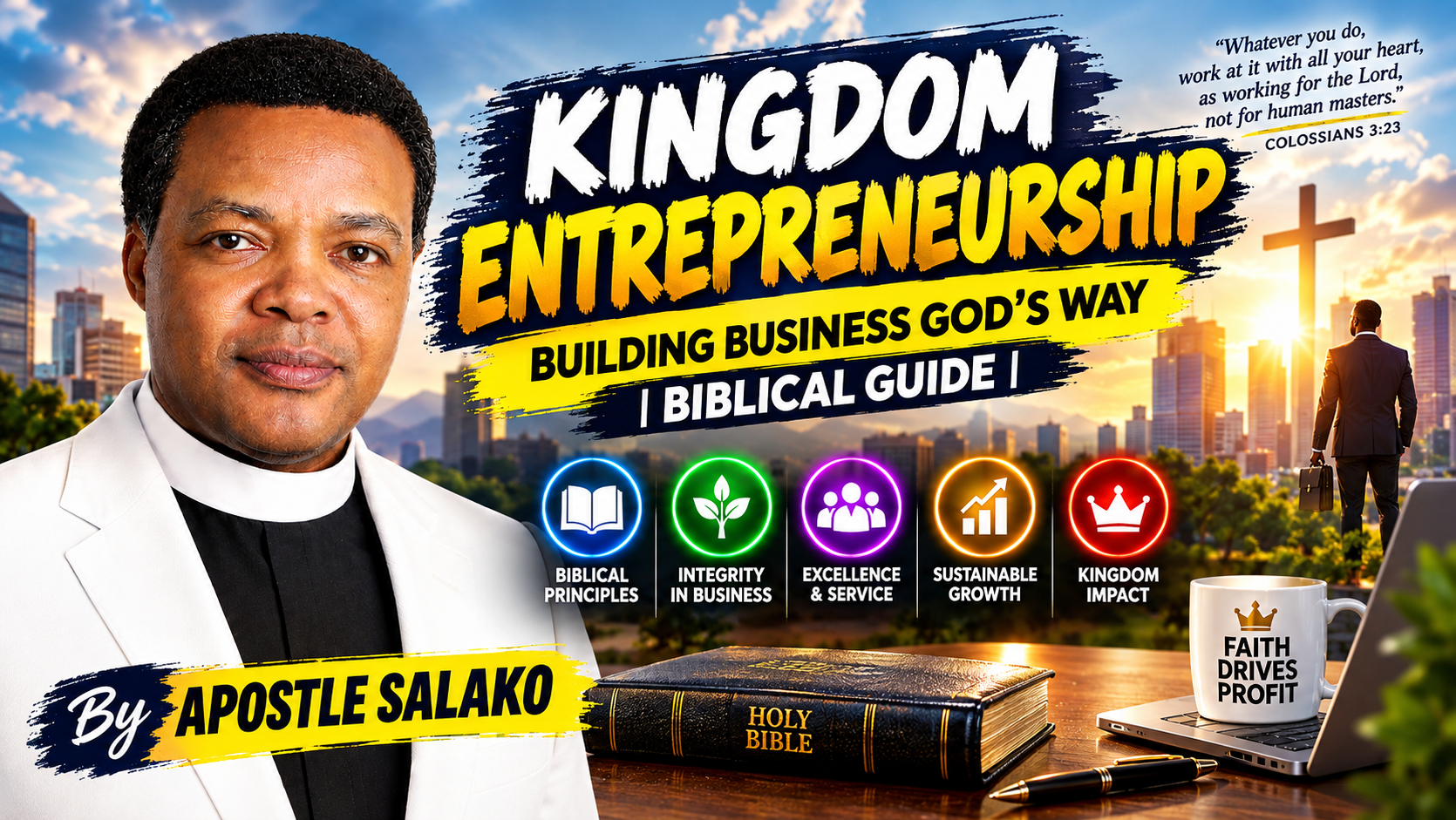
Introduction: Can Business Become an Expression of Your Faith?
Entrepreneurship is often described in terms of profit, innovation, competition, investment, market share and growth. Christianity, on the other hand, is commonly associated with prayer, worship, discipleship, holiness, service and evangelism.
But Scripture does not require believers to separate their spiritual lives from their working lives.
God cares about how we work, how we treat customers, how we pay employees, how we handle money, how we make decisions, how we respond to competition, how we use influence and what we do with the resources He places in our hands.
This is where kingdom entrepreneurship becomes important.
Kingdom entrepreneurship is not simply putting a Bible verse on a business website. It is not merely calling a company a “Christian business.” It is a way of approaching enterprise under the lordship of Jesus Christ.
A kingdom entrepreneur seeks to build a legitimate business while maintaining biblical integrity, serving people, creating value, managing resources responsibly and using prosperity as an opportunity for stewardship and service.
The objective is not to make Christianity a marketing strategy.
The objective is to allow Christian convictions to shape the way business is conceived, built, managed and expanded.
The Bible says:
“And whatsoever ye do, do it heartily, as to the Lord, and not unto men.”
— Colossians 3:23, KJV
That principle applies to the marketplace.
Your business may be a shop, farm, consultancy, school, media company, technology company, construction firm, restaurant, logistics company, financial service, creative agency, manufacturing business, online store or professional practice.
Whatever legitimate work God has placed before you, you can approach it with excellence and integrity.
Kingdom entrepreneurship therefore asks deeper questions:
• What problem is my business solving?
• Who am I serving?
• Am I creating genuine value?
• Am I treating people fairly?
• Is my pricing honest?
• Are my business practices ethical?
• Am I managing money responsibly?
• Am I building something sustainable?
• Am I using my gifts faithfully?
• Does my success make me more useful to God and people?
• What kind of person am I becoming while building this business?
These questions move entrepreneurship beyond money.
They transform business into an arena for stewardship, service, creativity, leadership and influence.
This article presents a practical biblical framework for building business God’s way.
1. What Is Kingdom Entrepreneurship?
Kingdom entrepreneurship is the practice of building and managing a legitimate enterprise according to biblical values while using business as an avenue for service, stewardship, creativity, employment, wealth creation and positive influence.
It combines entrepreneurial responsibility with Christian discipleship.
A kingdom entrepreneur does not necessarily operate a ministry.
This distinction is important.
A Christian business can be a business without pretending to be a church.
A Christian entrepreneur can sell products and services without turning every transaction into a religious presentation.
The difference is found primarily in the values, methods, motives and stewardship practices governing the enterprise.
A kingdom entrepreneur seeks to conduct business truthfully.
He or she understands that customers are people rather than numbers.
Employees are people rather than disposable resources.
Money is a tool rather than a master.
Profit is a measurement of economic sustainability rather than the ultimate meaning of life.
Influence is an opportunity for responsibility rather than personal worship.
Kingdom entrepreneurship therefore brings together several biblical principles:
Stewardship: Everything ultimately belongs to God.
Service: Business should solve real problems and create genuine value.
Integrity: Truthfulness should govern transactions.
Excellence: Work should be performed diligently.
Wisdom: Decisions should be based on understanding rather than impulse.
Justice: People should be treated fairly.
Generosity: Prosperity creates opportunities to bless others.
Discipline: Sustainable businesses require consistent management.
Humility: Success should not eliminate dependence upon God.
Purpose: Business should contribute to meaningful objectives beyond personal consumption.
This does not mean every business will look the same.
God may lead one entrepreneur into agriculture, another into technology, another into education, another into fashion, another into construction and another into media.
The assignment may differ.
The biblical principles remain.
2. The Biblical Foundation of Work
Work did not begin as a consequence of sin.
Before humanity fell into sin, God placed Adam in the Garden of Eden and gave him responsibility.
Genesis 2:15 says:
“And the LORD God took the man, and put him into the garden of Eden to dress it and to keep it.”
Work therefore existed before the Fall.
Sin affected work, making it more difficult and introducing frustration, but work itself is part of God's created order.
This means Christians should not automatically regard business, employment or entrepreneurship as spiritually inferior to traditional ministry.
The marketplace can become a place where Christian character is demonstrated.
A person who builds houses honestly, manages employees fairly, produces quality food, develops useful technology, teaches students effectively or provides reliable transportation is participating in productive work.
Proverbs repeatedly connects diligence with productive outcomes.
Proverbs 22:29 says:
“Seest thou a man diligent in his business? he shall stand before kings.”
Diligence matters.
Skill matters.
Reliability matters.
Planning matters.
Wisdom matters.
Christianity does not excuse incompetence.
Calling does not eliminate preparation.
Prayer does not replace planning.
Faith does not remove the need for discipline.
A Christian entrepreneur should therefore pursue both spiritual maturity and professional competence.
You should pray about your business, but you should also understand your industry.
You should trust God, but you should also study your numbers.
You should believe for increase, but you should also improve your products.
You should seek divine wisdom, but you should also listen to customers.
Faith and responsible action belong together.
3. God Is the Owner; We Are Stewards
One of the most important foundations of kingdom entrepreneurship is stewardship.
Psalm 24:1 declares:
“The earth is the LORD'S, and the fulness thereof; the world, and they that dwell therein.”
Everything ultimately belongs to God.
Your abilities belong to God.
Your opportunities belong to God.
Your intellectual capacity belongs to God.
Your business ideas belong to God in the sense that your capacity to think, create and act ultimately depends upon Him.
Your money must therefore be managed as a stewardship responsibility.
This changes the question from:
“How much can I get?”
to:
“How faithfully can I manage what has been entrusted to me?”
That is a major shift.
A steward is not careless.
A steward keeps records.
A steward plans.
A steward protects resources.
A steward develops resources.
A steward understands accountability.
Jesus taught extensively about stewardship.
In Matthew 25, the parable of the talents presents servants who received different levels of responsibility.
The issue was not that everyone received the same amount.
The issue was what each person did with what had been entrusted to them.
This has an important entrepreneurial implication.
Do not spend your life comparing your starting point with somebody else's.
One person may receive more capital.
Another may have stronger networks.
Another may have greater technical ability.
Another may have more experience.
Another may start with almost nothing.
Your responsibility is to faithfully develop what God has placed in your hands.
4. The Entrepreneurial Gifts God Gives People
Entrepreneurship involves multiple gifts.
Some people are natural problem-solvers.
Some are excellent communicators.
Some are skilled negotiators.
Some understand numbers.
Some are creative.
Some are gifted at leadership.
Some are excellent with technology.
Some understand people.
Some are exceptionally organized.
Some can see opportunities before others notice them.
These abilities can become powerful entrepreneurial assets when developed responsibly.
Romans 12:6 teaches:
“Having then gifts differing according to the grace that is given to us…”
Different people have different capacities.
Do not build a business simply because another person became successful in that industry.
Ask:
What am I equipped to do?
What problems do I understand?
What skills can I develop?
What needs exist around me?
What experience has God allowed me to gain?
What resources are already available to me?
Your assignment may be hidden inside your combination of gifts, experience and opportunity.
However, gifting alone is insufficient.
A gifted entrepreneur who refuses to learn can still fail.
Potential must be developed.
Talent must meet discipline.
Vision must meet execution.
Faith must meet responsibility.
5. Discovering Your Business Assignment
Not every business idea is your assignment.
Some ideas are attractive because they are fashionable.
Others look profitable because somebody else succeeded.
Some are inspired by social media.
Others are motivated by comparison.
Before starting a business, examine the idea carefully.
Ask five questions.
1. What problem does this business solve?
A sustainable business usually addresses a real need.
2. Who experiences the problem?
Identify the specific customer.
3. Why would they pay for the solution?
Good intentions do not automatically create demand.
4. Can I deliver the promised value consistently?
A business should not promise what it cannot deliver.
5. Can the business become financially sustainable?
A business that continually loses money requires a strategy change.
Kingdom entrepreneurship is not opposed to profit.
It seeks to earn profit without sacrificing biblical principles.
You should therefore study the market, understand customer needs, analyze costs, examine competitors and test your assumptions.
Proverbs 18:13 warns against answering before hearing.
That principle is relevant to entrepreneurship.
Listen before launching.
Research before investing.
Understand before expanding.
6. Business Begins With Serving People
At the heart of every business is an exchange of value.
A customer gives money.
The business provides a product or service.
For the relationship to remain sustainable, the customer must receive genuine value.
Jesus gave a powerful principle:
“And as ye would that men should do to you, do ye also to them likewise.”
— Luke 6:31
This principle can influence customer service.
Would you want to receive a defective product without explanation?
Would you want a company to hide important terms?
Would you want to be treated disrespectfully after making payment?
Would you want a business to exaggerate its claims?
Probably not.
Therefore, do not build your business around practices you would resent as a customer.
Serving customers well means:
• communicating clearly;
• delivering what was promised;
• admitting mistakes;
• responding to complaints;
• protecting customer information;
• respecting customer time;
• maintaining quality;
• being transparent about limitations.
Excellent customer service is not merely a commercial technique.
It can also be an expression of Christian character.
7. Profit Is Important, But Profit Is Not the Purpose of Everything
Profit is necessary for most businesses to survive.
Without sufficient revenue, a business cannot sustainably pay employees, replace equipment, develop products, serve customers or expand.
Therefore, Christians should not be ashamed of legitimate profit.
The problem is not profit.
The problem is allowing money to become the master.
Jesus said:
“Ye cannot serve God and mammon.”
— Matthew 6:24
Money is a useful servant but a dangerous master.
A kingdom entrepreneur should therefore pursue profitable usefulness.
The goal is to create something valuable enough that customers willingly exchange money for it.
Profit then becomes one indicator that the enterprise is creating economic value.
But profitability should exist alongside:
• integrity;
• service;
• sustainability;
• generosity;
• justice;
• responsibility;
• personal discipline.
A business can make money and still destroy the entrepreneur's family, character and spiritual life.
Therefore, financial growth must be evaluated within a larger framework.
8. Excellence as a Biblical Business Principle
Christian business owners should resist the idea that “God understands” when poor quality is produced.
Faith does not justify negligence.
Daniel provides an excellent example of professional excellence.
Daniel 6:3 says:
“Then this Daniel was preferred above the presidents and princes, because an excellent spirit was in him…”
Excellence is not perfection.
Perfectionism can become paralyzing.
Excellence means consistently seeking to improve the quality of what you provide.
For an entrepreneur, this may mean:
• better packaging;
• better bookkeeping;
• better customer communication;
• better technology;
• better training;
• better product development;
• better time management;
• better documentation;
• better delivery systems.
Excellence is often built through small improvements repeated over time.
Ask yourself every quarter:
What can we improve?
What complaints keep appearing?
Where are customers experiencing unnecessary friction?
What process wastes time?
What product feature needs improvement?
What skill does the team need to develop?
That is practical kingdom stewardship.
9. Integrity in Kingdom Business
Integrity is one of the strongest foundations of a sustainable business.
Proverbs 11:1 says:
“A false balance is abomination to the LORD: but a just weight is his delight.”
The biblical concern for honest measurement has direct business implications.
Do not manipulate measurements.
Do not falsify records.
Do not knowingly sell counterfeit goods as genuine products.
Do not make promises you know you cannot keep.
Do not deceive customers about costs.
Do not manufacture fake testimonials.
Do not lie about qualifications.
Do not manipulate financial records.
Do not exploit employees simply because they need work.
Integrity becomes especially important when dishonest behavior appears profitable.
A kingdom entrepreneur must decide beforehand that certain practices are unacceptable.
If your values change whenever money is involved, they are not really values.
10. Biblical Principles of Pricing
Pricing can create ethical challenges.
How much should you charge?
Should you reduce your price?
Should you offer discounts?
How should you respond to competitors?
Scripture does not provide a universal price list for every industry.
Instead, biblical principles help establish boundaries.
Your price should account for legitimate costs, skill, labor, risk, business sustainability and the value of the product or service.
Avoid both exploitation and destructive underpricing.
Underpricing can be problematic because it may prevent the business from surviving.
Overpricing can become problematic when it depends upon deception or exploitation.
Transparent pricing builds trust.
Where possible, communicate:
• what the customer receives;
• what is included;
• what is excluded;
• additional costs;
• delivery conditions;
• refund policies;
• timelines.
A clear price is part of clear communication.
11. Money Management and Financial Stewardship
Many businesses do not fail because the owner lacks passion.
Some fail because the owner does not understand financial management.
Kingdom entrepreneurship requires financial discipline.
You should know:
• monthly revenue;
• gross profit;
• operating expenses;
• cash flow;
• debt obligations;
• taxes;
• inventory costs;
• payroll;
• customer acquisition costs;
• emergency reserves;
• reinvestment requirements.
Revenue is not the same thing as profit.
Profit is not the same thing as cash flow.
Cash in the bank is not necessarily money available for personal spending.
A business owner should separate business finances from personal finances wherever practical.
Create clear financial records.
Review them regularly.
Build a budget.
Know your obligations.
Plan for unexpected expenses.
Do not confuse a busy business with a profitable business.
Financial stewardship requires clarity.
12. Debt and Kingdom Entrepreneurship
Debt can sometimes be used strategically, but debt can also create significant pressure.
Proverbs 22:7 says:
“The borrower is servant to the lender.”
This is not a command that every form of borrowing is automatically sinful.
It is a warning about the power debt can exercise over a person's freedom.
Before taking business debt, consider:
• Why is the money needed?
• What will the money produce?
• What is the repayment plan?
• What happens if sales decline?
• What interest and fees apply?
• Is the debt funding productive assets or unnecessary consumption?
• Does the repayment obligation create unacceptable risk?
Do not borrow simply to appear successful.
A larger office, expensive vehicle or impressive equipment does not automatically make a business successful.
Capital should serve strategy.
Debt should never become an excuse for financial irresponsibility.
13. Saving, Investing and Reinvestment
A wise entrepreneur thinks beyond today's revenue.
Joseph's leadership in Egypt demonstrates the importance of preparation during seasons of abundance.
Genesis 41 describes a strategy of storing resources during years of plenty in preparation for years of famine.
The broader principle is valuable:
Do not consume everything simply because you received it.
A business may need several financial buckets:
1. Operating capital.
2. Emergency reserves.
3. Tax obligations.
4. Reinvestment capital.
5. Owner compensation.
6. Long-term investment.
7. Charitable or kingdom giving.
The exact percentages will vary according to the business.
The important principle is intentional allocation.
When everything is spent, growth becomes difficult.
Reinvestment can include:
• employee training;
• better equipment;
• technology;
• inventory;
• marketing;
• research;
• professional development;
• improved systems.
Growth should be planned rather than accidental.
14. Employees, Partners and Customers
A business is built by people.
The entrepreneur who understands this will treat relationships as strategic and moral responsibilities.
If you employ people, remember that they have families, responsibilities, dreams and pressures.
Fair compensation matters.
Clear expectations matter.
Respect matters.
Professional development matters.
Safe working conditions matter.
Communication matters.
The same applies to business partners.
Before entering partnerships, clarify:
• ownership;
• responsibilities;
• decision-making;
• financial contributions;
• profit sharing;
• intellectual property;
• conflict resolution;
• exit arrangements.
Do not assume that friendship automatically creates business compatibility.
Wisdom requires clarity.
Amos 3:3 asks:
“Can two walk together, except they be agreed?”
Agreement does not mean that partners must think identically.
It means they understand their responsibilities and fundamental expectations.
15. Leadership in Kingdom Business
Christian leadership should not be built around domination.
Jesus taught servant leadership.
Mark 10:43 says:
“But so shall it not be among you: but whosoever will be great among you, shall be your minister.”
This principle applies to business leadership.
A business leader should not use authority merely to satisfy ego.
Leadership should create an environment in which people can perform meaningful work effectively.
Good leadership involves:
• setting direction;
• communicating expectations;
• developing people;
• making difficult decisions;
• accepting responsibility;
• correcting problems;
• recognizing good performance;
• managing conflict;
• maintaining standards.
A kingdom leader does not avoid accountability.
In fact, accountability becomes more important as responsibility increases.
The larger your organization becomes, the more people are affected by your decisions.
Therefore, leadership must become increasingly disciplined.
16. Competition Without Compromise
Business competition is normal.
You may compete with companies that have more money, better equipment, larger teams or stronger distribution networks.
Competition can motivate improvement.
But Christian entrepreneurs should avoid unethical strategies.
Do not destroy a competitor through false accusations.
Do not steal intellectual property.
Do not impersonate another business.
Do not create fake negative reviews.
Do not spread false information.
Do not deceive customers into believing that another company provides something it does not.
Instead, compete through legitimate value.
Improve your product.
Improve service.
Improve reliability.
Improve customer experience.
Improve efficiency.
Improve communication.
Build trust.
You do not have to become unethical simply because somebody else is unethical.
17. Marketing Without Manipulation
Marketing is not inherently unspiritual.
If you have a useful product, people need to know it exists.
Marketing communicates value.
But marketing should not become manipulation.
Do not manufacture false urgency.
Do not invent testimonials.
Do not make impossible promises.
Do not hide important terms.
Do not use fear irresponsibly.
Do not exploit people's religious beliefs to pressure them into buying.
This is especially important in Christian business.
Do not say:
“God told you to buy this product.”
Do not suggest that purchasing your product proves someone's faith.
Do not promise guaranteed financial miracles.
Instead, communicate honestly.
Explain what the product does.
Show how it works.
Identify who it is for.
State its limitations.
Allow customers to make informed decisions.
Trust grows when marketing respects the intelligence and freedom of the customer.
18. Technology and Digital Entrepreneurship
The modern marketplace provides unprecedented opportunities for entrepreneurs.
A person can build a business through:
• websites;
• social media;
• online education;
• digital products;
• e-commerce;
• content creation;
• software;
• consulting;
• remote services;
• online communities;
• digital marketing.
This creates opportunities but also responsibilities.
Technology should be used intentionally.
Do not allow social media metrics to determine your identity.
Followers are not the same as customers.
Views are not the same as revenue.
Revenue is not the same as impact.
Impact is not the same as spiritual maturity.
Use technology as a tool.
Build an owned digital presence where practical.
Maintain customer records responsibly.
Protect sensitive information.
Create useful content.
Avoid copying other people's work.
The digital marketplace rewards speed, but Christian entrepreneurs must still value truth.
19. Innovation and Creativity
God is creative.
Genesis begins with creation.
Human beings, made in God's image, possess the capacity to create, design, organize and develop.
Entrepreneurship therefore requires creativity.
Creativity does not always mean inventing something completely new.
It can mean improving an existing solution.
For example:
• delivering faster;
• packaging better;
• simplifying a complex service;
• making education more accessible;
• improving customer communication;
• reducing waste;
• creating a more convenient process.
Ask:
How can this problem be solved better?
That question can produce innovation.
Do not become so attached to an existing method that you refuse to improve.
A kingdom entrepreneur should remain teachable.
20. Failure, Setbacks and Business Seasons
Every entrepreneur will experience setbacks.
Some businesses will have slow months.
Some products will fail.
Some partnerships will end.
Some marketing campaigns will produce disappointing results.
Some investments will lose money.
Failure is painful, but it can also become a teacher.
The key is to distinguish between:
Failure of a strategy and failure of identity.
If a business strategy fails, examine it.
Do not immediately conclude that you are a failure as a person.
Ask:
• What happened?
• What assumption was wrong?
• What did customers tell us?
• What did the numbers reveal?
• What should we stop?
• What should we improve?
• What should we continue?
• What should we learn?
Proverbs 24:16 says:
“For a just man falleth seven times, and riseth up again…”
Resilience does not mean refusing to learn.
It means continuing responsibly after setbacks.
21. Prayer and Business Decision-Making
Prayer should be part of the Christian entrepreneur's life.
But prayer should not become a substitute for responsible investigation.
Nehemiah provides an interesting leadership pattern.
He prayed, but he also inspected Jerusalem's walls.
He assessed the situation.
He developed a plan.
He mobilized people.
He assigned responsibilities.
He dealt with opposition.
This provides a useful model:
Pray. Assess. Plan. Act. Review. Pray again.
Before making major business decisions, pray for wisdom.
James 1:5 says:
“If any of you lack wisdom, let him ask of God…”
But after praying, gather relevant information.
If you are considering an investment, study it.
If you are launching a product, research the market.
If you are hiring someone, verify qualifications.
If you are signing a contract, understand the terms.
Spiritual sensitivity and practical wisdom should work together.
22. Balancing Family, Ministry and Business
One of the dangers of entrepreneurship is becoming consumed by the business.
A business can demand attention every hour of the day.
But success that destroys everything else is not healthy success.
Your family needs you.
Your spiritual life needs attention.
Your body needs rest.
Your relationships need investment.
Your church community may need your participation.
Your mind needs recovery.
Jesus regularly withdrew from crowds.
Rest is not necessarily laziness.
Rest recognizes human limitations.
A business owner should therefore build systems that reduce unnecessary dependence upon the owner's constant presence.
Document processes.
Train people.
Delegate responsibly.
Create schedules.
Set boundaries.
Use technology appropriately.
A business should eventually become an organization rather than a permanent emergency.
23. Wealth and Generosity
The Bible does not present wealth as the ultimate measure of spiritual maturity.
At the same time, Scripture recognizes that resources can be used for good purposes.
Deuteronomy 8:18 says:
“But thou shalt remember the LORD thy God: for it is he that giveth thee power to get wealth…”
The verse places wealth within the context of remembering God.
Resources create responsibility.
A successful entrepreneur can:
• create employment;
• support charitable work;
• assist vulnerable people;
• fund education;
• support missions;
• develop community projects;
• mentor younger entrepreneurs;
• invest in productive ventures;
• strengthen families.
Generosity should therefore be intentional.
Do not wait until you become extremely wealthy before learning generosity.
Practice responsible generosity at every stage.
At the same time, generosity requires wisdom.
Being generous does not mean abandoning financial responsibility.
You can give while maintaining sustainable personal and business finances.
24. Building a Business That Outlives You
One measure of entrepreneurial maturity is whether the business can survive beyond its founder.
Many businesses depend completely on one individual.
When that individual becomes unavailable, everything stops.
This is a vulnerability.
Build systems.
Develop leaders.
Document processes.
Train employees.
Create financial controls.
Build institutional knowledge.
Develop a strong brand.
Protect intellectual property.
Establish succession principles.
Proverbs 13:22 says:
“A good man leaveth an inheritance to his children's children…”
An inheritance is not necessarily only money.
It can include:
• wisdom;
• skills;
• values;
• relationships;
• businesses;
• property;
• intellectual property;
• reputation;
• opportunities.
Think generationally.
What are you building that could benefit people you may never personally meet?
25. A Practical Kingdom Business Framework
Here is a simple framework for building a business God's way.
P — Purpose
Why does the business exist?
Write the answer clearly.
R — Research
Understand your market, customer, competitors and costs.
O — Offer
Define exactly what you provide.
V — Value
Explain the problem you solve and the benefit customers receive.
I — Integrity
Establish non-negotiable ethical standards.
D — Discipline
Create financial, operational and personal routines.
E — Excellence
Continually improve your product and service.
This framework produces the word PROVIDE, reminding the entrepreneur that business is ultimately about providing genuine value.
26. Common Mistakes Christian Entrepreneurs Should Avoid
Mistake 1: Assuming prayer replaces preparation
Prayer is essential, but preparation remains necessary.
Mistake 2: Calling every business idea a divine instruction
Not every idea is a prophecy.
Some ideas require testing.
Mistake 3: Copying another entrepreneur
Learn from others without becoming an imitation.
Mistake 4: Mixing personal and business money carelessly
Poor financial separation creates confusion.
Mistake 5: Ignoring customer feedback
Customers can reveal problems the entrepreneur cannot see.
Mistake 6: Expanding too quickly
Growth requires capacity.
Mistake 7: Using Christian language to hide poor service
Calling a business “kingdom” does not make poor performance acceptable.
Mistake 8: Measuring success only by money
Revenue matters, but it is not the entire picture.
Mistake 9: Neglecting family
A successful company cannot automatically repair damaged relationships.
Mistake 10: Refusing professional advice
Humility includes learning from people with relevant expertise.
27. A Kingdom Entrepreneur’s Daily Habits
A strong business is often built through repeated habits.
Consider developing these daily practices:
1. Begin with God
Pray.
Read Scripture.
Ask for wisdom.
2. Review priorities
Identify the most important tasks.
3. Serve customers
Look for ways to improve customer experience.
4. Monitor finances
Know what is happening with your money.
5. Improve something
Make at least one meaningful improvement.
6. Communicate clearly
Do not allow avoidable misunderstandings to accumulate.
7. Learn
Read, study or develop a skill.
8. Delegate
Do not carry every responsibility yourself.
9. Review
Ask what worked and what did not.
10. Give thanks
Remember that success is not merely a product of personal strength.
These habits create consistency.
28. Kingdom Entrepreneurship and the Great Commission
Business is not a replacement for the Great Commission.
Jesus commanded His followers to make disciples.
Matthew 28:19 says:
“Go ye therefore, and teach all nations…”
Entrepreneurship and evangelism are distinct responsibilities, but they can exist alongside one another.
A Christian entrepreneur can conduct excellent business while remaining a faithful disciple of Christ.
Business can create opportunities for:
• employment;
• relationships;
• community service;
• generosity;
• mentorship;
• ethical influence.
But avoid turning customers into targets for religious pressure.
Your faith should produce integrity, compassion, excellence and humility.
Where appropriate, you can share your testimony or beliefs, but respect the freedom and dignity of others.
Christian witness is strengthened when your conduct supports your message.
29. A Biblical Action Plan for Starting or Rebuilding Your Business
If you are starting a business, use this practical sequence.
Step 1: Write the problem
What problem are you solving?
Write it in one sentence.
Step 2: Identify the customer
Who specifically needs the solution?
Step 3: Define the offer
What exactly will you sell?
Step 4: Calculate the numbers
Estimate:
• startup costs;
• monthly costs;
• pricing;
• expected sales;
• break-even point;
• cash requirements.
Step 5: Research
Talk to potential customers.
Study competitors.
Test your assumptions.
Step 6: Build a simple version
Do not always wait for perfection.
Create a workable initial offer.
Step 7: Get feedback
Ask customers what they liked, disliked and would change.
Step 8: Improve
Use the feedback to strengthen the product.
Step 9: Establish systems
Document recurring processes.
Step 10: Create financial discipline
Separate business and personal finances as much as possible.
Step 11: Establish ethical standards
Write down what you will never compromise.
Step 12: Develop your spiritual life
Continue praying, studying Scripture and growing in Christ.
Step 13: Build relationships
Find mentors, professionals and trustworthy advisers.
Step 14: Measure performance
Track meaningful business indicators.
Step 15: Reinvest wisely
Use part of your profit to strengthen the business.
Step 16: Practice generosity
Give according to your convictions and capacity.
Step 17: Think long-term
Build something that can serve people for years.
31. Conclusion: Build With God, Serve People, Create Value
Kingdom entrepreneurship is ultimately about stewardship.
God has given human beings abilities to create, organize, cultivate, build and serve.
Entrepreneurship provides one avenue through which those abilities can be expressed.
But the Christian entrepreneur must remember that business success is not merely about accumulating money.
It is about becoming a faithful steward.
Build with integrity.
Serve people.
Create genuine value.
Pay attention to quality.
Manage money wisely.
Treat employees fairly.
Respect customers.
Learn continuously.
Use technology responsibly.
Prepare for setbacks.
Practice generosity.
Protect your family.
Develop future leaders.
Think beyond yourself.
And above all, remember that your identity is not determined by your business.
You are more than your revenue.
You are more than your company's valuation.
You are more than your social-media following.
You are more than your professional title.
Your business is something you manage.
It is not who you are.
The Christian entrepreneur therefore works from identity rather than for identity.
You do not need business success to prove your worth.
Instead, you can build from the security of knowing that your ultimate value comes from God.
Colossians 3:23 remains a powerful guiding principle:
“And whatsoever ye do, do it heartily, as to the Lord, and not unto men.”
Build carefully.
Build honestly.
Build excellently.
Build sustainably.
Build with wisdom.
Build with humility.
Build something that genuinely helps people.
And if God gives you greater resources, let those resources create greater responsibility rather than greater pride.
The ultimate question is not simply:
“How big can my business become?”
A more important question is:
“How faithfully can I steward what God has placed in my hands?”
That is the heart of kingdom entrepreneurship.
Final Kingdom Entrepreneurship Checklist
Before launching, expanding or restructuring your business, ask yourself:
• Is my business solving a real problem?
• Is my product or service genuinely useful?
• Is my business legally and ethically operated?
• Are my prices communicated honestly?
• Are my financial records accurate?
• Do I understand my costs?
• Do I have a realistic business model?
• Am I treating customers fairly?
• Am I treating employees and partners with dignity?
• Am I protecting customer information?
• Am I avoiding deceptive marketing?
• Am I developing my skills?
• Am I listening to customer feedback?
• Am I planning for difficult seasons?
• Am I managing debt responsibly?
• Am I saving and reinvesting wisely?
• Am I maintaining healthy boundaries?
• Am I protecting my family relationships?
• Am I praying for wisdom?
• Am I seeking appropriate professional counsel?
• Am I practicing generosity?
• Am I becoming a better steward as the business grows?
• Can this business create value beyond my own lifetime?
If you can answer these questions honestly, you have begun moving from merely owning a business to stewarding an enterprise.
Kingdom entrepreneurship is business under biblical stewardship: creating value, serving people, managing resources faithfully and using influence responsibly for the glory of God.
Apostle Adedamola Salako
Apostle Salako Adedamola is a Christian preacher, teacher, mentor, and writer passionate about biblical teaching, Christian living, leadership development, mentorship, stewardship, faith, prayer, and practical discipleship. Through biblical teaching and practical instruction, he seeks to help believers grow in their relationship with God and apply biblical principles to everyday life.
Frequently Asked Questions
QWhat is kingdom entrepreneurship?
Kingdom entrepreneurship is the practice of building and managing a legitimate business according to biblical principles while using enterprise to create value, serve people, steward resources and pursue responsible prosperity.
QIs making profit biblical?
Legitimate profit is not inherently unbiblical. Scripture contains numerous examples of commerce, productive labor, wealth and stewardship. The central issue is how money is acquired, managed and used.
QDoes a Christian business have to be a ministry?
No. A Christian can operate an ordinary commercial business while maintaining Christian ethics and values.
QCan Christians become wealthy?
Christians can possess wealth, but Scripture warns against allowing wealth to become an idol. Wealth carries stewardship responsibilities.
QShould Christians avoid business loans?
Not every loan is necessarily sinful. However, debt should be approached cautiously and responsibly because excessive debt can create significant financial obligations.
QHow should Christians deal with competition?
Compete through legitimate value, quality, innovation, service and integrity rather than deception, false accusations or unethical practices.
QShould I pray before making business decisions?
Yes. Prayer is appropriate for every area of Christian life. But prayer should be accompanied by research, wise counsel, financial analysis and responsible planning.
QWhat if my business fails?
A failed business does not automatically mean that your life or calling has failed. Examine the reasons, learn from the experience and determine what should change.
QCan I use social media to grow my Christian business?
Yes. Social media can be a useful business tool. Use it to communicate genuine value, build relationships, educate customers and market products honestly.
QWhat is the difference between a Christian entrepreneur and a kingdom entrepreneur?
The terms can overlap. A kingdom entrepreneur emphasizes stewardship, service, biblical ethics and the responsible use of enterprise in alignment with God's purposes.
QHow can I start kingdom entrepreneurship with little money?
Start with the skills, knowledge and resources already available to you. Service-based businesses, consulting, education, creative work and digital services can sometimes require less initial capital than asset-heavy businesses. The principle is to begin responsibly rather than waiting indefinitely for perfect conditions.
Enjoyed this article?
Get the next one straight to your inbox. One thoughtful email a week.
Comments (0)
Comments are stored locally in your browser. For published responses, email us via the Contact page.
You may also like
Provoking the Blessing of God at an Unexpected Time
A pastoral take on stewardship in a consumption economy.
Financial Stewardship Principles for Christians Facing Global Economic Shifts in 2026
Field notes from two seasons in the studio.
Biblical Principles of Personal Finance: A Complete Christian Guide to Managing Money God's Way
Discover biblical principles of personal finance, including budgeting, saving, giving, debt management, work, investing, contentment, stewardship, and building wealth according to Scripture.