
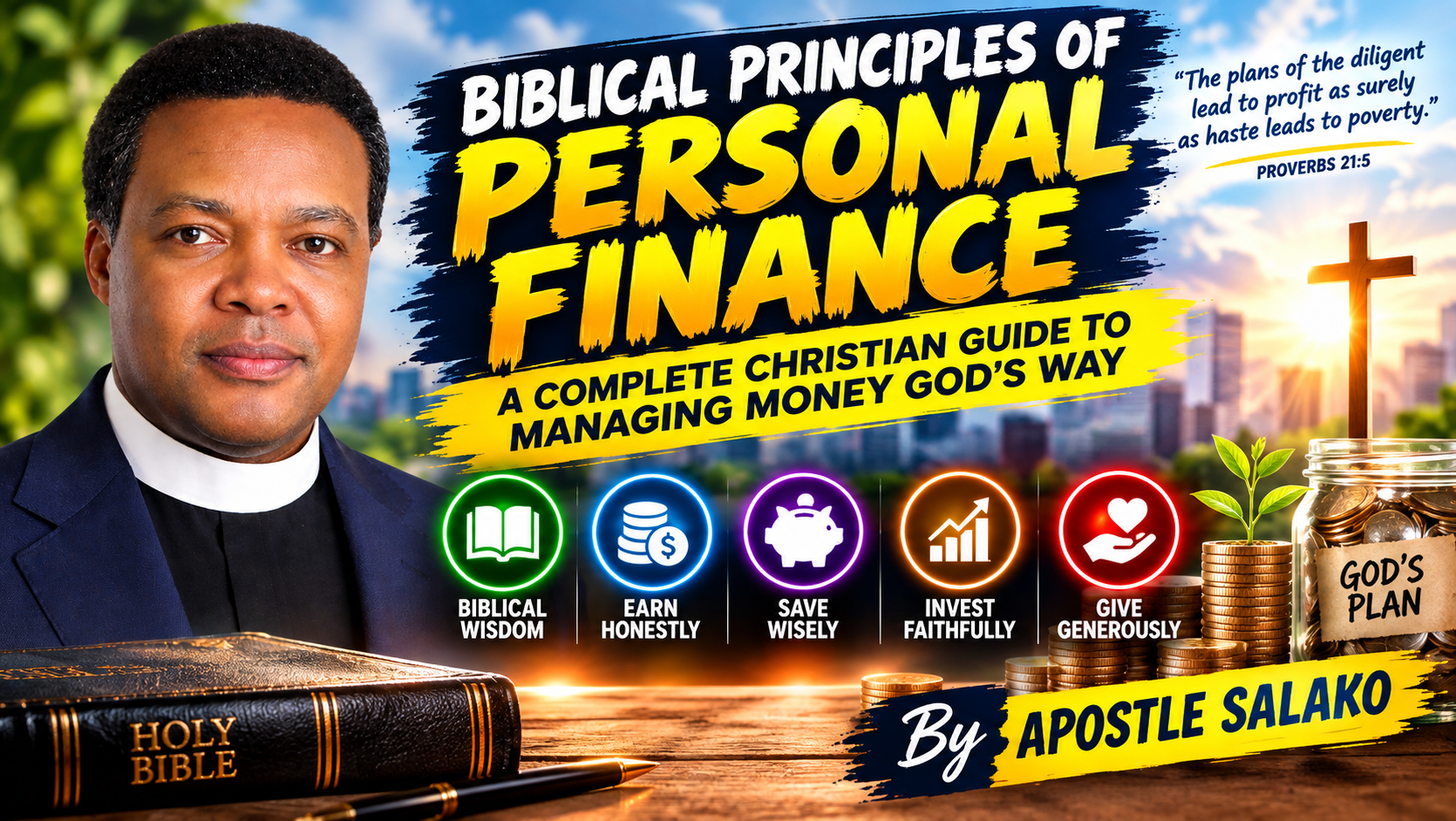
Introduction: Why Christians Need a Biblical Approach to Personal Finance
Money is one of the most practical areas of everyday life.
We use money to provide food, pay bills, support our families, give to the work of God, educate our children, conduct business, prepare for emergencies, and plan for the future. Yet many people have never been taught how to manage money from a biblical perspective.
Some Christians think that talking about money is automatically worldly. Others believe that financial success is proof of God's approval. Both extremes can produce unhealthy attitudes toward wealth.
The Bible presents a more balanced perspective.
Scripture does not teach that money itself is evil. Instead, it teaches us how to relate to money, possessions, work, wealth, generosity, debt, planning, and material things.
Jesus spoke about money frequently because our relationship with possessions can reveal something about our hearts.
Matthew 6:21 says:
For where your treasure is, there will your heart be also.
The issue, therefore, is not simply how much money we have. The deeper issue is who owns our hearts and how faithfully we manage what God has placed in our hands.
Biblical personal finance begins with stewardship.
A Christian does not ultimately view himself as the absolute owner of everything he possesses. Psalm 24:1 declares:
The earth is the LORD'S, and the fulness thereof; the world, and they that dwell therein.
If everything ultimately belongs to God, then our income, possessions, opportunities, abilities, businesses, careers, and resources should be managed with accountability to Him.
This changes the way we think about money.
Instead of asking only:
How can I make more money?
we begin asking:
How can I faithfully manage what God has entrusted to me?
Instead of asking:
How can I become rich quickly?
we ask:
How can I create value, work diligently, avoid destructive financial habits, provide responsibly, give generously, and prepare wisely for the future?
That is the foundation of biblical personal finance.
This article explores practical biblical principles that can help Christians develop a healthier relationship with money and build a disciplined financial life.
It is not a promise of instant wealth. It is not a get-rich-quick formula. It is a framework for faithful stewardship, wisdom, discipline, generosity, responsibility, and long-term financial maturity.
1. What Is Biblical Personal Finance?
Biblical personal finance is the practice of managing income, spending, saving, giving, debt, investments, possessions, and financial decisions according to biblical principles.
It combines spiritual responsibility with practical wisdom.
The Bible is not a modern financial textbook, and Scripture does not provide a specific budgeting app, investment portfolio, or percentage allocation for every person's income.
However, Scripture provides principles that can guide financial decisions.
These include:
• stewardship;
• diligence;
• honesty;
• generosity;
• contentment;
• planning;
• saving;
• responsibility;
• self-control;
• avoidance of destructive debt;
• wise counsel;
• care for family;
• compassion toward others;
• and freedom from the love of money.
Proverbs 21:5 says:
The thoughts of the diligent tend only to plenteousness; but of every one that is hasty only to want.
The principle is straightforward: financial progress generally requires patience, discipline, planning, and consistent action.
Biblical finance is therefore not simply about becoming wealthy.
It is about becoming faithful.
A person may have substantial resources and still be financially foolish. Another person may have modest resources and demonstrate excellent stewardship.
The question is not merely:
How much do you have?
The question is:
How faithfully are you managing what you have?
2. God Is the Ultimate Owner
The first principle of biblical personal finance is ownership.
Psalm 24:1 declares:
The earth is the LORD'S, and the fulness thereof; the world, and they that dwell therein.
This principle changes our entire financial perspective.
Your salary belongs ultimately to God.
Your business opportunity belongs ultimately to God.
Your property belongs ultimately to God.
Your skills and abilities are gifts that can be used under God's authority.
Even your capacity to work and generate income should be viewed as something for which you can give thanks.
Deuteronomy 8:18 says:
But thou shalt remember the LORD thy God: for it is he that giveth thee power to get wealth.
This verse does not teach that every believer will become materially rich. Rather, it reminds God's people not to forget Him when economic capacity increases.
Financial success can create a spiritual temptation: independence from God.
A person may begin with prayer and dependence but eventually conclude, "I achieved everything by myself."
Biblical stewardship prevents this attitude.
If God is the ultimate owner, then financial decisions become an area of discipleship.
Before spending money, we can ask:
Is this responsible?
Before borrowing, we can ask:
Is this debt necessary and manageable?
Before investing, we can ask:
Have I understood the risks?
Before giving, we can ask:
How can I use my resources to bless others?
Before pursuing wealth, we can ask:
What is motivating me?
This is what it means to bring finances under God's lordship.
3. Money Is a Tool, Not a Master
Money is useful.
It can provide food, shelter, education, transportation, healthcare, business capital, charitable support, and many other necessities.
But money becomes dangerous when it becomes a master.
Jesus said in Matthew 6:24:
Ye cannot serve God and mammon.
The problem is not simply possessing money.
The problem is allowing money to possess the heart.
Paul gives an important warning in 1 Timothy 6:9–10. He explains that the desire to become rich can lead people into temptation and that:
the love of money is the root of all evil.
The verse does not say money itself is the root of all evil.
It identifies the love of money as the problem.
Money should therefore remain a servant rather than becoming a master.
Healthy financial questions include:
• What purpose does this money serve?
• Is this expenditure necessary?
• Does this purchase support my responsibilities?
• Can I afford it without creating unnecessary financial pressure?
• Can my resources bless someone else?
• Am I pursuing income at the expense of my family or spiritual life?
• Has financial ambition become an idol?
A Christian should be able to use money without worshipping it.
4. The Principle of Stewardship
One of the strongest financial concepts in Scripture is stewardship.
A steward manages something belonging to another person.
Jesus taught about stewardship in several parables.
In Matthew 25:14–30, the parable of the talents illustrates accountability for resources entrusted to individuals.
The servants received different amounts, but each was accountable for what had been placed in his hands.
This teaches an important principle:
God does not require every person to have the same resources, but He expects faithful stewardship.
Comparison can therefore become financially destructive.
One person may earn more than another.
One may own a business.
Another may work for an employer.
One may receive an inheritance.
Another may begin with very little.
Instead of comparing ourselves with others, we should focus on faithful management.
Stewardship involves several areas:
Income
How do I earn money?
Spending
How do I use money?
Saving
How do I prepare for future needs?
Giving
How do I bless others?
Investing
How do I responsibly deploy resources for future purposes?
Debt
How do I handle financial obligations?
Legacy
What am I building for those who come after me?
Stewardship transforms financial management from a purely economic activity into an aspect of Christian character.
5. Work Diligently and Earn Honestly
Biblical financial health begins with productive work.
Proverbs repeatedly praises diligence and warns against laziness.
Proverbs 10:4 says:
He becometh poor that dealeth with a slack hand: but the hand of the diligent maketh rich.
Work is not merely a means of receiving a paycheck.
Work can be an expression of responsibility, creativity, service, and contribution.
Paul writes in 2 Thessalonians 3:10:
if any would not work, neither should he eat.
Scripture therefore encourages responsibility.
However, biblical work must also be honest.
Financial success obtained through fraud, manipulation, exploitation, corruption, or deception cannot be described as biblical prosperity.
Proverbs 11:1 says:
A false balance is abomination to the LORD: but a just weight is his delight.
This principle applies to business, employment, sales, contracts, accounting, and everyday transactions.
The Christian financial question is not only:
How much can I earn?
It is:
How can I earn responsibly and honorably?
A Christian entrepreneur should seek to create genuine value.
An employee should work faithfully.
A professional should provide competent service.
A trader should avoid deception.
A business owner should treat workers fairly.
Financial integrity is part of Christian witness.
6. Create a Financial Plan
Planning is a biblical principle.
Luke 14:28 says:
For which of you, intending to build a tower, sitteth not down first, and counteth the cost...
Jesus used planning as an illustration of wisdom.
Financial planning begins by understanding where you are going.
A simple personal financial plan may answer:
1. What is my current income?
2. What are my essential expenses?
3. What debts do I owe?
4. What financial goals do I have?
5. How much can I save?
6. How much can I give?
7. What emergencies should I prepare for?
8. What long-term goals require investment?
9. What financial risks need attention?
10. What habits must change?
Without a plan, money tends to disappear through small, repeated decisions.
A financial plan gives money direction.
You should not need to become obsessed with money to manage it well.
The goal is not to spend every day thinking about finances.
The goal is to establish a system that allows your financial life to operate with greater discipline.
7. The Biblical Principle of Budgeting
The word "budget" may not appear in the Bible as a modern financial term, but the principle of counting costs and planning resources is clearly compatible with Scripture.
A budget is simply a plan for your money.
It answers:
Where will my income go?
A basic monthly budget can include:
• giving;
• housing;
• food;
• transportation;
• utilities;
• education;
• healthcare;
• debt repayment;
• savings;
• investments;
• family needs;
• personal spending;
• business expenses.
A useful budget should be realistic.
If the plan is impossible to follow, it will quickly be abandoned.
The purpose of budgeting is not to make life miserable.
It is to create clarity.
When you know what your money is doing, you can make intentional decisions rather than constantly reacting to financial pressure.
Proverbs 27:23 says:
Be thou diligent to know the state of thy flocks, and look well to thy herds.
The principle can be applied to modern financial stewardship:
Know the state of your finances.
Know what comes in.
Know what goes out.
Know what you owe.
Know what you own.
Know what you are saving.
Know what you are investing.
Financial ignorance is not the same thing as faith.
Wisdom requires attention.
8. Learn to Live Within Your Means
One of the most practical financial principles is learning to distinguish between needs, wants, and unnecessary financial pressure.
Modern culture can encourage people to spend money they do not have in order to appear wealthier than they are.
Social media can intensify this problem.
People see holidays, cars, houses, clothing, businesses, restaurants, gadgets, and lifestyles without seeing the debt, sacrifices, family circumstances, income sources, or financial struggles behind the images.
Christian financial wisdom rejects comparison.
Hebrews 13:5 says:
Let your conversation be without covetousness; and be content with such things as ye have.
Contentment does not mean refusing to improve.
Contentment means refusing to make possessions the foundation of identity.
You can pursue financial growth while remaining grateful.
You can work toward a better home without despising your current home.
You can build a business without believing that your business determines your worth.
You can improve your income without becoming controlled by greed.
Living within your means creates room for saving, giving, investing, and preparing for the future.
9. The Importance of Saving
Saving is another important component of wise financial stewardship.
Proverbs 21:20 says:
There is treasure to be desired and oil in the dwelling of the wise; but a foolish man spendeth it up.
The principle is simple:
Do not consume everything you receive.
Saving creates financial resilience.
It can help prepare for:
• unexpected repairs;
• medical expenses;
• temporary income disruption;
• education;
• business opportunities;
• major purchases;
• retirement;
• family responsibilities.
Saving also develops discipline.
A person who saves consistently learns delayed gratification.
Instead of spending every increase in income, part of the increase can become future security.
This is especially important when income is irregular.
If you are self-employed, a freelancer, entrepreneur, or ministry worker, your income may fluctuate.
Building savings can create breathing room during periods of lower income.
Saving is not a lack of faith.
Prudent preparation and trust in God are not enemies.
Joseph's administration in Egypt provides a powerful example of preparing during years of abundance for years of scarcity (Genesis 41).
The specific economic circumstances were unique, but the broader principle of preparation is valuable.
10. Prepare for Emergencies and the Future
Life is unpredictable.
Unexpected events can create financial pressure.
A responsible financial plan should therefore include emergency preparation.
An emergency fund is money intentionally set aside for unexpected essential expenses.
The appropriate amount depends on personal circumstances, income stability, family responsibilities, and other factors.
The principle is more important than a particular number:
Prepare before the emergency arrives.
Proverbs 6:6–8 points to the ant as an example of preparation:
which having no guide, overseer, or ruler, provideth her meat in the summer, and gathereth her food in the harvest.
Preparation is not fear.
Preparation is wisdom.
A Christian should not live in constant anxiety about the future.
Jesus taught His followers not to be consumed by worry about tomorrow (Matthew 6:25–34).
But refusing to worry does not mean refusing to plan.
There is a difference between:
faithful preparation
and
fearful obsession.
Biblical financial maturity seeks the first while avoiding the second.
11. Understanding Debt Biblically
Debt requires wisdom.
Proverbs 22:7 says:
The rich ruleth over the poor, and the borrower is servant to the lender.
This verse illustrates the power relationship debt can create.
Debt is not automatically identical to sin in every circumstance, but excessive or poorly managed debt can severely restrict financial freedom.
Before borrowing, consider:
• Why am I borrowing?
• Is the purchase necessary?
• What is the total cost?
• What interest or fees apply?
• Can my income comfortably support repayment?
• What happens if my income decreases?
• Am I borrowing for an asset, a genuine need, or unnecessary consumption?
• Is there a less expensive alternative?
Consumer debt can become especially dangerous when used to maintain a lifestyle that income cannot support.
Credit can appear convenient because the cost is delayed.
But delayed payment does not eliminate the obligation.
A wise Christian should understand the difference between access to credit and ability to afford the purchase.
The fact that someone is willing to lend you money does not necessarily mean that borrowing is wise.
12. The Danger of Financial Greed
Greed can quietly enter a person's financial life.
It may begin as ambition.
Then ambition becomes obsession.
Then obsession becomes identity.
Eventually, a person may sacrifice family, integrity, health, relationships, rest, generosity, and spiritual priorities in pursuit of money.
Jesus warned:
Take heed, and beware of covetousness: for a man's life consisteth not in the abundance of the things which he possesseth.
— Luke 12:15
This is one of the most important biblical financial principles.
Your possessions do not determine your value.
A person can own very little and have great character.
Another person can own much and still be spiritually poor.
The biblical objective is therefore not simply accumulation.
It is faithful stewardship.
13. Contentment and Financial Peace
Contentment is one of the most powerful financial disciplines.
Paul writes in Philippians 4:11–12 that he had learned how to live in different circumstances.
He understood both abundance and need.
This is significant because financial peace cannot depend entirely on income.
If peace requires constant increases in income, there will never be enough.
There will always be:
• a larger house;
• a newer vehicle;
• a more expensive phone;
• a bigger business;
• a more luxurious holiday;
• a higher investment target;
• a wealthier person to compare yourself with.
Contentment breaks this cycle.
Contentment does not prohibit growth.
It simply prevents growth from becoming an idol.
You can say:
I am grateful for what God has given me, and I will faithfully work toward responsible improvement.
That is different from:
I will never be satisfied until I have what someone else has.
14. Giving, Tithing, and Generosity
Generosity is central to Christian discipleship.
Proverbs 3:9 says:
Honour the LORD with thy substance, and with the firstfruits of all thine increase.
The New Testament also emphasizes intentional and cheerful giving.
2 Corinthians 9:7 says:
Every man according as he purposeth in his heart, so let him give; not grudgingly, or of necessity: for God loveth a cheerful giver.
Christian giving should therefore be motivated by worship, love, obedience, compassion, and gratitude.
It should not be reduced to a transaction in which a person attempts to manipulate God into producing a financial return.
Giving is not a lottery ticket.
It is an expression of stewardship.
The Bible contains extensive teaching concerning tithing, offerings, generosity, care for the poor, support for ministry, and helping those in need. Christians and Christian traditions differ in how they understand the relationship between Old Testament tithing and New Testament giving, so believers should study Scripture carefully and act according to conscience, conviction, and sound teaching.
Whatever one's particular theological position, generosity should not be separated from Christian discipleship.
A financially healthy Christian should seek opportunities to bless others.
This includes giving to legitimate ministry, helping people in genuine need, supporting family responsibilities, and contributing to worthwhile causes.
Generosity should also be practiced wisely.
Wisdom and generosity are not opposites.
15. Investing With Wisdom
Investing involves using present resources with the expectation of achieving future financial benefit.
The Bible does not prescribe a modern investment portfolio.
Therefore, Christians should be cautious about attaching specific stocks, cryptocurrencies, trading systems, or investment products directly to biblical promises.
Instead, Scripture provides principles.
Proverbs 21:5 emphasizes diligent planning.
Ecclesiastes 11:2 says:
Give a portion to seven, and also to eight; for thou knowest not what evil shall be upon the earth.
This passage has been interpreted in various ways, but it is often associated with diversification and prudent distribution of resources.
Modern investors should understand:
• risk;
• diversification;
• time horizon;
• liquidity;
• fees;
• taxation;
• volatility;
• inflation;
• opportunity cost;
• and the possibility of loss.
Never invest money simply because someone promises extraordinary returns.
Do not confuse confidence with certainty.
Do not borrow heavily to speculate without understanding the consequences.
Do not put emergency funds into highly volatile assets simply because you hope for rapid growth.
Investment decisions should be consistent with your financial situation, knowledge, goals, and risk tolerance.
16. Avoiding Get-Rich-Quick Schemes
The desire for rapid wealth has caused many people financial damage.
Whenever someone promises:
• guaranteed extraordinary returns;
• effortless wealth;
• secret investment opportunities;
• risk-free high profits;
• guaranteed trading profits;
• instant financial freedom;
you should slow down and investigate.
Proverbs 28:22 says:
He that hasteth to be rich hath an evil eye, and considereth not that poverty shall come upon him.
Financial growth generally requires time, work, discipline, learning, and patience.
There may be legitimate opportunities that produce substantial returns, but high potential returns generally come with meaningful risk.
Christian wisdom should not be gullible.
Faith does not require financial recklessness.
Before committing money, investigate the person, company, product, legal status, risks, fees, and withdrawal conditions.
Never allow spiritual language to replace financial due diligence.
A scheme does not become trustworthy merely because someone calls it a "Kingdom opportunity."
17. Financial Integrity and Honesty
Financial integrity means being truthful and responsible in financial dealings.
This includes:
• paying legitimate obligations;
• keeping accurate records;
• honoring contracts;
• avoiding fraud;
• avoiding false accounting;
• treating workers fairly;
• refusing bribery and corruption;
• not stealing;
• not manipulating customers;
• and being honest about financial claims.
Proverbs 12:22 says:
Lying lips are abomination to the LORD: but they that deal truly are his delight.
Christian financial success without Christian integrity is not genuine success.
Your reputation is an asset.
Trust takes years to build and moments to destroy.
A business may make money through dishonest methods, but the Christian standard is higher than profitability.
The question is:
Can I make this money with a clear conscience before God?
18. Family and Financial Responsibility
Financial stewardship begins close to home.
1 Timothy 5:8 says:
But if any provide not for his own, and specially for those of his own house, he hath denied the faith...
Providing for one's household is a serious responsibility.
This does not mean that one person's financial role is identical in every family.
Families differ in income structures, responsibilities, cultures, abilities, and circumstances.
However, financial responsibility should be shared with maturity.
Spouses should communicate about:
• income;
• major purchases;
• debts;
• savings;
• children's education;
• housing;
• investments;
• giving;
• business decisions;
• and long-term goals.
Financial secrecy can damage marriages.
Healthy communication can strengthen them.
Money should become an area where husband and wife pursue wisdom together rather than an area of constant conflict.
19. Teaching Children About Money
Children need financial education.
If parents do not teach children about money, culture will teach them.
Children can gradually learn:
• the difference between needs and wants;
• the importance of saving;
• the value of work;
• generosity;
• delayed gratification;
• responsible spending;
• basic budgeting;
• gratitude;
• and financial honesty.
Parents can teach through everyday activities.
For example, a child receiving an allowance or gift can learn to divide money among spending, saving, and giving.
The exact percentages are less important than developing the habit.
Proverbs 22:6 encourages parents to train children according to God's ways.
Financial education can therefore become part of broader discipleship.
The goal is not merely to raise children who know how to make money.
The goal is to raise adults who know how to manage resources responsibly.
20. Business, Entrepreneurship, and Kingdom Stewardship
Business can be a legitimate avenue for service, creativity, employment, innovation, and wealth creation.
Christian entrepreneurs should understand that business is not merely about profit.
A healthy business creates value.
It solves problems.
It provides useful products or services.
It creates employment.
It treats customers fairly.
It pays legitimate obligations.
It honors agreements.
It develops people.
It contributes to society.
The biblical principles of diligence, honesty, wisdom, stewardship, and generosity can therefore influence entrepreneurship.
Deuteronomy 8:18 reminds believers that God gives the capacity to create wealth.
This should produce humility rather than arrogance.
If your business succeeds, success should not become an excuse to forget God.
If your business struggles, failure does not mean that God has abandoned you.
Business involves markets, customer demand, competition, execution, management, capital, timing, regulation, and countless other factors.
Faith should therefore operate alongside competence.
Pray, but also learn.
Believe God, but also study your market.
Trust God, but keep proper records.
Expect provision, but also manage expenses.
Seek opportunities, but evaluate risk.
Kingdom entrepreneurship combines faith with responsibility.
21. Financial Discipline and Self-Control
Many financial problems are not caused by lack of income alone.
They can also result from lack of discipline.
A person may increase income while increasing expenses at an even faster rate.
This is known as lifestyle inflation.
Financial discipline means making intentional decisions even when immediate gratification is available.
Galatians 5:22–23 lists self-control among the fruit associated with the Spirit.
Self-control affects money.
It helps you say:
I can afford this, but I do not need it.
It helps you delay purchases.
It helps you resist unnecessary debt.
It helps you continue saving.
It helps you avoid emotional spending.
It helps you stay consistent with long-term goals.
A practical strategy is to introduce a waiting period for non-essential purchases.
For significant purchases, wait long enough to determine whether the desire remains.
Ask:
Do I need this?
Can I afford it?
What financial goal might this money support instead?
Would I still want it if nobody knew I bought it?
These questions can expose emotional spending.
22. Prayer and Financial Decision-Making
Christian financial planning should include prayer.
James 1:5 says:
If any of you lack wisdom, let him ask of God...
Financial decisions sometimes involve uncertainty.
You may need to decide whether to:
• start a business;
• change employment;
• purchase property;
• borrow money;
• invest;
• support a family member;
• accept a business partnership;
• expand a ministry;
• or delay a major purchase.
Prayer invites us to acknowledge our dependence on God.
However, prayer should not become an excuse to ignore facts.
A wise approach combines:
Prayer + Scripture + counsel + research + planning + discernment.
Proverbs 15:22 says:
Without counsel purposes are disappointed: but in the multitude of counsellors they are established.
Seek counsel from people with demonstrated competence and integrity.
A financial adviser may provide financial expertise.
An accountant may help with accounting and tax matters.
A lawyer may help with legal issues.
An experienced businessperson may provide practical insight.
A pastor or mature Christian mentor may help with spiritual discernment.
No single person necessarily possesses every type of expertise.
23. A Practical Biblical Personal Finance Plan
Biblical principles become useful when they are translated into action.
Here is a practical framework.
Step 1: Calculate Your Income
Determine your regular and irregular sources of income.
Do not estimate casually.
Write them down.
If income varies, calculate a conservative average based on historical earnings.
Step 2: Track Your Expenses
Record where your money actually goes.
Do not rely entirely on memory.
Include small recurring expenses.
Small purchases can become significant when repeated frequently.
Step 3: Separate Needs From Wants
Needs generally include essential expenses required for basic living and responsibilities.
Wants are desirable but not essential.
The distinction is not always identical for everyone.
The purpose is to develop awareness.
Step 4: Establish a Giving Plan
Decide how you will honor God and practice generosity.
Give intentionally rather than emotionally.
Step 5: Build an Emergency Reserve
Set aside money for genuine unexpected needs.
Build gradually if necessary.
Step 6: Reduce Destructive Debt
List all debts.
Record:
• balance;
• interest;
• required payment;
• due date;
• and total cost where available.
Then create a repayment strategy.
Step 7: Save for Specific Goals
Give your savings a purpose.
Examples include:
• education;
• housing;
• business capital;
• major purchases;
• retirement;
• family needs.
Purpose makes saving more concrete.
Step 8: Invest According to Your Circumstances
Do not invest merely because someone else is doing it.
Understand what you are buying.
Understand the risks.
Diversify appropriately.
Seek qualified professional advice when necessary.
Step 9: Review Monthly
At the end of each month ask:
• What worked?
• What failed?
• Where did I overspend?
• Did I save?
• Did I give?
• Did debt increase or decrease?
• What needs to change next month?
Step 10: Review Annually
Once or twice each year, review:
• net worth;
• savings;
• investments;
• debts;
• insurance;
• financial goals;
• family needs;
• business plans;
• and charitable commitments.
Financial stewardship should be an ongoing process.
24. Common Financial Mistakes Christians Should Avoid
Mistake 1: Thinking Faith Eliminates Planning
Faith and planning can work together.
Proverbs praises wise preparation.
Mistake 2: Believing Every Financial Problem Is a Spiritual Problem
Some financial difficulties have practical causes.
Poor budgeting, inadequate skills, excessive debt, bad business decisions, unemployment, unexpected expenses, and economic conditions can all affect finances.
Not every financial difficulty should automatically be interpreted as spiritual failure.
Mistake 3: Using Giving to Justify Financial Irresponsibility
Generosity is important, but giving does not remove every financial responsibility.
Wisdom includes both generosity and stewardship.
Mistake 4: Spending to Impress Others
Trying to maintain an image can create unnecessary debt.
Your financial life should not be controlled by other people's opinions.
Mistake 5: Ignoring Small Expenses
Repeated small expenditures can have a significant cumulative effect.
Mistake 6: Borrowing Without Understanding the Cost
Always understand repayment obligations before borrowing.
Mistake 7: Investing Without Research
Never invest simply because someone sounds confident.
Mistake 8: Chasing Fast Money
Quick-profit promises deserve careful investigation.
Mistake 9: Failing to Communicate With Your Spouse
Financial secrecy can damage trust.
Mistake 10: Confusing Wealth With God's Favor
Material abundance is not a complete measurement of spiritual maturity.
Mistake 11: Neglecting Generosity
Financial planning should not become selfish accumulation.
Mistake 12: Failing to Prepare
Unexpected events are part of life.
Preparation can reduce unnecessary financial stress.
25. A Biblical Money Checklist
Use this checklist to evaluate your financial life.
Stewardship
• Do I recognize God as the ultimate owner?
• Am I managing my resources responsibly?
• Do my financial decisions reflect my Christian values?
Income
• Is my income earned honestly?
• Am I developing useful skills?
• Am I working diligently?
Spending
• Do I know where my money goes?
• Do I distinguish needs from wants?
• Am I living within my means?
Saving
• Am I saving consistently?
• Do I have a plan for emergencies?
• Do I save for important future goals?
Debt
• Do I understand all my debts?
• Am I reducing unnecessary debt?
• Do I understand the total cost of borrowing?
Giving
• Do I practice generosity?
• Do I give intentionally?
• Is my giving motivated by love and worship rather than manipulation?
Investing
• Do I understand my investments?
• Have I considered risk?
• Am I avoiding unrealistic promises?
• Have I sought appropriate professional advice?
Character
• Am I financially honest?
• Am I content?
• Am I exercising self-control?
• Is money becoming too important in my life?
Family
• Am I fulfilling my responsibilities?
• Do we communicate openly about money?
• Are we teaching our children financial wisdom?
Spiritual Life
• Do I pray about important decisions?
• Do I seek biblical wisdom?
• Is my pursuit of wealth consistent with my commitment to Christ?
27. Conclusion: Manage Money as a Faithful Steward
Biblical personal finance is ultimately about much more than money.
It is about character.
It is about discipline.
It is about wisdom.
It is about responsibility.
It is about generosity.
It is about contentment.
It is about integrity.
And above all, it is about recognizing God's authority over every area of life.
Money can be a useful servant but a terrible master.
When money becomes our identity, it controls us.
When money becomes a tool under wise stewardship, it can help us fulfill responsibilities, serve others, support ministry, build businesses, prepare for the future, provide for our families, and contribute positively to society.
The goal of biblical personal finance is therefore not simply:
How can I become rich?
A better question is:
How can I become a faithful steward of everything God has entrusted to me?
That question changes everything.
It changes how we earn.
It changes how we spend.
It changes how we save.
It changes how we borrow.
It changes how we invest.
It changes how we give.
It changes how we plan.
It changes how we define success.
The Christian financial journey should be built on the understanding that God owns, we steward, and we are accountable.
Psalm 90:12 says:
So teach us to number our days, that we may apply our hearts unto wisdom.
We should apply the same spirit of wisdom to our financial lives.
Count the cost.
Work diligently.
Earn honestly.
Spend intentionally.
Save wisely.
Give generously.
Borrow carefully.
Invest prudently.
Avoid greed.
Practice contentment.
Seek counsel.
Pray for wisdom.
And remember that financial resources are tools entrusted to us for purposes greater than ourselves.
True financial maturity is not demonstrated merely by how much money a person can accumulate.
It is demonstrated by how faithfully that person manages what has been placed in his hands.
May God give us wisdom to earn with integrity, discipline to manage resources responsibly, grace to give generously, patience to build steadily, discernment to avoid financial traps, and humility to remember that every good gift ultimately comes from Him.
Money should serve God's purposes in our hands—not replace God in our hearts.
About the Author
Apostle Salako Adedamola is a Christian preacher, teacher, mentor, and content creator passionate about biblical teaching, Christian living, leadership, stewardship, faith, prayer, personal development, and practical application of God's Word. Through his teaching and ministry resources, he seeks to help Christians understand Scripture and apply biblical principles to everyday life.
Through his teaching and ministry resources, he seeks to help Christians understand Scripture and apply biblical principles to everyday life.
Important Financial Disclaimer
This article provides general educational information from a Christian and biblical perspective. It is not individualized financial, investment, legal, tax, accounting, or professional advice.
Financial circumstances differ from person to person. Before making significant financial, investment, borrowing, business, tax, or legal decisions, readers should conduct appropriate research and consider consulting qualified professionals who understand their individual circumstances.
Scripture should guide Christian values and stewardship, while specific financial decisions should also account for relevant facts, laws, risks, costs, and personal circumstances.
No particular investment, financial product, business opportunity, or financial outcome is guaranteed by this article.
Apostle Adedamola Salako
Apostle Salako Adedamola is a Christian preacher, teacher, mentor, and writer passionate about biblical teaching, Christian living, leadership development, mentorship, stewardship, faith, prayer, and practical discipleship. Through biblical teaching and practical instruction, he seeks to help believers grow in their relationship with God and apply biblical principles to everyday life.
Frequently Asked Questions
QWhat does the Bible say about managing money?
The Bible teaches principles of stewardship, diligence, generosity, planning, contentment, honesty, saving, responsibility, and wise decision-making. It also warns against greed and the love of money.
QDoes the Bible say Christians should be wealthy?
Scripture contains examples of faithful people who possessed significant resources, but it does not teach that every Christian will become wealthy. Christian discipleship should not be measured solely by material possessions. The biblical emphasis is faithful stewardship.
QIs saving money biblical?
Yes. Scripture contains principles supporting prudent preparation and responsible saving. Proverbs 21:20, for example, contrasts wise preservation of resources with foolish consumption.
QIs debt a sin?
The Bible strongly warns about the dangers and obligations associated with borrowing, particularly in Proverbs 22:7. Scripture does not reduce every form of borrowing to a simple universal rule, so Christians should evaluate debt according to purpose, cost, ability to repay, and its impact on their responsibilities.
QShould Christians invest money?
Christians may invest, but investments should be approached with wisdom, research, appropriate risk assessment, and good stewardship. Scripture does not endorse specific modern investment products.
QDoes giving guarantee financial prosperity?
The Bible teaches generosity, but Christian giving should not be treated as a guaranteed financial transaction with God. Giving is fundamentally an act of worship, obedience, love, and stewardship.
QWhat is the biblical meaning of prosperity?
Biblical prosperity should not be reduced to material wealth. A biblical understanding can include spiritual well-being, wisdom, fruitful work, provision, peace, generosity, righteousness, and the ability to fulfill God-given responsibilities.
QHow can I become financially disciplined?
Start by tracking your income and expenses, creating a realistic budget, reducing unnecessary spending, establishing savings, addressing debt, setting financial goals, and reviewing your progress regularly.
QHow should Christians handle financial anxiety?
Bring concerns to God in prayer while taking responsible practical steps. Philippians 4:6–7 encourages believers to bring their concerns to God, while biblical wisdom also encourages planning and responsible stewardship.
QCan a Christian pursue wealth?
A Christian can pursue productive work, business growth, financial stability, and responsible wealth creation without making money an idol. The critical question is what controls the heart.
QWhat is the most important biblical financial principle?
One foundational principle is stewardship: recognizing that everything ultimately belongs to God and managing resources faithfully.
Enjoyed this article?
Get the next one straight to your inbox. One thoughtful email a week.
Comments (0)
Comments are stored locally in your browser. For published responses, email us via the Contact page.
You may also like
Giving, Tithing and Generosity According to Scripture
Discover what the Bible teaches about giving, tithing, generosity, offerings, stewardship, and caring for others. Learn practical biblical principles for giving with faith, wisdom, gratitude, and a willing heart.
Provoking the Blessing of God at an Unexpected Time
A pastoral take on stewardship in a consumption economy.

Financial Stewardship Principles for Christians Facing Global Economic Shifts in 2026
Field notes from two seasons in the studio.