
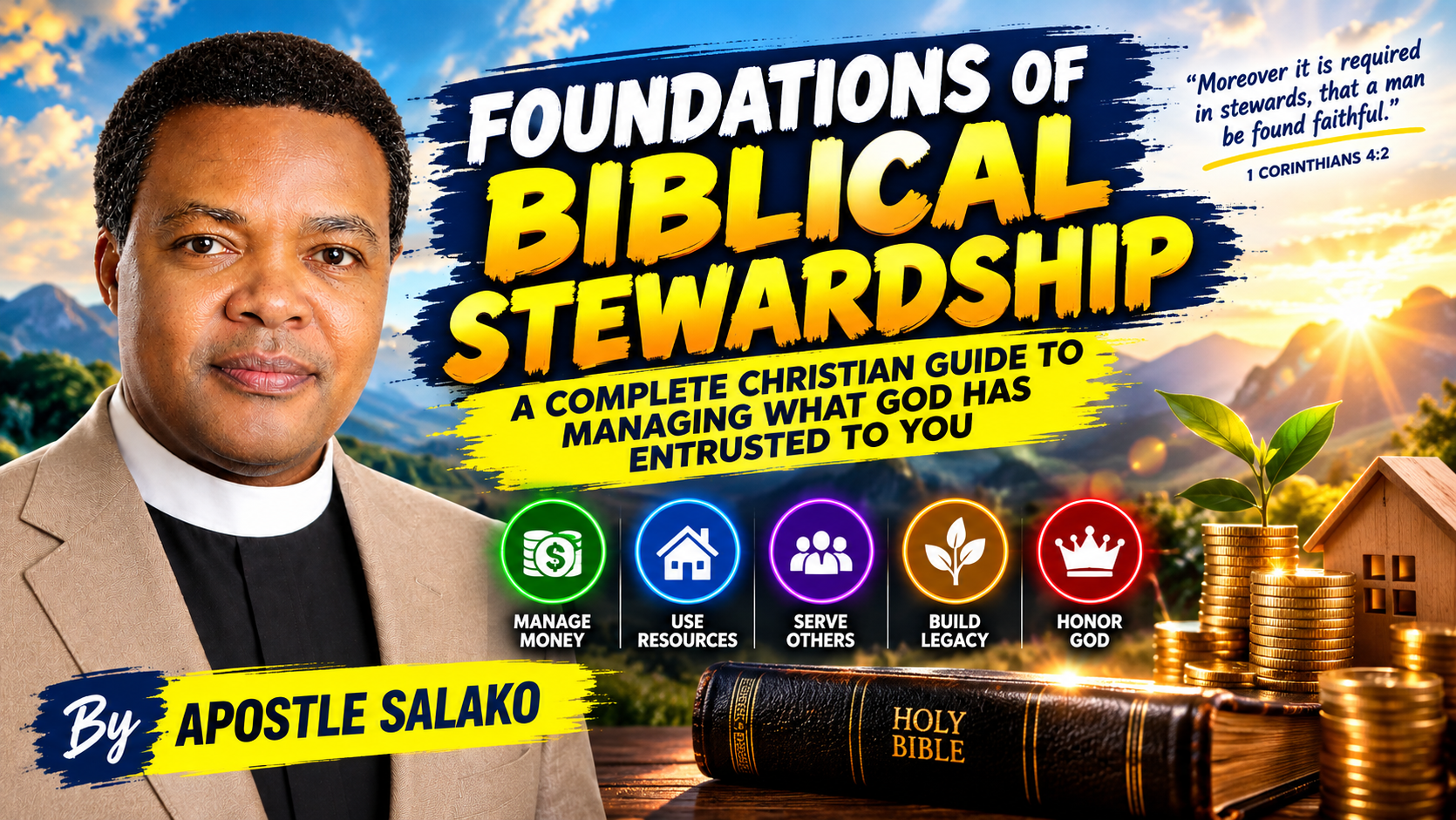
Introduction: Stewardship Is More Than Money
When many Christians hear the word stewardship, their first thought is money.
They think about tithing.
They think about offerings.
They think about giving to the church.
They think about financial responsibility.
These are certainly important aspects of stewardship, but biblical stewardship is much bigger.
Stewardship is the biblical responsibility of managing what God has entrusted to us in a way that honors Him and serves His purposes.
God has entrusted human beings with time.
He has entrusted us with abilities.
He has entrusted us with relationships.
He has entrusted us with opportunities.
He has entrusted us with possessions.
He has entrusted many people with financial resources.
He has entrusted believers with spiritual gifts.
Most importantly, He has entrusted us with the gospel and the responsibility to represent Christ faithfully.
Therefore, stewardship is not merely a financial subject.
It is a discipleship subject.
It is a character subject.
It is a worship subject.
It is a leadership subject.
It is a kingdom subject.
The fundamental question of stewardship is not:
"How much do I own?"
The deeper question is:
"How faithfully am I managing what God has placed in my hands?"
Psalm 24:1 declares:
"The earth is the LORD'S, and the fulness thereof; the world, and they that dwell therein."
This statement changes the way we look at everything.
If God owns everything, then what we call "mine" is ultimately something that has been entrusted to us.
Our responsibility is therefore not simply to accumulate.
Our responsibility is to manage.
Not merely to consume.
But to use wisely.
Not merely to receive.
But to distribute faithfully.
Not merely to ask, "What can this do for me?"
But also to ask:
"What does God want me to do with this?"
That is the heart of biblical stewardship.
What Is Biblical Stewardship?
A steward is someone entrusted with the management of something belonging to another person.
In biblical thinking, stewardship begins with God's ownership and humanity's responsibility.
The steward has authority, but that authority is delegated.
The steward can make decisions, but those decisions are accountable.
The steward can use resources, but those resources ultimately belong to the owner.
This principle appears throughout Scripture.
Jesus taught about stewardship repeatedly.
One of the clearest examples is found in the parable of the talents in Matthew 25:14–30.
A master traveled into a far country and entrusted different amounts to his servants.
One received five talents.
Another received two.
Another received one.
When the master returned, he evaluated what each servant had done with what had been entrusted to him.
The issue was not that every servant had received the same amount.
The issue was what each servant did with what he received.
This teaches an important principle:
God does not ask you to manage somebody else's assignment. He asks you to be faithful with yours.
Someone may have more money than you.
Someone may have a larger platform.
Someone may have more followers.
Someone may have a different spiritual gift.
Someone may have a different career.
Someone may have more opportunities.
But comparison is not the central question of stewardship.
Faithfulness is.
The question is:
What has God placed in my hands, and what am I doing with it?
The First Foundation: God Owns Everything
The foundation of biblical stewardship is ownership.
Before understanding how to manage resources, we must understand who ultimately owns them.
Psalm 24:1 says:
"The earth is the LORD'S, and the fulness thereof; the world, and they that dwell therein."
Haggai 2:8 says:
"The silver is mine, and the gold is mine, saith the LORD of hosts."
Deuteronomy 8:18 reminds God's people that it is God who gives the ability to produce wealth.
This means that even our capacity to work, create, think, build, invent, communicate, and produce is ultimately dependent upon God.
This does not mean Christians should become passive.
Quite the opposite.
Understanding God's ownership should make us more responsible.
If a wealthy person gives you responsibility over a business, you are expected to treat that business carefully.
If someone gives you their property to manage, you cannot treat it as though you are the ultimate owner.
The same principle applies spiritually.
Your life belongs to God.
Your time belongs to God.
Your abilities belong to God.
Your resources belong to God.
Your influence belongs to God.
Your opportunities belong to God.
Your possessions belong to God.
Therefore, stewardship begins with surrender.
Ownership changes our attitude
When people believe they are absolute owners, they may think:
"I can do whatever I want."
But when they recognize God's ownership, the question changes:
"How does God want me to use this?"
That question can transform financial decisions, career decisions, family decisions, ministry decisions, and personal priorities.
The Second Foundation: We Are Stewards, Not Owners
The distinction between ownership and stewardship is one of the most important concepts in Christian living.
A steward possesses something temporarily but manages it on behalf of the owner.
This means stewardship involves trust, responsibility, accountability, and purpose.
Jesus illustrated this principle in Luke 16:10:
"He that is faithful in that which is least is faithful also in much."
Notice that Jesus connects stewardship with faithfulness.
The issue is not merely how much someone possesses.
The issue is how faithfully the person handles what has been entrusted to them.
This is especially important because human beings naturally tend to measure success by possession.
We say:
"I own a house."
"I own a business."
"I own a car."
"I own money."
"I own this property."
From a legal and social perspective, ownership has legitimate meaning.
But from a biblical perspective, ultimate ownership belongs to God.
We are temporary managers.
That realization produces humility.
It also produces responsibility.
Stewardship is a privilege
Being a steward should not feel like punishment.
It is a privilege.
God allows human beings to participate in His purposes.
He gives us resources that can accomplish good things.
He gives us time that can be invested in eternal purposes.
He gives us abilities that can serve others.
He gives us money that can meet needs and support kingdom work.
He gives us influence that can encourage people.
The steward therefore says:
"Lord, thank You for trusting me with this."
The Third Foundation: Stewardship Begins With the Heart
Biblical stewardship is not fundamentally about money.
It is about the heart.
Jesus said in Matthew 6:21:
"For where your treasure is, there will your heart be also."
Our handling of resources reveals something about our priorities.
Money can reveal our values.
Time can reveal our priorities.
Attention can reveal our interests.
Words can reveal our character.
Relationships can reveal our maturity.
Resources are therefore not merely external objects.
They can become mirrors of the heart.
Stewardship exposes misplaced priorities
A person may say that God is first while consistently giving God the leftovers.
A person may say family is important while never making time for family.
A person may say ministry matters while refusing to develop their gifts.
A person may say wisdom matters while continually making reckless decisions.
Stewardship challenges the gap between what we say and what we actually practice.
This is why Christian stewardship should not begin with a spreadsheet.
It should begin with prayer.
"Lord, examine my heart."
"Show me what I have been managing poorly."
"Show me where I have been wasteful."
"Show me where I have been selfish."
"Show me where I have neglected responsibilities."
"Teach me to be faithful."
That is a stewardship prayer.
The Fourth Foundation: Faithfulness Matters to God
One of the strongest themes in biblical stewardship is faithfulness.
Paul wrote in 1 Corinthians 4:2:
"Moreover it is required in stewards, that a man be found faithful."
Notice the wording.
It does not say:
"It is required in stewards that they be famous."
It does not say:
"It is required that they become wealthy."
It does not say:
"It is required that they become popular."
It says:
faithful.
This is tremendously important.
Christian stewardship is not a competition.
God does not call every person to manage the same amount.
He calls every person to faithfulness.
Faithfulness in small things
Some people want great opportunities but neglect small responsibilities.
They want a large ministry but cannot maintain discipline.
They want financial abundance but cannot manage current income.
They want leadership but cannot serve faithfully.
They want influence but do not manage their words.
Jesus' teaching in Luke 16:10 establishes a principle:
Faithfulness in small responsibilities prepares us for larger responsibilities.
This does not mean every faithful person will automatically become wealthy or famous.
It means that Christian maturity involves learning to handle present responsibilities faithfully rather than despising them while waiting for something bigger.
The Fifth Foundation: Stewardship Requires Wisdom
Good intentions are not enough.
A person can sincerely love God and still manage resources poorly.
Stewardship therefore requires wisdom.
Proverbs repeatedly connects wisdom with practical living.
Proverbs 21:5 says:
"The thoughts of the diligent tend only to plenteousness; but of every one that is hasty only to want."
This principle applies to finances, work, relationships, projects, and ministry.
Wisdom asks questions such as:
• What is the purpose of this resource?
• What are the consequences of this decision?
• Can I afford this?
• Is this necessary?
• Is this opportunity consistent with my calling?
• What does Scripture teach?
• Have I prayed about it?
• Have I sought wise counsel?
• What will this decision produce over time?
Biblical stewardship is therefore not reckless spirituality.
Faith does not eliminate wisdom.
Prayer does not eliminate planning.
Trust in God does not eliminate responsibility.
Proverbs 16:3 says:
"Commit thy works unto the LORD, and thy thoughts shall be established."
We should commit our plans to God while also applying wisdom to those plans.
Stewardship of Money and Finances
Money is one of the most visible areas of stewardship.
The Bible speaks extensively about money because financial decisions often expose priorities, discipline, generosity, contentment, and wisdom.
However, biblical financial stewardship should not be reduced to the pursuit of wealth.
The Christian question is not merely:
"How can I get more money?"
It is:
"How can I faithfully manage the money God has placed under my responsibility?"
1. Earn honestly
Proverbs 10:4 says:
"He becometh poor that dealeth with a slack hand: but the hand of the diligent maketh rich."
Scripture consistently values diligence.
Christians should pursue honest work, productive activity, integrity, and excellence.
Money earned through dishonesty contradicts biblical stewardship.
2. Budget wisely
A budget is essentially a plan for directing resources.
Luke 14:28 presents the principle of counting the cost before beginning a project.
A practical Christian budget may include:
• giving
• essential expenses
• savings
• debt repayment
• investment
• family responsibilities
• education
• emergency reserves
• personal spending
• charitable support
The precise percentages will differ according to individual circumstances.
The biblical principle is intentional management.
3. Avoid unnecessary debt
The Bible does not present every form of borrowing in exactly the same way, but Scripture repeatedly warns about the burden associated with debt.
Proverbs 22:7 says:
"The borrower is servant to the lender."
Debt can reduce financial flexibility and limit future choices.
Wise stewardship therefore considers not only whether a purchase is possible today, but whether it creates an unhealthy burden tomorrow.
4. Save wisely
Proverbs 6:6–8 points to the ant as an example of preparation.
Saving is not necessarily a lack of faith.
Wise preparation can be an expression of responsibility.
A reserve can help a household respond to emergencies without immediately resorting to desperate measures.
5. Give generously
Generosity is an important expression of Christian stewardship.
2 Corinthians 9:7 says:
"Every man according as he purposeth in his heart, so let him give; not grudgingly, or of necessity: for God loveth a cheerful giver."
Giving should not be motivated primarily by manipulation, competition, or the desire to impress people.
Christian generosity flows from love and gratitude.
6. Reject greed
Jesus warned in Luke 12:15:
"Take heed, and beware of covetousness: for a man's life consisteth not in the abundance of the things which he possesseth."
This is a critical stewardship principle.
Having resources is not the same thing as allowing resources to control the heart.
The Christian steward learns to use money without becoming enslaved to money.
Stewardship of Time
Time is one of the most valuable resources God gives us because it cannot be stored for later use.
Once a day has passed, it cannot be recovered.
Psalm 90:12 says:
"So teach us to number our days, that we may apply our hearts unto wisdom."
Paul similarly writes in Ephesians 5:15–16:
"See then that ye walk circumspectly, not as fools, but as wise, Redeeming the time, because the days are evil."
Time stewardship means learning to distinguish between what is important and what merely demands attention.
Everyone receives the same basic daily clock
One person may be wealthy.
Another may be poor.
One may be famous.
Another may be unknown.
But every person has limited time.
The question is not how to create more hours.
The question is how to use the hours we have.
Questions for time stewardship
Ask yourself:
• How much time do I give to prayer?
• How much time do I give to Scripture?
• How much time do I give to family?
• How much time do I spend working?
• How much time do I spend learning?
• How much time do I spend serving others?
• How much time disappears into distractions?
• Am I regularly exhausted because I have failed to establish boundaries?
Time management without spiritual priorities can produce a very efficient but misdirected life.
The goal is not simply to become busy.
The goal is to become fruitful.
Stewardship of Spiritual Gifts and Talents
God has given people different abilities.
Some teach.
Some preach.
Some sing.
Some organize.
Some encourage.
Some lead.
Some serve quietly.
Some create.
Some build businesses.
Some mentor.
Some write.
Some demonstrate unusual gifts of compassion.
Romans 12:6–8 describes different gifts and emphasizes using them appropriately.
Peter writes in 1 Peter 4:10:
"As every man hath received the gift, even so minister the same one to another, as good stewards of the manifold grace of God."
This verse directly connects spiritual gifts with stewardship.
Your gift is not merely for personal identity.
It is a responsibility.
Discover your gift
Ask:
• What abilities has God given me?
• What do trusted mature believers recognize in me?
• What problems can I help solve?
• What kind of service produces meaningful fruit?
• What opportunities repeatedly come my way?
• What areas of ministry require my contribution?
Develop your gift
A gift does not remove the need for training.
A person may have a gift for teaching but still need to study.
A person may have a gift for music but still need practice.
A person may have leadership potential but still need character development.
Paul told Timothy in 1 Timothy 4:14:
"Neglect not the gift that is in thee."
The warning is significant.
A gift can be neglected.
Therefore:
Discover it. Develop it. Discipline it. Deploy it.
Stewardship of Work and Career
Work is not merely a means of receiving a salary.
Work can be an arena for service, creativity, excellence, provision, and witness.
Colossians 3:23 says:
"And whatsoever ye do, do it heartily, as to the Lord, and not unto men."
This principle transforms our understanding of work.
A Christian does not need a church title to honor God.
A teacher can honor God.
An engineer can honor God.
A trader can honor God.
A farmer can honor God.
A doctor can honor God.
A business owner can honor God.
A cleaner can honor God.
A student can honor God.
A craftsman can honor God.
The issue is integrity and faithfulness.
Work with excellence
Excellence is part of good stewardship.
If God has entrusted you with a job, perform it responsibly.
Be punctual.
Be honest.
Keep your word.
Develop competence.
Treat people respectfully.
Avoid fraudulent practices.
Don't use Christian language to cover poor work.
A Christian witness includes professional integrity.
Stewardship of Possessions
Possessions are resources.
They should be managed rather than worshipped.
The Bible does not teach that every Christian must live without possessions.
Rather, Scripture warns against allowing possessions to become idols.
Jesus' encounter with the rich young ruler in Matthew 19 demonstrates how possessions can expose the condition of the heart.
The problem was not merely that the man possessed resources.
The deeper issue was his attachment.
Ask better questions about possessions
Instead of asking:
"Can I buy this?"
also ask:
"Should I buy this?"
Instead of:
"Can I afford this?"
ask:
"Will this purchase support or undermine my priorities?"
Instead of:
"Do I want this?"
ask:
"Why do I want this?"
Possessions should serve life and purpose.
They should not become masters.
Stewardship of Relationships and Family
People are more valuable than possessions.
Yet relationships are often neglected because people assume they will always be there.
Marriage requires stewardship.
Parenting requires stewardship.
Friendship requires stewardship.
Mentorship requires stewardship.
Church relationships require stewardship.
Leadership relationships require stewardship.
Steward your words
Proverbs 15:1 says:
"A soft answer turneth away wrath: but grievous words stir up anger."
Words can build or destroy.
Therefore, communication is a stewardship responsibility.
Before speaking, ask:
• Is it true?
• Is it necessary?
• Is it loving?
• Is it constructive?
• Is this the right time?
Steward your trust
Trust takes time to build and can be destroyed quickly.
A faithful steward keeps confidences appropriately, avoids unnecessary gossip, and treats people with dignity.
Steward your family
Deuteronomy 6:6–7 emphasizes teaching God's truth within the household.
Parents therefore have a stewardship responsibility toward the spiritual formation and well-being of their children.
Family stewardship includes:
• presence
• instruction
• correction
• encouragement
• provision
• prayer
• affection
• example
Children learn not only from what parents say but also from what parents consistently demonstrate.
Stewardship of Opportunities
Opportunities are also resources.
Some opportunities come once.
Some return.
Some never return.
Esther's story demonstrates the importance of recognizing divine opportunity.
Mordecai told Esther:
"Who knoweth whether thou art come to the kingdom for such a time as this?"
— Esther 4:14
Opportunity requires discernment.
Not every opportunity is God's assignment.
Therefore, Christians should avoid the belief that every open door must automatically be entered.
Ask:
• Is this consistent with Scripture?
• Does this align with my responsibilities?
• Do I have the capacity?
• What are the consequences?
• Have I prayed?
• Have I sought wise counsel?
• Is this opportunity serving God's purposes or merely feeding my ego?
Stewardship includes knowing when to say yes and when to say no.
Stewardship of the Gospel
One of the greatest responsibilities given to believers is the gospel.
Paul described himself and other ministers as stewards of the mysteries of God in 1 Corinthians 4:1.
The gospel is not our private possession.
It is a message entrusted to us.
Jesus commanded His disciples in Matthew 28:19–20 to make disciples of nations.
This means every believer has some responsibility to represent Christ faithfully.
That responsibility may look different from person to person.
One person may preach publicly.
Another may evangelize personally.
Another may disciple young believers.
Another may support missions financially.
Another may use media to spread biblical teaching.
Another may demonstrate Christ through compassionate service.
But the principle remains:
What has been entrusted to us should be faithfully deployed.
Stewardship of the Body
The body also requires stewardship.
Paul writes in 1 Corinthians 6:19–20:
"What? know ye not that your body is the temple of the Holy Ghost..."
The Christian therefore should not treat physical life carelessly.
Healthy stewardship can include:
• adequate rest
• responsible nutrition
• appropriate physical activity
• personal hygiene
• avoiding destructive habits
• managing stress wisely
• seeking appropriate medical care when necessary
This is not about becoming obsessed with appearance.
It is about recognizing that our bodies affect our ability to serve, work, worship, and fulfill responsibilities.
Rest itself can be an act of stewardship.
Even Jesus withdrew from crowds and rested.
A person who constantly destroys their health in the name of productivity may eventually discover that they have been consuming the very resource they were supposed to manage.
Stewardship of Influence
Influence is a resource.
Every person has some sphere of influence.
It may be large or small.
A parent influences children.
A teacher influences students.
A pastor influences members.
A manager influences employees.
A business owner influences customers and workers.
A social-media creator influences viewers.
A friend influences friends.
Influence creates responsibility.
Jesus said in Matthew 5:16:
"Let your light so shine before men, that they may see your good works, and glorify your Father which is in heaven."
Christian influence should point people toward God rather than merely toward the personality of the person exercising influence.
Influence should produce service
Biblical leadership is not fundamentally about becoming important.
It is about becoming useful.
The greater the influence, the greater the responsibility.
A person with a large audience has greater opportunity to encourage—but also greater potential to mislead.
Therefore, digital influence requires stewardship.
Think before posting.
Verify information.
Avoid deliberately misleading people.
Don't exploit people's fears.
Don't manipulate vulnerable people.
Don't use Christian language merely as a marketing technique.
Use influence to educate, encourage, equip, and serve.
The Biblical Difference Between Ownership and Stewardship
Understanding the difference between ownership and stewardship can transform Christian decision-making.
Ownership mentality Stewardship mentality
"It belongs to me." "It has been entrusted to me."
"I can do whatever I want." "I should seek God's wisdom."
"How much can I get?" "How faithfully can I manage it?"
"How can this serve me?" "How can this serve God's purposes?"
"I must protect everything for myself." "I should manage and share responsibly."
"Success means accumulation." "Success includes faithfulness."
"My resources define me." "My character defines how I use resources."
This distinction does not mean Christians should ignore legitimate personal responsibility or property rights.
It means that Christian discipleship places everything under God's authority.
The steward lives with accountability.
Generosity as an Expression of Stewardship
Generosity is one of the clearest demonstrations that resources do not control our hearts.
The generous person recognizes that resources can become instruments of blessing.
Proverbs 11:25 says:
"The liberal soul shall be made fat: and he that watereth shall be watered also himself."
Biblical generosity takes different forms.
It may involve:
• financial giving
• feeding someone
• supporting missions
• helping a struggling family
• providing education
• sharing professional knowledge
• volunteering
• mentoring
• giving time
• opening one's home
• encouraging someone
• supporting useful community work
Generosity is therefore not limited to money.
You can be generous with knowledge.
You can be generous with attention.
You can be generous with encouragement.
You can be generous with opportunities.
You can be generous with forgiveness.
You can be generous with your time.
Generosity must be wise
Christian generosity does not require abandoning wisdom.
There is a difference between generosity and irresponsible financial behavior.
A steward should seek to help people in ways that genuinely contribute to good outcomes while maintaining legitimate responsibilities.
Paul's teaching in 2 Corinthians 9 emphasizes willing and cheerful giving rather than coercion.
Generosity should come from conviction, not manipulation.
Contentment and the Steward's Heart
Stewardship requires contentment.
Without contentment, a person can receive more and still feel poor.
The endless pursuit of "more" can become a spiritual trap.
Paul wrote in 1 Timothy 6:6:
"But godliness with contentment is great gain."
Contentment does not mean laziness.
It does not mean refusing to improve your circumstances.
It does not mean rejecting legitimate ambition.
It means that your sense of worth does not depend entirely upon what you possess.
A Christian can pursue growth without worshipping growth.
A Christian can build wealth without allowing wealth to become an idol.
A Christian can enjoy good things without becoming controlled by them.
This balance is essential.
Common Biblical Stewardship Mistakes
1. Thinking stewardship is only about money
This is probably one of the biggest misunderstandings.
Time, gifts, relationships, influence, possessions, opportunities, and the gospel are all stewardship responsibilities.
2. Comparing your assignment with someone else's
The parable of the talents teaches different levels of entrusted resources.
Do not build your identity around another person's assignment.
3. Waiting for abundance before becoming faithful
Some people say:
"When I have more money, I will give."
"When I have a larger platform, I will serve."
"When I have more time, I will pray."
Faithfulness starts with what is already in your hands.
4. Confusing consumption with success
Buying more does not automatically mean living better.
Biblical stewardship asks whether consumption serves a meaningful purpose.
5. Neglecting planning
Some Christians confuse faith with the absence of planning.
Scripture repeatedly demonstrates the value of wisdom, diligence, preparation, and counsel.
6. Using resources primarily for personal status
Resources can become tools of pride.
A steward should regularly examine motives.
7. Giving under manipulation
Christian giving should not be produced through fear, coercion, or psychological pressure.
2 Corinthians 9:7 emphasizes giving from the heart.
8. Ignoring small responsibilities
Jesus taught the importance of faithfulness in little things.
Do not despise small assignments.
9. Neglecting rest
A person who never rests may eventually lose the ability to serve effectively.
Rest can be part of responsible stewardship.
10. Forgetting accountability
The parables of Jesus repeatedly present stewardship as accountable management.
We should live with the awareness that our decisions matter.
Practical Steps for Becoming a Better Steward
Biblical stewardship becomes powerful when it moves from theory to practice.
Here is a practical framework.
Step 1: Recognize God's ownership
Begin each day with the understanding:
"Everything I have ultimately belongs to God."
This changes your attitude.
Step 2: Inventory your resources
Write down what has been entrusted to you.
Include:
• money
• time
• skills
• education
• relationships
• possessions
• opportunities
• influence
• spiritual gifts
• experience
You cannot manage what you refuse to acknowledge.
Step 3: Identify areas of waste
Ask:
Where am I wasting time?
Where am I wasting money?
Where am I neglecting relationships?
Where am I failing to develop my gifts?
Where am I saying yes to things that God has not assigned?
Honest answers are valuable.
Step 4: Establish priorities
Not everything is equally important.
Identify your highest responsibilities.
For many Christians, these may include:
1. relationship with God
2. marriage and family
3. calling and service
4. work and financial responsibilities
5. health
6. relationships and community
7. personal development
The exact order will differ according to one's circumstances and responsibilities.
Step 5: Create systems
Good stewardship becomes easier when supported by systems.
Financial systems can include:
• budgeting
• expense tracking
• savings
• debt management
• giving plans
Time systems can include:
• calendars
• task lists
• focused work periods
• regular rest
Spiritual systems can include:
• Bible reading
• prayer
• worship
• discipleship
• accountability
Step 6: Develop your gifts
Take training seriously.
Read.
Study.
Practice.
Seek feedback.
Find mentors.
Serve.
Your gift deserves development.
Step 7: Review regularly
A good steward evaluates.
Ask monthly:
• What worked?
• What failed?
• What did I learn?
• What needs adjustment?
• What is God teaching me?
• What responsibility needs greater attention?
Stewardship is an ongoing process.
A Biblical Stewardship Audit
One practical way to evaluate your stewardship is to conduct a personal audit.
Consider each area below.
Spiritual Life
• Am I cultivating my relationship with God?
• Am I reading and studying Scripture?
• Am I praying consistently?
• Am I growing spiritually?
Time
• Am I intentionally using my time?
• What consumes most of my attention?
• Are distractions controlling my schedule?
Money
• Do I know where my money goes?
• Am I living within reasonable limits?
• Do I save?
• Do I give?
• Do I manage debt responsibly?
Work
• Am I diligent?
• Am I trustworthy?
• Am I developing my competence?
• Do I work with integrity?
Gifts
• What abilities has God given me?
• Am I developing them?
• Am I using them to serve others?
Family
• Am I present?
• Do I listen?
• Do I communicate well?
• Am I investing spiritually and emotionally in those entrusted to me?
Body
• Am I caring responsibly for my physical well-being?
• Do I get adequate rest?
• Am I neglecting harmful habits?
Influence
• Does my influence point people toward truth?
• Are my words responsible?
• Does my online presence reflect Christian character?
Opportunities
• Am I recognizing opportunities to serve?
• Am I saying yes to everything instead of discerning what matters?
• Am I neglecting important opportunities because of fear?
Gospel
• Am I representing Christ faithfully?
• Am I helping others grow?
• Am I supporting the spread of the gospel?
This audit is not intended to produce condemnation.
It is intended to produce awareness.
Awareness creates the possibility of change.
Biblical Stewardship in Everyday Life
Stewardship is not reserved for pastors, business owners, or wealthy people.
It belongs to every believer.
The student
A student stewards:
• time
• education
• concentration
• opportunities
• relationships
• abilities
Studying diligently can itself be an expression of stewardship.
The employee
An employee stewards:
• working hours
• responsibilities
• company resources
• professional skills
• relationships
• reputation
The entrepreneur
An entrepreneur stewards:
• capital
• employees
• customers
• ideas
• intellectual property
• opportunities
• influence
Christian entrepreneurship should therefore involve both profitability and integrity.
The parent
A parent stewards:
• children
• time
• values
• family culture
• education
• spiritual formation
The church leader
A church leader stewards:
• people
• doctrine
• spiritual gifts
• finances
• influence
• opportunities
• ministry resources
Greater responsibility requires greater accountability.
The content creator
A Christian content creator stewards:
• audience attention
• information
• influence
• creative gifts
• technology
• reputation
The goal should not simply be to gain views.
The deeper question is:
What are those views accomplishing?
Stewardship and Kingdom Wealth
Biblical stewardship provides an important foundation for understanding wealth.
Wealth itself should not automatically be treated as either proof of spiritual superiority or proof of spiritual failure.
The Bible contains wealthy people who faithfully served God and also contains warnings to wealthy people who became controlled by their possessions.
The key question is:
What place does wealth occupy in the heart, and how is wealth being managed?
Deuteronomy 8:18 reminds Israel that God gives power to get wealth.
This should produce gratitude rather than arrogance.
A Christian seeking financial growth should therefore pursue:
• honest work
• wise management
• disciplined saving
• responsible investment
• generosity
• contentment
• integrity
• service
Kingdom-minded financial stewardship asks:
How can financial resources become instruments of responsible provision, service, generosity, and purpose?
This is very different from teaching people to worship wealth.
Stewardship, Prosperity and the Gospel
Christians should be careful about reducing the gospel to financial success.
Jesus did not call His followers merely to become rich.
He called them to follow Him.
He taught love.
He taught holiness.
He taught service.
He taught generosity.
He taught sacrifice.
He taught faith.
He taught obedience.
Therefore, financial stewardship must remain within the larger framework of discipleship.
A Christian may experience financial increase and still need spiritual growth.
A Christian may experience financial difficulty and still be deeply faithful.
Material circumstances alone cannot provide a complete measure of spiritual maturity.
The biblical goal is faithful discipleship.
The Steward's Attitude Toward Success
Success should be redefined through stewardship.
The world may ask:
"How much did you accumulate?"
The steward asks:
"How faithfully did I manage what I received?"
The world may ask:
"How many people know you?"
The steward asks:
"Did my influence serve people well?"
The world may ask:
"How impressive is your platform?"
The steward asks:
"Did I use my platform responsibly?"
The world may ask:
"What did you accomplish?"
The steward asks:
"Did I accomplish what God entrusted to me?"
This does not eliminate ambition.
It purifies ambition.
Frequently Asked Questions About Biblical Stewardship
What is biblical stewardship?
Biblical stewardship is the responsibility of faithfully managing the resources, abilities, opportunities, relationships, time, possessions, and responsibilities God has entrusted to us.
It is based on the understanding that God is the ultimate owner and human beings are accountable managers.
Is stewardship only about money?
No.
Money is one area of stewardship, but biblical stewardship also includes time, spiritual gifts, talents, relationships, work, possessions, influence, opportunities, the body, and the gospel.
What Bible verse best explains stewardship?
Several passages are important.
1 Corinthians 4:2 says:
"Moreover it is required in stewards, that a man be found faithful."
Other important passages include Matthew 25:14–30, Luke 16:10–12, Psalm 24:1, 1 Peter 4:10, and Ephesians 5:15–16.
Why is stewardship important for Christians?
Stewardship matters because Christians believe everything ultimately belongs to God.
Therefore, how we use what we have is part of our worship and discipleship.
How can I practice biblical stewardship with money?
You can begin by earning honestly, spending intentionally, budgeting, saving responsibly, managing debt wisely, giving generously, avoiding greed, and seeking biblical wisdom for financial decisions.
How can I become a better steward of time?
Identify your priorities, reduce unnecessary distractions, schedule important responsibilities, make time for prayer and Scripture, invest in relationships, work diligently, and maintain appropriate rest.
What does the Bible say about stewardship of spiritual gifts?
First Peter 4:10 describes believers as stewards of God's grace and instructs them to use their gifts to serve others.
Your spiritual gifts are not merely for personal recognition.
They are opportunities for service.
Does biblical stewardship mean Christians cannot enjoy possessions?
No.
The issue is not simply whether someone possesses things.
The issue is whether possessions possess the person.
Christians can receive, enjoy, use, and share resources responsibly while keeping God first.
Does stewardship guarantee financial prosperity?
No.
The Bible teaches faithfulness, wisdom, diligence, generosity, and responsible management, but Scripture does not present stewardship as a formula guaranteeing a particular level of financial wealth.
What is the difference between stewardship and ownership?
Ownership refers to possessing something, while stewardship refers to managing something entrusted to you.
Biblically, God is the ultimate owner, while human beings are called to faithful stewardship.
How does stewardship relate to generosity?
Generosity is one expression of stewardship.
When we understand that resources ultimately belong to God, we become less controlled by possessions and more willing to use resources to bless others.
Can poor people practice biblical stewardship?
Absolutely.
Stewardship is not determined by wealth.
A person with limited resources can demonstrate exceptional stewardship through faithfulness, wisdom, generosity, diligence, and contentment.
The parable of the talents emphasizes faithfulness with what has been entrusted rather than comparison with someone else's amount.
How can families practice stewardship together?
Families can create shared financial goals, teach children responsible money management, pray together, serve others, establish healthy routines, manage time intentionally, and discuss how their resources can be used responsibly.
A Prayer for Faithful Stewardship
Heavenly Father,
Thank You for everything You have entrusted to me.
Thank You for my life, my time, my abilities, my relationships, my opportunities, my possessions, my work, and every resource You have placed in my hands.
Help me to remember that everything ultimately belongs to You.
Teach me not to live selfishly or carelessly.
Give me wisdom to manage my resources.
Give me discipline to manage my time.
Give me humility to develop my gifts.
Give me integrity in my work.
Give me love in my relationships.
Give me courage to use my opportunities.
Give me compassion to serve others.
Give me wisdom concerning money.
Deliver me from greed, waste, pride, fear, and comparison.
Teach me to give generously and responsibly.
Help me to become faithful in small things.
Help me to represent Christ well.
May everything You have placed in my hands become useful for Your purposes.
When You increase my resources, keep my heart humble.
When resources are limited, teach me faithfulness.
When opportunities come, give me discernment.
When challenges arise, give me wisdom.
And when my life is evaluated, may I be found faithful.
In Jesus' name.
Amen.
Conclusion: Everything Belongs to God
The foundation of biblical stewardship is simple but profound:
God owns everything, and we are called to manage what He entrusts to us faithfully.
This truth changes the way we look at life.
Your money is a stewardship.
Your time is a stewardship.
Your abilities are a stewardship.
Your relationships are a stewardship.
Your work is a stewardship.
Your possessions are a stewardship.
Your influence is a stewardship.
Your opportunities are a stewardship.
Your spiritual gifts are a stewardship.
Your body is a stewardship.
Your calling is a stewardship.
The gospel itself is a sacred responsibility entrusted to believers.
Therefore, the Christian life should not be measured merely by what we possess.
It should also be measured by how faithfully we manage what we have received.
The goal is not comparison.
It is faithfulness.
The goal is not accumulation without purpose.
It is responsible management.
The goal is not using God to obtain resources.
It is using resources in a way that honors God.
The goal is not building a life centered on possessions.
It is building a life centered on Christ.
Jesus' parable of the talents reminds us that stewardship ultimately involves accountability.
One day, the question will not simply be:
"What did you have?"
The deeper question will be:
"What did you do with what you were given?"
That question should influence how we live today.
If God has given you little, be faithful with little.
If God has given you much, be faithful with much.
If God has given you a gift, develop it.
If God has given you time, use it wisely.
If God has given you influence, use it responsibly.
If God has given you resources, manage them wisely.
If God has given you opportunities, discern them carefully.
If God has entrusted people to you, love and serve them faithfully.
And above everything else, remember:
You are not the ultimate owner. You are a steward.
Psalm 24:1 gives us the foundation:
"The earth is the LORD'S, and the fulness thereof; the world, and they that dwell therein."
When this truth becomes more than a doctrine and becomes the foundation of everyday life, stewardship becomes worship.
Your budget can become worship.
Your work can become worship.
Your service can become worship.
Your generosity can become worship.
Your time can become worship.
Your leadership can become worship.
Your creativity can become worship.
Your relationships can become worship.
Your entire life can become an offering to God.
That is the heart of biblical stewardship.
Be faithful with what is in your hands.
Manage it with wisdom.
Use it with purpose.
Share it with generosity.
And dedicate it all to the glory of God.
Key Bible Passages for Further Study
For readers who want to study biblical stewardship more deeply, consider these passages:
• Genesis 1:26–28 — Humanity's responsibility over creation
• Deuteronomy 8:10–18 — God and the ability to produce wealth
• Psalm 24:1 — God's ownership
• Psalm 90:12 — Numbering our days
• Proverbs 3:9–10 — Honoring God with resources
• Proverbs 6:6–8 — Preparation and diligence
• Proverbs 10:4 — Diligence
• Proverbs 11:25 — Generosity
• Proverbs 21:5 — Planning and diligence
• Proverbs 22:7 — The burden of debt
• Matthew 5:16 — Stewardship of influence
• Matthew 6:19–24 — Treasure and the heart
• Matthew 25:14–30 — The parable of the talents
• Luke 12:13–21 — The rich fool
• Luke 16:1–13 — Stewardship and faithfulness
• Luke 16:10–12 — Faithfulness in little things
• Luke 19:11–27 — The parable of the pounds
• Romans 12:3–8 — Spiritual gifts
• 1 Corinthians 4:1–2 — Faithful stewards
• 1 Corinthians 6:19–20 — Stewardship of the body
• 2 Corinthians 9:6–11 — Generous giving
• Ephesians 5:15–17 — Stewardship of time
• Philippians 4:10–19 — Contentment and provision
• Colossians 3:23–24 — Stewardship of work
• 1 Timothy 6:6–19 — Wealth, contentment, and generosity
• 1 Peter 4:10–11 — Stewardship of God's grace
Apostle Salako Adedamola
Apostle Salako Adedamola is a preacher, teacher, mentor, and Christian content creator committed to communicating practical biblical principles for everyday Christian living.
Frequently Asked Questions
QWhat is biblical stewardship?
Biblical stewardship is the responsibility of faithfully managing the resources, abilities, opportunities, relationships, time, possessions, and responsibilities God has entrusted to us. It is based on the understanding that God is the ultimate owner and human beings are accountable managers.
QIs stewardship only about money?
No. Money is one area of stewardship, but biblical stewardship also includes time, spiritual gifts, talents, relationships, work, possessions, influence, opportunities, the body, and the gospel.
QWhat Bible verse best explains stewardship?
Several passages are important. 1 Corinthians 4:2 says: "Moreover it is required in stewards, that a man be found faithful." Other important passages include Matthew 25:14–30, Luke 16:10–12, Psalm 24:1, 1 Peter 4:10, and Ephesians 5:15–16.
QWhy is stewardship important for Christians?
Stewardship matters because Christians believe everything ultimately belongs to God. Therefore, how we use what we have is part of our worship and discipleship.
QHow can I practice biblical stewardship with money?
You can begin by earning honestly, spending intentionally, budgeting, saving responsibly, managing debt wisely, giving generously, avoiding greed, and seeking biblical wisdom for financial decisions.
QHow can I become a better steward of time?
Identify your priorities, reduce unnecessary distractions, schedule important responsibilities, make time for prayer and Scripture, invest in relationships, work diligently, and maintain appropriate rest.
QWhat does the Bible say about stewardship of spiritual gifts?
First Peter 4:10 describes believers as stewards of God's grace and instructs them to use their gifts to serve others. Your spiritual gifts are not merely for personal recognition. They are opportunities for service.
QDoes biblical stewardship mean Christians cannot enjoy possessions?
No. The issue is not simply whether someone possesses things. The issue is whether possessions possess the person. Christians can receive, enjoy, use, and share resources responsibly while keeping God first.
QDoes stewardship guarantee financial prosperity?
No. The Bible teaches faithfulness, wisdom, diligence, generosity, and responsible management, but Scripture does not present stewardship as a formula guaranteeing a particular level of financial wealth.
QWhat is the difference between stewardship and ownership?
Ownership refers to possessing something, while stewardship refers to managing something entrusted to you. Biblically, God is the ultimate owner, while human beings are called to faithful stewardship.
QHow does stewardship relate to generosity?
Generosity is one expression of stewardship. When we understand that resources ultimately belong to God, we become less controlled by possessions and more willing to use resources to bless others.
QCan poor people practice biblical stewardship?
Absolutely. Stewardship is not determined by wealth. A person with limited resources can demonstrate exceptional stewardship through faithfulness, wisdom, generosity, diligence, and contentment. The parable of the talents emphasizes faithfulness with what has been entrusted rather than comparison with someone else's amount.
QHow can families practice stewardship together?
Families can create shared financial goals, teach children responsible money management, pray together, serve others, establish healthy routines, manage time intentionally, and discuss how their resources can be used responsibly.
Enjoyed this article?
Get the next one straight to your inbox. One thoughtful email a week.
Comments (0)
Comments are stored locally in your browser. For published responses, email us via the Contact page.
You may also like
Giving, Tithing and Generosity According to Scripture
Discover what the Bible teaches about giving, tithing, generosity, offerings, stewardship, and caring for others. Learn practical biblical principles for giving with faith, wisdom, gratitude, and a willing heart.
Biblical Principles of Personal Finance: A Complete Christian Guide to Managing Money God's Way
Discover biblical principles of personal finance, including budgeting, saving, giving, debt management, work, investing, contentment, stewardship, and building wealth according to Scripture.
The Discipline of Quiet Mornings
Generosity is caught more than it is taught.