

Introduction: Great Leaders Are Developed, Not Manufactured
Leadership is one of the most discussed subjects in the world.
People talk about leadership in government, business, education, ministry, families, communities, organizations, and even social media. Books are written about leadership. Seminars are organized around leadership. Courses are created to teach leadership skills. Organizations spend enormous resources searching for effective leaders.
Yet the Bible presents leadership from a deeper perspective.
According to Scripture, leadership is not primarily about position. It is about character, responsibility, stewardship, influence, service, obedience, and faithfulness.
God does not merely look for people who can stand before crowds. He develops people who can carry responsibility without being destroyed by it.
A person may have charisma without character.
A person may have intelligence without wisdom.
A person may have ambition without integrity.
A person may have influence without spiritual maturity.
A person may have a title without having the character necessary to carry the title.
This is why God's process of developing leaders is often slower than human beings expect.
Joseph received dreams long before he received a position.
David was anointed king long before he sat on the throne.
Moses spent years in the wilderness before returning to Egypt.
Joshua served Moses before leading Israel.
Elisha followed Elijah before carrying the prophetic mantle.
Paul experienced preparation, opposition, suffering, learning, and ministry before becoming one of the most influential apostles in the early church.
The pattern is important:
God often develops the person before He enlarges the person's platform.
Many people want the platform without the preparation.
They want influence without discipline.
They want authority without accountability.
They want visibility without hidden faithfulness.
They want the crown without the process.
But God's method is different.
He develops leaders from the inside out.
A great leader, from a biblical perspective, is not necessarily the person with the largest organization, the biggest audience, the most impressive title, or the greatest public recognition.
A great leader is a person who has learned to submit his or her life to God, serve people faithfully, make wise decisions, carry responsibility with integrity, and influence others toward God's purposes.
This article examines how God develops such leaders.
1. What Is a Godly Leader?
A godly leader is a person who influences others while remaining submitted to God.
Leadership is influence, but biblical leadership is more than influence.
A person can influence others toward destructive behavior. Therefore, influence alone does not make someone a godly leader.
Biblical leadership combines influence with character, responsibility, truth, service, wisdom, and accountability.
Jesus demonstrated this perfectly.
He possessed authority, yet He served.
He had followers, yet He washed feet.
He taught crowds, yet He invested deeply in individuals.
He had power, yet He did not use power selfishly.
Jesus told His disciples:
“For even the Son of man came not to be ministered unto, but to minister, and to give his life a ransom for many.” — Mark 10:45, KJV
This statement challenges the world's understanding of leadership.
The world often asks:
“How many people serve you?”
Jesus asks:
“How many people are you willing to serve?”
That distinction is foundational.
A godly leader understands that leadership is stewardship.
Your position is not ultimately yours.
Your influence is not ultimately yours.
Your gifts are not ultimately yours.
Your opportunities are not ultimately yours.
They are responsibilities entrusted to you.
Paul explained this principle in 1 Corinthians 4:2:
“Moreover it is required in stewards, that a man be found faithful.”
Faithfulness is therefore central to biblical leadership.
A great leader is not merely talented.
A great leader is trustworthy.
2. God Begins Leadership Development With Character
One of the most important principles of biblical leadership is that God develops character before expanding influence.
This principle appears repeatedly in Scripture.
When Paul described qualifications for church leadership in 1 Timothy 3, the emphasis was not primarily on popularity, wealth, public speaking ability, or organizational size.
The passage emphasizes qualities such as being blameless, self-controlled, respectable, hospitable, able to teach, gentle, responsible in the home, mature, and respected by outsiders. (Bible Gateway)
That tells us something profound.
Character is leadership infrastructure.
A building can only rise as high as its foundation can support.
Likewise, influence can only safely increase to the extent that character can carry it.
A person with weak character and increasing influence becomes increasingly dangerous—to himself, his family, his organization, and the people following him.
God therefore works on the heart.
He develops:
• honesty,
• humility,
• patience,
• self-control,
• faithfulness,
• courage,
• compassion,
• integrity,
• forgiveness,
• responsibility,
• purity of motive,
• emotional maturity,
• spiritual discernment.
This process can be uncomfortable because character development exposes things we would rather hide.
God may reveal impatience.
He may expose pride.
He may reveal a desire for recognition.
He may confront the need for control.
He may expose selfish ambition.
He may teach forgiveness.
He may bring people into your life who challenge your attitude.
These experiences are not necessarily interruptions to leadership development.
They may be part of the development itself.
Why character matters more than charisma
Charisma can attract people.
Character can sustain trust.
Communication can attract an audience.
Integrity can sustain influence.
Talent can open a door.
Character determines what happens after the door opens.
This is why aspiring leaders should ask not only:
“What can I do?”
but also:
“Who am I becoming?”
3. God Uses Small Assignments to Prepare Leaders for Great Responsibilities
Many people want large opportunities while ignoring small responsibilities.
But Scripture teaches the importance of faithfulness in little things.
Jesus said:
“He that is faithful in that which is least is faithful also in much.” — Luke 16:10, KJV
David is an excellent example.
Before David became king, he was a shepherd.
His leadership development did not begin in a palace.
It began in a field.
David learned to protect sheep.
He learned courage.
He learned responsibility.
He learned patience.
He learned to observe.
He learned to confront danger.
He learned to depend upon God.
When Samuel came to Jesse's house to anoint the future king, David was not initially presented.
He was working in the field.
This is significant.
David's preparation was happening before public recognition.
The field became his classroom.
The sheep became his responsibility.
The wilderness became part of his leadership laboratory.
Many future leaders overlook their current assignment because it does not look impressive.
But your present assignment may be preparing you for your future responsibility.
If you cannot manage a small team responsibly, increasing the size of the team may multiply your problems.
If you cannot manage your finances responsibly, greater financial resources may create greater problems.
If you cannot keep your word in small matters, larger promises will not automatically make you faithful.
If you cannot serve people when nobody is watching, public ministry will not automatically make you a servant.
Never despise small beginnings
Zechariah 4:10 asks:
“For who hath despised the day of small things?”
God can use small assignments to develop large capacities.
Therefore:
Serve well where you are.
Work diligently.
Keep your commitments.
Treat people with respect.
Learn.
Grow.
Be faithful.
Your current responsibility may be preparing you for tomorrow's opportunity.
4. God Develops Leaders Through Hidden Seasons
One of the hardest experiences for an aspiring leader is obscurity.
You know you have potential, but nobody seems to recognize it.
You know you have gifts, but opportunities appear limited.
You have ideas, but your platform is small.
You feel called to something greater, yet your current environment appears ordinary.
This can produce frustration.
But hidden seasons can be highly productive.
Moses spent approximately forty years in the wilderness before God called him to confront Pharaoh.
David experienced years between his anointing and his enthronement.
Joseph experienced imprisonment between his prophetic dreams and his governmental authority.
These stories teach us that delay is not necessarily denial.
Sometimes God develops leaders away from public applause.
The hidden season develops qualities that public platforms cannot easily teach.
Hidden seasons develop internal strength
When nobody is watching, you discover why you are doing what you are doing.
If your motivation is entirely recognition, obscurity will frustrate you.
If your motivation is obedience, obscurity can become productive.
A person who learns to serve God privately is better prepared to serve Him publicly.
The hidden season asks important questions:
• Will you remain faithful without applause?
• Will you continue praying when nobody knows?
• Will you study when there is no audience?
• Will you serve when there is no reward?
• Will you maintain integrity when there is no public accountability?
• Will you keep developing when nobody celebrates your progress?
Godly leadership grows in these environments.
5. God Uses Trials to Develop Leadership Strength
Leadership inevitably involves pressure.
People will disappoint you.
Plans will fail.
Opportunities will disappear.
Criticism will come.
Some people will misunderstand you.
Others may oppose you.
Unexpected responsibilities will arise.
How a person responds to pressure reveals the maturity of that person.
This is why trials can become part of leadership development.
James 1:2–4 teaches:
“My brethren, count it all joy when ye fall into divers temptations;
Knowing this, that the trying of your faith worketh patience.
But let patience have her perfect work, that ye may be perfect and entire, wanting nothing.”
Trials can develop patience.
Patience is essential for leadership.
A leader who becomes angry every time something goes wrong will eventually damage relationships.
A leader who cannot tolerate delays may make reckless decisions.
A leader who collapses whenever criticized may become controlled by people's opinions.
A leader who has learned endurance can remain steady during difficult seasons.
Trials reveal what is inside
Pressure does not always create character; often, it reveals character.
When pressure comes, you discover:
How patient you are.
How dependent upon God you are.
How you treat people.
How you make decisions.
How you respond to criticism.
How you handle disappointment.
How much you trust God.
God can use these moments to transform weaknesses into areas of strength.
6. God Teaches Leaders Obedience
Leadership without obedience to God can become dangerous.
A person may be highly intelligent but spiritually disobedient.
A person may be gifted but resistant to correction.
A person may be successful but moving outside God's direction.
Biblical leadership begins with submission to God.
Jesus demonstrated perfect obedience.
Philippians 2:8 says:
“And being found in fashion as a man, he humbled himself, and became obedient unto death, even the death of the cross.”
Obedience teaches leaders to distinguish between what they want and what God requires.
This is especially important because leadership often provides opportunities to exercise personal preferences.
A leader can eventually reach a position where people rarely challenge him.
That is dangerous.
The greater the authority, the greater the need for accountability.
Obedience builds trust
When leaders consistently obey God's principles, people can trust their decisions more readily.
Obedience produces consistency.
Consistency produces credibility.
Credibility strengthens influence.
God therefore develops leaders who are willing to obey even when obedience is inconvenient.
Sometimes God says:
Wait.
Sometimes He says:
Go.
Sometimes He says:
Forgive.
Sometimes He says:
Apologize.
Sometimes He says:
Serve.
Sometimes He says:
Give.
Sometimes He says:
Stop.
Sometimes He says:
Start.
A mature leader learns to respond to God rather than allowing circumstances, ego, or public opinion to become the primary source of direction.
7. God Develops Leaders Through Humility
Humility is one of the strongest foundations of godly leadership.
Leadership can easily produce pride.
People begin to praise you.
Your name becomes known.
Others seek your advice.
Your decisions affect many people.
Your platform grows.
Your influence increases.
Without humility, success can become spiritually dangerous.
Proverbs 16:18 warns:
“Pride goeth before destruction, and an haughty spirit before a fall.”
Biblical humility does not mean thinking that you have no value.
It means understanding that your gifts, opportunities, and achievements do not make you independent of God.
Paul asked:
“For who maketh thee to differ from another? and what hast thou that thou didst not receive?” — 1 Corinthians 4:7, KJV
Humility remembers the source.
Humility allows leaders to learn
Proud people stop learning.
Humble people remain teachable.
A leader should be able to say:
“I was wrong.”
“I need help.”
“I do not know.”
“Please explain.”
“Thank you for correcting me.”
“I apologize.”
“Let us learn from this.”
These statements do not weaken leadership.
They can demonstrate maturity.
Humility protects leadership longevity
A leader who believes he knows everything eventually becomes isolated.
A humble leader creates room for other people to contribute.
He understands that leadership is not about being the only intelligent person in the room.
It is about bringing together people, wisdom, gifts, experience, and resources to accomplish a worthy purpose.
8. God Teaches Leaders to Serve
Jesus radically redefined leadership.
In Matthew 20:26–28, He taught His disciples that greatness in God's kingdom is connected with service.
This principle is often called servant leadership.
A servant leader does not ask only:
“What can people do for me?”
He asks:
“What can I do to help these people become what God has called them to become?”
This changes leadership completely.
A pastor serves the congregation.
A parent serves the family.
A mentor serves the mentee.
A business leader serves customers and employees responsibly.
A community leader serves the community.
A teacher serves students.
Service does not eliminate authority.
Rather, it changes how authority is exercised.
Jesus washed feet
John 13 provides one of the strongest pictures of servant leadership in Scripture.
Jesus washed the feet of His disciples.
The Teacher became the servant.
The Lord demonstrated humility.
He showed His followers that leadership is not merely about being above others.
It is also about being willing to serve others.
Great leaders develop people
A leader who needs everyone to remain dependent on him has misunderstood leadership.
The goal of healthy leadership is multiplication.
Paul instructed Timothy in 2 Timothy 2:2:
“And the things that thou hast heard of me among many witnesses, the same commit thou to faithful men, who shall be able to teach others also.”
Notice the multiplication:
Paul → Timothy → faithful people → others.
That is leadership development.
A great leader does not merely build an organization.
A great leader builds people.
9. God Develops Leaders Through Discipline
Leadership requires discipline because responsibility cannot be sustained by emotion alone.
There will be days when you do not feel motivated.
There will be days when prayer feels difficult.
There will be days when studying feels tiring.
There will be days when people disappoint you.
There will be days when your plans fail.
Discipline keeps you moving when emotion fluctuates.
Paul compared Christian life to athletic discipline.
1 Corinthians 9:27 says:
“But I keep under my body, and bring it into subjection…”
A leader must learn self-government before attempting to govern responsibilities around him.
This includes:
• time management,
• financial discipline,
• emotional discipline,
• spiritual discipline,
• communication discipline,
• relational discipline,
• physical responsibility,
• intellectual development.
Spiritual disciplines
A Christian leader should cultivate habits such as:
Prayer
Prayer keeps the leader dependent upon God.
Bible study
Scripture provides the foundation for truth and discernment.
Fasting
Fasting can cultivate spiritual discipline and dependence on God.
Worship
Worship redirects attention from self to God.
Meditation on Scripture
Meditating on God's Word allows truth to shape thinking and behavior.
Fellowship
Christian community provides encouragement and accountability.
Leadership without spiritual discipline can become personality-driven rather than Christ-centered.
10. God Uses Mentorship and Spiritual Relationships
God frequently develops leaders through relationships.
Joshua learned from Moses.
Elisha learned from Elijah.
Timothy learned from Paul.
The disciples learned from Jesus.
These relationships were not identical, but they demonstrate an important principle:
Leadership development often happens through observation, instruction, correction, practice, and responsibility.
A mentor can help an emerging leader see what he cannot yet see about himself.
A good mentor can:
• provide perspective,
• challenge unhealthy habits,
• share experience,
• model integrity,
• provide correction,
• encourage growth,
• identify potential,
• create opportunities for service,
• teach practical wisdom.
But Christian mentorship should never replace dependence on God.
A mentor is not God.
A mentor can be wrong.
A mentor has limitations.
Therefore, Scripture remains the final authority for Christian doctrine and conduct.
Choose mentors carefully
A person's success alone does not make that person a suitable spiritual mentor.
Look for qualities such as:
• integrity,
• humility,
• faithfulness,
• wisdom,
• spiritual maturity,
• healthy relationships,
• sound biblical understanding,
• accountability,
• willingness to correct and be corrected.
The goal is not merely to copy someone's personality.
The goal is to learn principles that help you faithfully fulfill your own God-given assignment.
11. God Develops Wisdom and Discernment in Leaders
Knowledge tells you what something is.
Wisdom helps you understand what to do with that knowledge.
Leadership requires both.
Solomon recognized the need for wisdom when God gave him an opportunity to ask for what he wanted.
1 Kings 3:9 records Solomon's request for:
“an understanding heart to judge thy people, that I may discern between good and bad.”
This is a leadership prayer worth studying.
Solomon did not simply ask for wealth.
He recognized that leadership requires discernment.
A leader must know:
When to speak.
When to remain silent.
When to act.
When to wait.
When to confront.
When to forgive.
When to delegate.
When to seek counsel.
When to say no.
When to change direction.
When to persevere.
Wisdom grows through experience and reflection
A mature leader learns from experience.
After every major situation, ask:
What happened?
What did I do well?
What did I do poorly?
What did I learn?
What should I change?
What should I repeat?
What principle can I teach someone else?
This converts experience into wisdom.
Without reflection, people can repeat the same mistakes for years.
12. God Tests a Leader's Motives
God is concerned not only with what leaders do but why they do it.
Two people can perform the same action for completely different reasons.
One person may serve because he genuinely loves people.
Another may serve because he wants recognition.
One may preach because he wants people to know Christ.
Another may preach primarily because he wants applause.
One may build a business to create value and serve people responsibly.
Another may pursue wealth purely for status.
Motives matter.
Proverbs 16:2 says:
“All the ways of a man are clean in his own eyes; but the LORD weigheth the spirits.”
Leadership development therefore involves heart examination.
Ask yourself:
Why do I want influence?
Why do I want a larger platform?
Why do I want recognition?
Why do I want leadership?
Why do I want people to follow me?
Would I still serve if nobody knew my name?
Would I continue if someone else received the credit?
Would I rejoice if another leader succeeded?
Would I be willing to step aside when someone more suitable should lead?
These questions can reveal motives.
Healthy ambition versus selfish ambition
Ambition itself is not automatically wrong.
A desire to accomplish meaningful work can be healthy.
The problem arises when ambition becomes self-centered and disconnected from love, truth, service, and God's purposes.
A godly leader wants to succeed without sacrificing integrity.
13. God Develops Leaders Through Responsibility
Responsibility is one of God's major leadership classrooms.
Every responsibility teaches something.
Managing a family teaches responsibility.
Managing money teaches stewardship.
Leading a small group teaches communication.
Serving in church teaches teamwork.
Mentoring one person teaches patience.
Managing a project teaches planning.
Handling conflict teaches emotional maturity.
Each assignment can develop capacity.
Jesus taught the principle of faithfulness in small things.
Therefore, do not wait for a large opportunity before practicing leadership.
Practice leadership where you are.
Responsibility exposes weaknesses
When you become responsible for other people, your weaknesses become visible.
You may discover:
You are impatient.
You do not delegate well.
You avoid difficult conversations.
You communicate poorly.
You micromanage.
You make decisions too quickly.
You make decisions too slowly.
You struggle to receive criticism.
These discoveries are valuable.
You cannot correct what you refuse to acknowledge.
Leadership development therefore requires honest self-assessment.
14. God Teaches Leaders How to Handle Success
Failure can test a leader.
Success can test a leader even more.
When people begin to recognize you, your heart is tested.
When money increases, stewardship is tested.
When opportunities multiply, priorities are tested.
When people praise you, humility is tested.
When your organization grows, systems are tested.
When your influence expands, character is tested.
Deuteronomy 8:18 reminds God's people that it is God who gives power to obtain wealth.
Success should therefore produce gratitude rather than self-worship.
A leader should never confuse blessing with personal superiority.
Success must increase responsibility
If God gives you greater influence, ask:
How can I serve more people?
How can I protect integrity?
How can I develop other leaders?
How can I remain accountable?
How can I steward resources responsibly?
How can I ensure that growth does not destroy my family or spiritual life?
Growth should not merely make your platform larger.
It should make your stewardship deeper.
15. God Develops Leaders Through Failure and Restoration
Nobody develops into a mature leader without making mistakes.
Peter denied Jesus.
David committed serious sins.
Moses made mistakes.
Elijah experienced moments of discouragement.
John Mark temporarily withdrew from missionary work.
Yet Scripture does not present these people simply as their failures.
God can restore and redevelop people.
This does not mean consequences disappear.
It does not mean every leadership position should automatically be restored.
It means failure does not have to be the end of a person's usefulness.
Failure can teach humility
People who have never failed may struggle to understand the weaknesses of others.
A leader who has experienced correction may become more compassionate.
Failure can teach:
• humility,
• caution,
• empathy,
• responsibility,
• dependence upon God,
• the importance of accountability.
The mature response to failure is not denial.
It is repentance, learning, restoration where appropriate, and responsible change.
16. God Develops Leaders Who Can Develop Others
The final stage of leadership maturity is multiplication.
If everything depends on you, your leadership has reached a ceiling.
Moses learned this lesson.
Jethro observed that Moses was attempting to handle too much alone. In Exodus 18, he advised Moses to establish a structure of delegated responsibility.
This is an important principle.
Leadership is not doing everything yourself.
Leadership includes building systems, empowering people, delegating responsibility, developing successors, and creating healthy structures.
Why leaders must develop successors
A leader who refuses to develop others creates dependency.
A leader who develops others creates continuity.
Ask:
Who am I training?
Who can do what I currently do?
Who can lead in my absence?
Who understands the values of this organization or ministry?
Who has demonstrated faithfulness?
Who needs more training?
Who can eventually train someone else?
This is how leadership becomes generational.
17. Biblical Examples of Leaders God Developed
Joseph: From the Pit to the Palace
Joseph's journey included:
• family conflict,
• betrayal,
• slavery,
• false accusation,
• imprisonment,
• interpretation of dreams,
• administrative responsibility,
• eventual political authority.
His leadership was not developed in one day.
His early experiences taught him responsibility and endurance.
Eventually, Joseph was positioned to manage resources and preserve lives during famine.
His story demonstrates that God can use difficult seasons as preparation.
Moses: From the Palace to the Wilderness and Back
Moses grew up in Pharaoh's household but later spent years in Midian.
The wilderness was not the end of his story.
It became part of his preparation.
When God called him, Moses had to learn dependence upon God's authority rather than his own strength.
His leadership would eventually involve confronting Pharaoh, guiding Israel, receiving God's law, managing conflict, and carrying enormous responsibility.
David: From Shepherd to King
David's leadership began with sheep.
He later confronted Goliath.
Then came years of uncertainty, conflict, and waiting.
David learned courage, dependence, leadership, military strategy, and restraint.
One of the remarkable aspects of David's development was his refusal to take the throne by simply killing Saul when opportunities arose.
His journey illustrates the importance of timing and restraint.
Joshua: From Assistant to Successor
Joshua's leadership was closely connected with Moses.
He did not suddenly appear as a fully developed leader.
He served.
He observed.
He fought battles.
He accompanied Moses.
He learned.
Eventually, God commissioned him to lead Israel after Moses.
This demonstrates the power of faithful apprenticeship.
Elisha: From Servant to Prophet
Elisha's story illustrates mentorship vividly.
When Elijah called him, Elisha left his previous occupation and followed.
He served Elijah.
He remained near him.
He witnessed Elijah's ministry.
Eventually, Elisha received a prophetic mantle and continued the work.
This demonstrates a valuable principle:
Before some people lead publicly, they must first learn to serve privately.
Timothy: From Young Disciple to Ministry Leader
Timothy's development demonstrates the value of spiritual mentorship.
Paul invested in him.
Timothy received teaching, correction, responsibility, and ministry opportunities.
Eventually, he carried significant pastoral responsibility.
Paul's relationship with Timothy shows that leadership development can happen through intentional discipleship.
18. Signs That God Is Developing You as a Leader
How do you know that God may be developing you for greater responsibility?
Consider these signs.
1. You are becoming more responsible
You no longer blame everyone else for your problems.
You begin taking ownership.
2. You are becoming more teachable
You can receive correction without immediately becoming defensive.
3. You care more about people
Leadership becomes less about being important and more about helping others.
4. You are becoming more disciplined
You recognize that purpose requires structure.
5. You are learning patience
You no longer feel that everything must happen immediately.
6. You are becoming more discerning
You are learning to distinguish between opportunities and distractions.
7. You are learning to handle criticism
You no longer allow every opinion to determine your identity.
8. You are becoming more consistent
Your private life and public life are becoming more aligned.
9. You are learning to delegate
You understand that other people can contribute.
10. You are developing other people
You are no longer asking only, “How can I succeed?”
You are asking, “Who can I help succeed?”
11. You are becoming less dependent on applause
You can serve faithfully even when recognition is limited.
12. You are becoming more dependent upon God
Perhaps the greatest sign is this:
As your responsibility increases, your dependence on God also increases.
19. Practical Steps for Growing Into a Godly Leader
Leadership development should not remain theoretical.
Here are practical steps you can begin applying.
Step 1: Study Scripture consistently
Build your leadership philosophy on biblical principles rather than popular culture alone.
Study passages about:
• servant leadership,
• wisdom,
• humility,
• stewardship,
• integrity,
• discipline,
• courage,
• responsibility,
• spiritual gifts,
• mentorship.
Step 2: Identify your current assignment
Ask:
What has God already placed in my hands?
Your answer may include:
• family,
• ministry,
• business,
• career,
• students,
• employees,
• church members,
• community responsibilities,
• financial resources,
• spiritual gifts.
Start there.
Step 3: Become faithful in small things
Do not wait for a large platform.
Serve faithfully now.
Your current environment is part of your training.
Step 4: Find mature mentors
Look for people whose character deserves respect.
Do not choose mentors based only on popularity.
Study their lives.
Observe how they treat people.
Observe their integrity.
Observe how they handle money, conflict, success, family, correction, and responsibility.
Step 5: Develop a personal prayer life
A leader needs a private relationship with God.
Public leadership without private spiritual depth eventually becomes exhausting.
Create regular times for:
• prayer,
• Scripture,
• worship,
• reflection,
• confession,
• thanksgiving,
• intercession.
Step 6: Learn continuously
Read books.
Study Scripture.
Take courses.
Listen to experienced leaders.
Learn from history.
Study communication.
Study management.
Study conflict resolution.
Study finance.
Study people.
Leadership requires lifelong learning.
Step 7: Ask for honest feedback
Ask trusted people:
“What is one leadership weakness you see in me?”
Then listen.
Do not argue immediately.
Reflect.
Pray.
Make adjustments.
Step 8: Learn to communicate clearly
A leader must communicate:
• vision,
• expectations,
• values,
• correction,
• encouragement,
• instructions,
• decisions.
Poor communication creates confusion.
Clear communication builds alignment.
Step 9: Develop emotional maturity
Do not allow anger to control your decisions.
Do not allow fear to control your decisions.
Do not allow praise to control your identity.
Do not allow criticism to control your emotions.
Learn to pause.
Pray.
Think.
Then respond.
Step 10: Practice delegation
Identify tasks that others can handle.
Train people.
Give them responsibility.
Allow them to learn.
Correct mistakes appropriately.
Do not create a system where everything depends on you.
Step 11: Protect your integrity
Never sacrifice your values for temporary success.
Reputation takes years to build and can be damaged quickly.
Your private life matters.
Your financial conduct matters.
Your relationships matter.
Your words matter.
Your treatment of people matters.
Your online behavior matters.
Step 12: Develop other leaders
When you discover someone with potential, invest in that person.
Teach.
Coach.
Correct.
Encourage.
Give responsibility.
Let the person grow.
Your greatest leadership achievement may not be what you personally accomplish.
It may be the people you develop.
20. Common Mistakes People Make While Becoming Leaders
Mistake 1: Chasing titles
A title does not automatically create leadership capacity.
Character should precede recognition.
Mistake 2: Comparing yourself with other leaders
Comparison can create insecurity, envy, or pride.
Study others for learning, not identity.
Your assignment may be different from theirs.
Mistake 3: Seeking visibility too early
Visibility without maturity can magnify weaknesses.
Use hidden seasons productively.
Mistake 4: Ignoring family responsibility
Biblical leadership includes responsibility at home.
Paul's leadership qualifications in 1 Timothy 3 connect leadership with household management and personal character. (Bible Gateway)
Mistake 5: Refusing correction
A leader who cannot be corrected becomes dangerous.
Remain teachable.
Mistake 6: Trying to do everything
Overcontrol produces exhaustion.
Learn delegation.
Mistake 7: Building around personality
A ministry, business, or organization should not depend entirely on one person's personality.
Build principles, systems, people, and values.
Mistake 8: Confusing popularity with effectiveness
A popular person is not automatically a mature leader.
Measure leadership by faithfulness, fruit, integrity, responsibility, and service.
Mistake 9: Neglecting personal development
Leadership requires continual growth.
Keep learning.
Mistake 10: Forgetting God after success
Success should increase gratitude and responsibility, not independence from God.
21. Frequently Asked Questions
What does the Bible say about developing leaders?
The Bible presents leadership development as a process involving character, service, wisdom, faithfulness, obedience, spiritual maturity, responsibility, and multiplication. Passages such as 1 Timothy 3 emphasize character and maturity as important qualifications for church leadership. (Bible Gateway)
Does God prepare leaders before giving them positions?
Frequently, biblical narratives show preparation preceding significant responsibility. Joseph, Moses, David, Joshua, Elisha, and Timothy all experienced developmental stages before receiving major responsibilities.
This does not mean every person's journey follows the same timeline. However, Scripture consistently emphasizes faithfulness, maturity, and preparation.
Why does God allow leaders to experience difficult seasons?
Difficult seasons can expose weaknesses, develop endurance, teach dependence upon God, and provide experiences that later help leaders serve others with wisdom and compassion.
James 1:2–4 connects testing with the development of patience and maturity.
Can someone become a great leader without being famous?
Yes.
Biblical greatness is not defined by fame.
A parent faithfully leading a family, a teacher shaping students, a mentor developing young people, a church worker serving faithfully, or a business owner treating employees and customers ethically can exercise meaningful leadership without public recognition.
What is the most important quality of a godly leader?
There is no single quality that replaces all others, but Scripture places substantial emphasis on character, faithfulness, humility, love, wisdom, integrity, and service.
Why is humility important in leadership?
Humility keeps leaders teachable and reminds them that leadership is stewardship rather than personal ownership.
How can I start developing as a leader?
Begin with your current responsibilities.
Be faithful.
Study Scripture.
Develop discipline.
Seek wise mentors.
Receive correction.
Serve people.
Learn continuously.
Develop your character.
Train others.
How do I know if I am ready for greater leadership?
Readiness should not be measured only by desire.
Consider your character, consistency, emotional maturity, responsibility, teachability, spiritual life, ability to work with people, and willingness to serve.
Ask trusted mature people for honest feedback.
Can failure disqualify someone from leadership permanently?
Failure can have serious consequences, and restoration must be handled responsibly. However, biblical examples demonstrate that God can redeem people after failure.
Restoration does not mean ignoring consequences or automatically restoring someone to every previous position. Wisdom, repentance, accountability, time, and evidence of change matter.
What is servant leadership?
Servant leadership is an approach to leadership in which authority is exercised for the good and development of others rather than merely for personal status.
Jesus is the central biblical model of servant leadership.
22. Conclusion: Trust God's Leadership Development Process
God develops great leaders differently from the way the world often develops celebrities.
The world may emphasize visibility.
God emphasizes character.
The world may emphasize position.
God emphasizes stewardship.
The world may emphasize power.
God emphasizes service.
The world may emphasize immediate results.
God often works through process.
The world may ask:
“How many people know your name?”
God's process asks:
“Can I trust you with responsibility?”
This is why your preparation matters.
Your hidden season matters.
Your character matters.
Your prayer life matters.
Your response to correction matters.
Your treatment of people matters.
Your integrity matters.
Your family responsibilities matter.
Your stewardship matters.
Your ability to serve matters.
Your willingness to learn matters.
Your ability to develop others matters.
Do not become frustrated because your present position seems small.
David had sheep before he had a throne.
Joseph had a prison before he had a palace.
Moses had a wilderness before he had a nation to lead.
Joshua served before he succeeded Moses.
Elisha followed before he carried Elijah's mantle.
Timothy learned before he became a mature ministry leader.
The process was part of the preparation.
Therefore, do not merely pray:
“God, give me a bigger platform.”
Also pray:
“God, make me the person who can faithfully carry the platform You entrust to me.”
Do not merely ask for influence.
Ask for integrity.
Do not merely ask for opportunities.
Ask for wisdom.
Do not merely ask for followers.
Ask for the ability to serve.
Do not merely ask for success.
Ask for the character to handle success.
Do not merely ask God to increase your ministry.
Ask Him to increase your capacity.
And when God gives you responsibility, remember that leadership is stewardship.
You are not called merely to become great.
You are called to become useful in God's hands.
The greatest evidence of mature leadership is not how many people depend on you.
It is how many people become stronger, wiser, more responsible, more faithful, and more capable because you invested in them.
That is multiplication.
That is servant leadership.
That is kingdom leadership.
And that is one of the ways God develops great leaders.
A Prayer for Leadership Development
Heavenly Father,
Thank You for every responsibility You have entrusted to me.
Develop my character before You increase my influence.
Teach me humility when I am praised and courage when I am criticized.
Teach me patience during seasons of waiting.
Teach me wisdom when I must make difficult decisions.
Teach me obedience when Your instructions challenge my preferences.
Give me a heart that loves people and a spirit that is willing to serve.
Help me remain faithful in small things.
Protect me from pride, selfish ambition, greed, dishonesty, and the desire for recognition.
Give me wise mentors and trusted people who can correct me when necessary.
Help me develop the gifts You have placed within me.
Make me a leader who builds people rather than using people.
Give me grace to develop other leaders who can carry responsibility with integrity.
Let my leadership bring glory to Jesus Christ.
May my private life support my public ministry.
May my character support my influence.
May my service demonstrate Your love.
And when You increase my responsibility, increase my capacity to carry it faithfully.
In Jesus Christ's name,
Amen.
Final Leadership Reflection
Before you pursue your next leadership opportunity, ask yourself these ten questions:
1. Am I faithful with what I currently have?
2. Can I receive correction?
3. Are my motives pure?
4. Do I genuinely care about people?
5. Can I remain humble when people praise me?
6. Can I remain faithful when nobody notices me?
7. Am I willing to serve before I am promoted?
8. Do I have people who can speak honestly into my life?
9. Am I developing other people?
10. Would greater influence make me more dependent upon God or less dependent upon Him?
These questions can become part of your personal leadership development journey.
Remember:
God does not merely prepare people for positions. He prepares people for responsibility.
And before God enlarges your influence, allow Him to enlarge your character.
Apostle Adedamola Salako
Apostle Salako Adedamola is a Christian preacher, teacher, mentor, and writer passionate about biblical teaching, Christian living, leadership development, mentorship, stewardship, faith, prayer, and practical discipleship. Through biblical teaching and practical instruction, he seeks to help believers grow in their relationship with God and apply biblical principles to everyday life.
Frequently Asked Questions
QWhat does the Bible say about developing leaders?
The Bible presents leadership development as a process involving character, service, wisdom, faithfulness, obedience, spiritual maturity, responsibility, and multiplication. Passages such as 1 Timothy 3 emphasize character and maturity as important qualifications for church leadership.
QDoes God prepare leaders before giving them positions?
Frequently, biblical narratives show preparation preceding significant responsibility. Joseph, Moses, David, Joshua, Elisha, and Timothy all experienced developmental stages before receiving major responsibilities. Scripture consistently emphasizes faithfulness, maturity, and preparation.
QWhy does God allow leaders to experience difficult seasons?
Difficult seasons can expose weaknesses, develop endurance, teach dependence upon God, and provide experiences that later help leaders serve others with wisdom and compassion. James 1:2–4 connects testing with patience and maturity.
QCan someone become a great leader without being famous?
Yes. Biblical greatness is not defined by fame. Parents, teachers, mentors, church workers, and ethical business owners can exercise meaningful leadership without public recognition.
QWhat is the most important quality of a godly leader?
No single quality replaces all others, but Scripture places substantial emphasis on character, faithfulness, humility, love, wisdom, integrity, and service.
QWhy is humility important in leadership?
Humility keeps leaders teachable and reminds them that leadership is stewardship rather than personal ownership.
QHow can I start developing as a leader?
Begin with your current responsibilities. Be faithful, study Scripture, develop discipline, seek wise mentors, receive correction, serve people, learn continuously, develop your character, and train others.
QHow do I know if I am ready for greater leadership?
Consider your character, consistency, emotional maturity, responsibility, teachability, spiritual life, ability to work with people, and willingness to serve. Ask trusted mature people for honest feedback.
QCan failure disqualify someone from leadership permanently?
Failure can have serious consequences, but biblical examples show that God can redeem people after failure. Restoration requires wisdom, repentance, accountability, time, and evidence of change; it does not mean ignoring consequences or automatically restoring every previous position.
QWhat is servant leadership?
Servant leadership exercises authority for the good and development of others rather than merely for personal status. Jesus is the central biblical model of servant leadership.
Enjoyed this article?
Get the next one straight to your inbox. One thoughtful email a week.
Comments (0)
Comments are stored locally in your browser. For published responses, email us via the Contact page.
You may also like

Lessons from Nehemiah on Vision and Leadership: Biblical Principles for Godly Leaders
Discover powerful lessons from Nehemiah on vision and leadership. Learn how prayer, courage, planning, integrity, delegation, perseverance, and godly vision can transform Christian leadership.
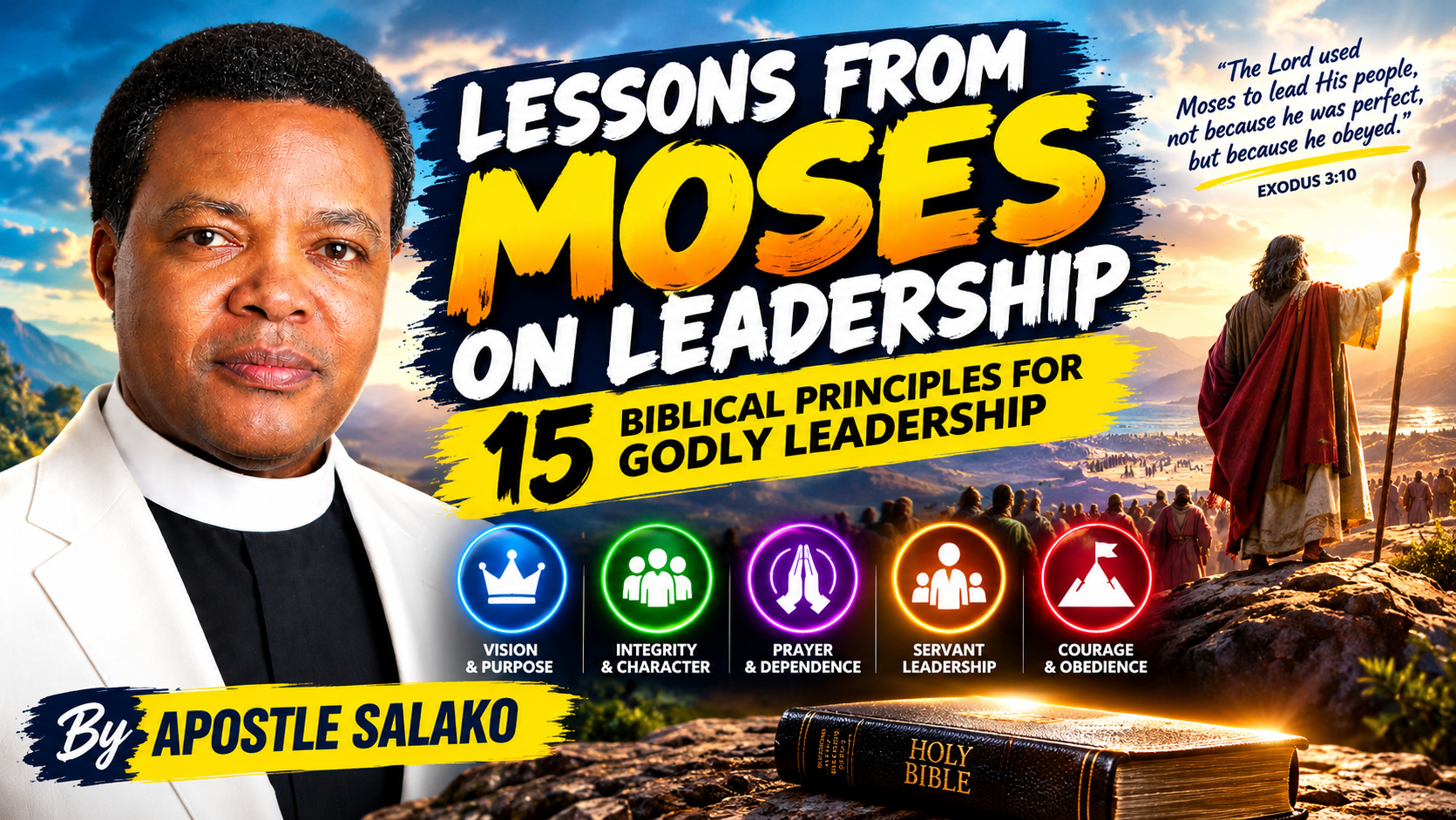
Lessons from Moses on Leadership: 15 Biblical Principles for Godly Leadership
Discover powerful lessons from Moses on leadership, including humility, courage, prayer, delegation, obedience, perseverance, mentoring, accountability, and finishing well.

Biblical Leadership Principles Every Christian Should Know | Complete Christian Leadership Guide
Discover biblical leadership principles every Christian should know — servant leadership, integrity, wisdom, humility, vision, stewardship, and lessons from Jesus and great leaders of the Bible.