
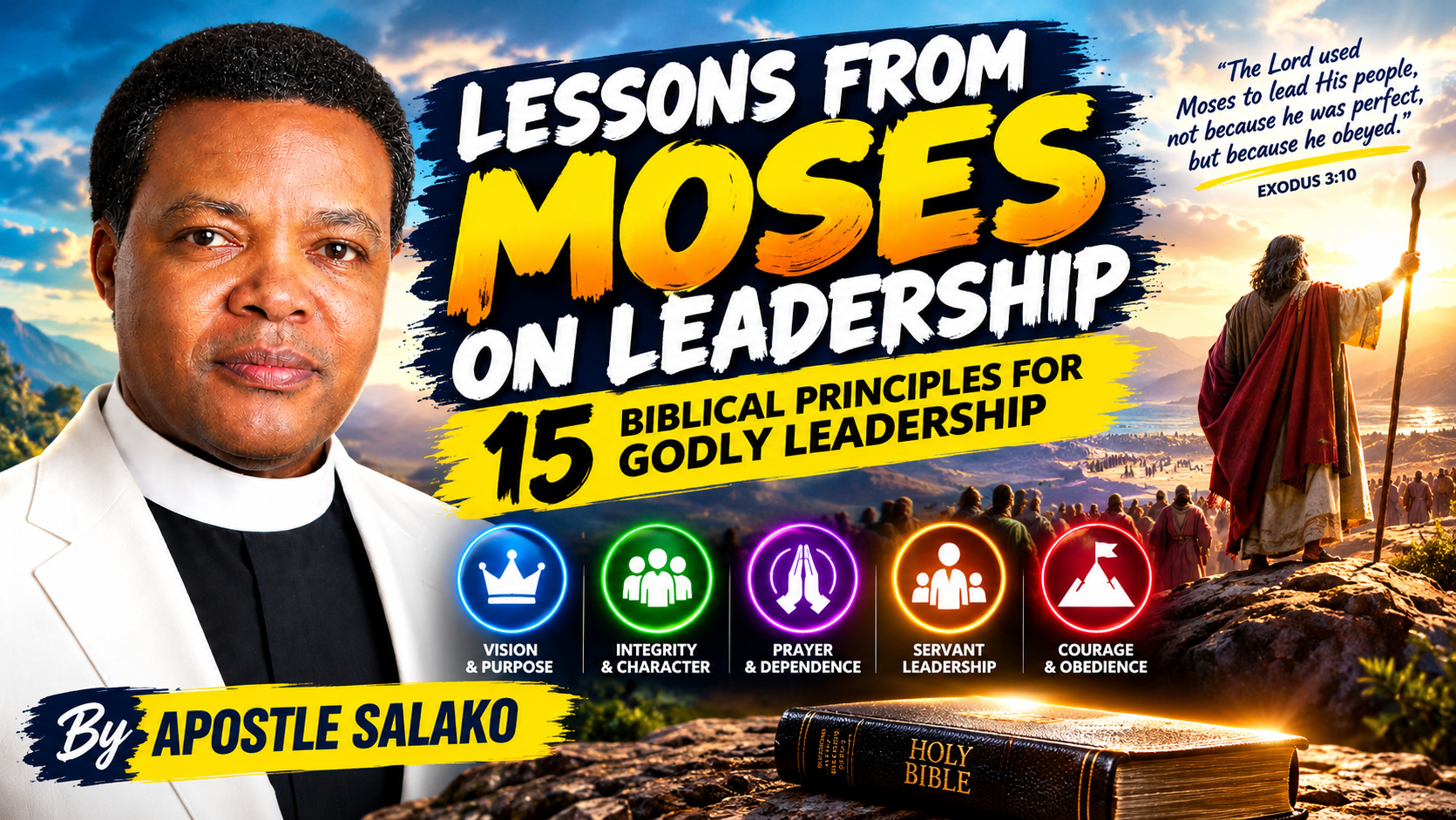
Introduction: Why Moses Still Matters as a Leadership Example
Leadership is one of the most discussed subjects in the modern world.
Businesses study leadership. Governments depend upon leadership. Churches require leadership. Families need leadership. Schools, ministries, organizations, communities, and institutions all depend upon people who can accept responsibility, make wise decisions, influence others, solve problems, and remain faithful to a mission.
Yet leadership is not merely about occupying a position.
A person can have a title without having character. Someone can possess authority without possessing wisdom. Someone can command people without knowing how to serve them. A person can build an organization while destroying the people within it.
The Bible presents a different understanding of leadership.
Biblical leadership begins with God, is shaped by character, expressed through service, strengthened through obedience, and measured by faithfulness.
One of the clearest examples is Moses.
Moses was called by God to lead the children of Israel out of Egyptian bondage and toward the Promised Land. His assignment was enormous. He had to confront Pharaoh, communicate God's message, organize a nation, handle disputes, teach God's commandments, respond to rebellion, intercede for the people, make difficult decisions, and prepare the next generation.
The biblical account of Moses' leadership spans the books of Exodus, Leviticus, Numbers, and Deuteronomy. His story therefore provides an extensive picture of leadership—not merely the victories, but also the pressures, mistakes, frustrations, responsibilities, and consequences that accompany leadership.
Moses was not presented as a flawless human being.
He hesitated when God called him.
He struggled with his ability to speak.
He became frustrated with the people.
He sometimes carried more responsibility than one person should carry.
He needed counsel from Jethro.
He experienced opposition.
He faced rebellion.
And eventually, his own disobedience at Meribah became part of the reason he did not personally lead Israel into Canaan.
This makes his story especially valuable.
The lessons from Moses on leadership are not simply lessons about how to become powerful. They are lessons about how to become faithful.
A leader may have influence and still fail morally. A leader may experience great victories and still need correction. A leader may accomplish extraordinary things and still need to recognize that the mission ultimately belongs to God.
Moses teaches us that leadership is a stewardship.
The central question is not: “How many people follow me?”
It is: “Am I faithfully leading the people God has entrusted to me?”
That question is relevant to pastors, ministers, business owners, parents, teachers, community leaders, mentors, entrepreneurs, and anyone entrusted with responsibility.
In this article, we will examine fifteen major lessons from Moses on leadership and consider how those principles can be applied to Christian leadership today.
Understanding Moses' Leadership Journey
Before examining individual leadership principles, it is important to understand the development of Moses.
Moses' leadership did not appear suddenly.
There was a process.
Moses was born during a dangerous period in Israel's history. Pharaoh had ordered the killing of Hebrew male children, but Moses was preserved and eventually raised in Pharaoh's household (Exodus 1–2).
His early environment exposed him to Egyptian culture and leadership structures.
However, his identity as a Hebrew remained important.
When Moses saw an Egyptian beating a Hebrew, he intervened violently and killed the Egyptian. The incident forced him to flee Egypt.
He eventually settled in Midian, where he became a shepherd.
This period is significant.
Moses moved from a royal environment to the wilderness.
He moved from prominence to obscurity.
He went from being associated with Pharaoh's household to tending sheep.
But the wilderness became part of God's preparation.
When God eventually appeared to Moses through the burning bush, Moses was no longer the confident young man who had attempted to solve Israel's problem through his own strength.
He had been humbled by experience.
God then called him to return to Egypt.
Exodus 3:10 records God's command:
“Come now therefore, and I will send thee unto Pharaoh, that thou mayest bring forth my people the children of Israel out of Egypt.” — Exodus 3:10, KJV
Moses immediately recognized the magnitude of the assignment.
His response revealed insecurity:
“Who am I, that I should go unto Pharaoh, and that I should bring forth the children of Israel out of Egypt?” — Exodus 3:11, KJV
This question introduces one of the great themes of biblical leadership:
God often calls people who recognize that the assignment is bigger than their natural ability.
Moses' story demonstrates that divine calling does not eliminate human weakness. Instead, God's calling requires the leader to learn dependence upon God.
Lesson 1: Leadership Begins with a Divine Calling
One of the first lessons from Moses on leadership is that genuine spiritual leadership begins with calling.
Moses did not simply decide one morning that he wanted to become the deliverer of Israel.
God called him.
The distinction matters.
There is a difference between ambition and assignment.
Ambition asks: “What position can I obtain?”
Calling asks: “What has God entrusted to me?”
Moses' assignment was bigger than his personal ambitions.
He was sent to Pharaoh.
He was sent to Israel.
He was sent to participate in God's redemptive purpose for His people.
Calling gives leadership direction.
Without a clear sense of mission, leadership can become personality-driven.
A leader may begin measuring success by popularity, money, recognition, numbers, titles, or public approval.
But when leadership is rooted in calling, the leader can remain focused on the assignment.
Moses had to remember that he was not creating his own mission.
He was carrying God's message.
Calling does not mean the absence of fear.
Moses was afraid.
He questioned himself.
He questioned his communication ability.
He even asked God to send someone else.
Exodus 4:10 says:
“O my Lord, I am not eloquent...”
God did not respond by pretending Moses had no weakness.
Instead, God promised His presence and provision.
This is important for emerging leaders.
You do not need to believe that you are naturally sufficient before you can obey God.
You need to trust that the God who calls also equips.
If God has entrusted you with leadership, identify the assignment. Ask: What exactly am I called to accomplish? Who am I called to serve? What biblical values must govern my leadership? What responsibilities has God actually given me? What responsibilities have I assumed that God never assigned? Clear calling protects leaders from unnecessary distraction.
Lesson 2: Great Leaders Must Learn Dependence on God
Moses' leadership demonstrates that spiritual leadership cannot be sustained by human ability alone.
The Exodus was impossible without God.
Pharaoh was more powerful than Moses.
Egypt was stronger than Israel.
The wilderness was hostile.
The people were often difficult.
Yet God repeatedly demonstrated His power.
Moses had to learn that the leader is not the source of the miracle.
God is.
This principle is especially important in Christian ministry.
A preacher may have communication skills. A pastor may have administrative ability. A ministry leader may have technology, finances, staff, and experience. But none of these things can replace dependence upon God.
Moses needed God's presence.
One of the most remarkable moments occurs in Exodus 33.
After Israel's sin with the golden calf, Moses understood that the journey ahead required God's presence.
He declared:
“If thy presence go not with me, carry us not up hence.” — Exodus 33:15, KJV
This is a profound leadership principle.
Moses would rather remain in the wilderness with God's presence than enter the Promised Land without it.
Leadership should not become self-sufficient.
Success can create a dangerous temptation.
A leader may begin with prayer and end with strategy.
The leader may begin with dependence and eventually operate entirely through experience.
Experience is useful, but experience must never replace God.
A mature Christian leader can use strategy while remaining dependent upon divine direction.
Before major decisions, pray. Before important meetings, pray. Before appointing leaders, pray. Before launching a ministry, pray. Before correcting people, pray. Before responding to criticism, pray. The goal is not to become passive. The goal is to make prayer part of the decision-making process.
Lesson 3: Leadership Requires Courage
Moses had to confront Pharaoh.
That required extraordinary courage.
Pharaoh possessed political power, military resources, economic authority, and social influence. Moses arrived with a message that challenged the established order:
“Thus saith the LORD God of Israel, Let my people go...” — Exodus 5:1, KJV
Leadership frequently requires difficult conversations.
Sometimes a leader must tell the truth when the truth is unpopular. Sometimes a pastor must correct behavior. Sometimes a parent must establish boundaries. Sometimes a business leader must make an unpopular decision. Sometimes a ministry leader must protect biblical standards even when doing so creates resistance.
Courage does not mean aggression.
Biblical courage is the ability to obey what is right despite fear.
Courage is strengthened by perspective.
Hebrews 11:27 describes Moses as enduring because he saw the One who is invisible.
His courage was connected to faith.
This teaches us that Christian leadership is not built on personality alone.
Faith changes how leaders interpret circumstances.
A problem may be large, but God remains greater.
Courage and wisdom must work together.
Courage without wisdom can become recklessness.
Moses did not simply act impulsively after receiving God's call. He followed God's instructions concerning Pharaoh, Israel, the Passover, the wilderness journey, and the nation's organization.
Effective leadership therefore combines conviction, wisdom, and obedience.
Lesson 4: Humility Is a Foundation of Godly Leadership
Numbers 12:3 contains a remarkable description:
“Now the man Moses was very meek, above all the men which were upon the face of the earth.”
The word “meek” in this context should not be confused with weakness.
Moses possessed tremendous authority.
He confronted Pharaoh. He led Israel. He received God's commandments. He judged disputes. He dealt with rebellion.
Yet Scripture describes him as remarkably humble.
This presents a paradox: the strongest leaders are not necessarily those who constantly demonstrate their strength.
Humility allows leaders to learn.
A proud leader believes: “I already know everything.” A humble leader can say: “I need counsel.”
Moses demonstrated this when he accepted Jethro's advice.
Humility allows leaders to share credit.
A leader who needs all recognition will struggle to develop other people. Healthy leaders celebrate the contributions of others.
Humility protects against entitlement.
Leadership can create privileges. People may respect you, praise you, and depend upon you. If the leader is not careful, service can become entitlement.
Moses' story reminds us that leadership authority remains under God's authority.
Humility is not self-contempt.
Biblical humility does not mean believing you have no value. It means recognizing that your gifts, opportunities, authority, and achievements are ultimately accountable to God.
Lesson 5: A Leader Must Listen to Wise Counsel
One of the clearest leadership lessons in Exodus 18 comes from Jethro.
Moses was attempting to judge the people from morning until evening.
Jethro observed the situation and told him:
“The thing that thou doest is not good.” — Exodus 18:17, KJV
This was a strong statement.
Jethro then explained that Moses and the people would wear themselves out.
Moses listened.
That is leadership maturity.
Leaders need people who can tell them the truth.
If everyone around a leader only says: “Yes, sir. You are always right. Everything is perfect,” the leader becomes vulnerable.
Wise leaders deliberately maintain relationships with people who can provide honest, constructive counsel.
Counsel does not remove authority.
Listening does not mean surrendering leadership. Moses remained the leader. But he became a better leader because he received wise advice.
Jethro's counsel was practical.
He recommended selecting capable people who feared God, were trustworthy, and rejected dishonest gain. He also proposed a structure in which responsibility was distributed among leaders over groups of people.
This is a significant leadership principle: spiritual leadership still requires organizational wisdom. Prayer does not eliminate planning. Faith does not eliminate structure. Calling does not eliminate administration.
Questions leaders should ask: Who can correct me? Who can challenge my assumptions? Who has permission to tell me uncomfortable truths? Do I listen only to people who agree with me? Do I have mature mentors?
A leader without honest counsel can become isolated.
Lesson 6: Learn to Delegate Responsibility
Moses initially carried too much of the nation's workload.
Jethro recognized the danger.
Exodus 18 describes how Moses eventually appointed capable leaders to share the judicial burden.
This is one of the most practical lessons from Moses on leadership.
You cannot build something sustainable by doing everything yourself.
Delegation is not laziness.
Delegation is stewardship.
A leader who refuses to delegate may believe: “No one can do it as well as I can.” That mindset can become destructive.
If everything depends on one person, the organization becomes fragile.
Delegation creates capacity.
When Moses delegated appropriate responsibilities, decisions could be handled more efficiently, people could receive attention, Moses could focus on higher-level responsibilities, other leaders could develop experience, and the community could function more effectively.
Delegate according to character and capacity.
Not everyone should receive the same responsibility. Exodus 18 emphasizes qualities such as competence, reverence for God, trustworthiness, and integrity.
This is crucial. Do not promote people simply because they are popular. Do not give responsibility merely because someone is talented. Character matters.
Ask: “What am I doing that someone else can be trained to do?” Then train them.
Lesson 7: Leaders Must Develop Other Leaders
Moses did not merely lead Israel.
He helped develop future leadership.
Joshua became a major example.
Joshua appeared in the story during the battle with Amalek in Exodus 17. Moses entrusted the battlefield leadership to Joshua while Moses, Aaron, and Hur served in their respective roles. The account illustrates that different people can contribute different forms of leadership toward one mission.
Later, Moses publicly strengthened Joshua before the people.
Deuteronomy 31:7 records Moses saying:
“Be strong and of a good courage...”
Moses understood that the future of Israel required leadership beyond himself.
A leader's legacy is measured partly by what happens after them.
If everything collapses when the leader leaves, the leader may have built dependence rather than development.
Healthy leadership reproduces leadership.
A pastor should raise pastors. A mentor should develop mentors. A business owner should develop capable managers. A ministry leader should create opportunities for emerging leaders. Parents should teach children responsibility.
Give people real responsibility.
Leadership development requires more than teaching. People need opportunities to practice. Give them appropriate assignments. Allow them to make decisions. Review their performance. Correct mistakes. Encourage growth. Then increase responsibility gradually.
A useful principle is: do not merely build followers. Build people who can faithfully lead others.
Lesson 8: Prayer and Intercession Are Essential to Leadership
Moses was not merely an administrator.
He was an intercessor.
Again and again, when Israel sinned, Moses stood before God on behalf of the people.
Exodus 32 provides a powerful example. After Israel worshipped the golden calf, Moses interceded for them.
In Numbers 14, Moses again appealed to God's mercy after Israel's rebellion.
This demonstrates an important dimension of spiritual leadership: a shepherd carries people in prayer.
Leadership involves standing in the gap.
A spiritual leader cannot merely criticize people when they fail. A leader must also pray for them.
There will be moments when people disappoint you. They may make poor decisions, complain, misunderstand your intentions, or even oppose you.
Prayer prevents leadership from becoming merely reactive.
Intercession changes the leader too.
When you pray for people, your heart can be transformed. You begin to see their weaknesses alongside your own. You become slower to condemn and more willing to help.
Private prayer supports public leadership.
Moses repeatedly encountered God. The tent of meeting became a place of communion and direction.
For Christian leaders, public ministry must never replace private fellowship with God.
A microphone cannot substitute for prayer. A platform cannot substitute for character. A large congregation cannot substitute for intimacy with God.
Lesson 9: Leaders Must Know How to Handle Opposition
Moses experienced enormous opposition.
Pharaoh opposed him. Israel complained. Korah and others challenged his leadership in Numbers 16. Miriam and Aaron also challenged him in Numbers 12.
This teaches us something important: leadership does not eliminate opposition. Sometimes leadership actually attracts it.
Not every criticism requires a defensive response.
Moses did not respond to every challenge with personal revenge. Numbers 12 is particularly instructive. When Miriam and Aaron spoke against Moses, Scripture emphasizes his humility.
There are moments when leaders need to answer criticism. There are also moments when leaders need to remain calm and allow God to vindicate what He has established.
Distinguish criticism from rebellion.
Not every person who disagrees with you is rebellious. Some disagreement can improve leadership.
Healthy leaders should ask: Is this criticism biblical? Is there truth in it? Is there a legitimate concern? Is the person seeking correction or division? What response would honor God?
This prevents leaders from treating every disagreement as an attack.
Do not allow opposition to redefine the mission.
Moses had to continue leading even when the people complained. Opposition can become a distraction if the leader spends all of his energy responding to every voice.
Stay focused on the assignment.
Lesson 10: A Leader Must Teach and Communicate Clearly
Moses was not only a deliverer.
He was a teacher.
Jethro advised Moses to teach the people God's statutes and laws (Exodus 18:20).
Later, Moses delivered extensive instruction in Deuteronomy.
This demonstrates that leadership is not merely about making decisions. Leadership includes transferring understanding.
People cannot follow what they do not understand.
A leader should communicate the vision, the values, the expectations, the standards, the responsibilities, and the reasons behind important decisions.
Christian leaders have a particular responsibility.
Church leadership must be grounded in Scripture. The leader's responsibility is not to create personal doctrine and demand that people follow it. The leader must faithfully teach the Word of God.
Moses received God's commandments and communicated them to Israel.
Repeat important principles.
People forget. Leaders should not assume that communicating something once is enough. Important values should be repeated. Vision should be repeated. Standards should be repeated. Biblical truth should be taught consistently.
Communication should be understandable.
A leader may possess deep knowledge but communicate poorly. The goal is not to impress people with complexity. The goal is to help people understand truth and apply it.
Good biblical leadership therefore combines truth and clarity.
Lesson 11: Leaders Must Remain Obedient to God
Moses' life demonstrates both the blessing of obedience and the seriousness of disobedience.
One of the most sobering moments occurs in Numbers 20.
The people complained because they had no water.
God instructed Moses concerning the rock.
However, Moses acted differently from God's instruction and struck the rock.
God then told Moses and Aaron:
“Because ye believed me not, to sanctify me in the eyes of the children of Israel...” — Numbers 20:12, KJV
Moses' position did not exempt him from accountability.
That is an extremely important leadership principle.
Spiritual authority does not cancel accountability.
A pastor is accountable to God. A bishop is accountable to God. A ministry founder is accountable to God. A business leader is accountable for how authority is exercised. A parent is accountable for stewardship.
Position does not place anyone above God's standards.
Great leaders can still make serious mistakes.
Moses had experienced extraordinary encounters with God. Yet he made a serious error. This should humble every leader.
Past success is not permission for present disobedience.
Never assume that previous victories guarantee future success.
A leader can preach powerfully yesterday and still need God's grace today. A leader can make wise decisions for years and make a foolish decision tomorrow.
Therefore: remain watchful, remain teachable, remain prayerful, remain obedient.
Lesson 12: Do Not Allow People's Complaints to Destroy Your Vision
Leadership can be emotionally exhausting.
Israel complained repeatedly.
They complained about water. They complained about food. They complained about the wilderness. They complained about Moses.
At various points, Moses became deeply frustrated.
This teaches leaders something realistic: people's responses can affect leaders emotionally.
The question is how the leader responds.
Leadership requires emotional discipline.
A leader cannot allow every complaint to dictate strategy. Neither should a leader ignore legitimate concerns.
The mature response is discernment. Ask: Is this complaint revealing a real problem or merely resistance to necessary change?
Leaders need healthy ways to process pressure.
Moses repeatedly brought his burdens to God. That is a pattern worth following.
Instead of carrying frustration indefinitely, bring it to God. Seek wise counsel. Rest when necessary. Share appropriate responsibility. Avoid making major decisions while emotionally overwhelmed.
Do not lead from wounded pride.
A leader who feels personally attacked may make decisions to defend reputation rather than fulfill mission.
The mission must remain more important than personal ego.
Lesson 13: Leaders Need Godly Companions
Moses had people around him.
Aaron played an important role. Joshua became a close assistant. Hur supported Moses during the battle with Amalek. Jethro provided counsel.
The leadership story of Moses demonstrates that no significant assignment should be approached as though one person can do everything alone.
Aaron complemented Moses.
Moses struggled with communication and initially expressed concern about his speech. Aaron became an important spokesperson.
This illustrates a powerful principle: your weakness may reveal the kind of partnership you need. You do not have to pretend to possess every gift.
Hur helped Moses endure.
During the battle against Amalek, Moses became physically tired. Aaron and Hur supported his hands.
The principle extends beyond the literal event. Leaders become tired. Leaders need people who can support them.
Build a trustworthy inner circle.
A leader should have people who can pray with them, challenge them, encourage them, provide expertise, carry responsibility, and help during difficult seasons.
Leadership isolation can become dangerous. Community strengthens leadership.
Lesson 14: Leadership Requires Patience and Perseverance
Moses' assignment was not completed in a few days.
Israel's journey through the wilderness lasted decades.
That required perseverance.
Leadership is often measured not by how enthusiastically someone starts, but by how faithfully they continue.
Long-term leadership is difficult.
There will be seasons when progress is slow, people disappoint you, resources appear inadequate, criticism increases, results are not immediate, and the original vision seems distant.
This is where perseverance becomes essential.
Do not confuse delay with failure.
Israel spent years in the wilderness. Not every delay means that God has abandoned the mission. Sometimes God uses seasons of waiting to develop people.
Leaders must keep perspective.
Moses had to think beyond individual moments. A difficult day was not the entire story. A difficult month was not the entire story. A difficult season was not the entire story.
Leaders must maintain a long-term perspective.
Faithfulness matters.
Christian leadership is not only about visible achievement. Faithfulness matters.
Paul later wrote:
“Moreover it is required in stewards, that a man be found faithful.” — 1 Corinthians 4:2, KJV
Leadership is stewardship. Stewards are evaluated by faithfulness.
Lesson 15: Leaders Must Prepare Their Successors
One of Moses' greatest leadership responsibilities was preparing Joshua.
Moses knew that he would not continue forever.
That reality should challenge every leader.
No leader is permanent.
Every leader eventually leaves. A ministry leader may retire. A business founder may step aside. A pastor may transition. A parent eventually releases children into adulthood. A mentor eventually sees the mentee become independent.
Therefore, succession should not be treated as an emergency. It should be treated as leadership development.
Moses prepared Joshua publicly.
Deuteronomy 31 records Moses encouraging Joshua before Israel. He did not attempt to make Joshua dependent upon himself. He strengthened him for the future.
This is mature leadership.
Do not fear the success of younger leaders.
Insecure leaders may fear being replaced. Secure leaders prepare successors.
The goal is not: “Everyone must remain under me.” The goal is: “The work of God must continue.”
Build a leadership pipeline.
A practical model can include: Identify, Teach, Train, Assign, Review, Correct, Release, Mentor. This creates continuity.
The Warning from Moses' Leadership Failure
It would be easy to write an article about Moses and focus only on his achievements.
But that would miss one of the most important lessons.
Moses failed at Meribah.
Numbers 20:10–12 records the incident.
The consequence was significant. Moses would see the Promised Land but would not personally lead Israel into it.
This should produce humility in every leader.
Leadership success does not make disobedience insignificant.
Moses had experienced the burning bush, the plagues, the Passover, the Red Sea, manna, God's provision, divine revelation, and extraordinary encounters with God.
Yet he still had to obey.
The lesson is clear: previous faithfulness does not excuse present disobedience.
Leaders must guard their reactions under pressure.
Moses had been pushed by years of complaints. The incident at Meribah reminds us that pressure can expose areas requiring continued spiritual discipline.
Therefore, leaders must learn to manage frustration.
Never let people provoke you into violating your values.
Other people's behavior does not remove your responsibility before God. You are responsible for your response.
That principle applies to ministry, family, business, and organizational leadership.
What Christian Leaders Today Can Learn from Moses
The lessons from Moses on leadership are highly relevant to contemporary Christian leadership.
For pastors.
Pastors can learn to combine spiritual depth with organizational wisdom. Preaching matters. Prayer matters. Counseling matters. But pastors also need teams, systems, delegation, training, communication, accountability, and succession planning.
For ministry leaders.
Do not attempt to personally perform every ministry function. Identify people with character and gifts. Train them. Trust them. Monitor them. Release responsibility appropriately.
For Christian entrepreneurs.
Moses demonstrates that leadership involves stewardship. Your business should not merely ask: “How much can I make?” A Christian entrepreneur should also ask whether the business operates ethically, whether people are treated with dignity, whether financial practices are honest, whether leadership reflects biblical values, and whether something sustainable is being built.
For parents.
Parents exercise leadership every day. Children learn not only from what parents say but from what parents model. Parents can teach responsibility, integrity, prayer, discipline, service, courage, respect, and perseverance.
For mentors.
Moses' relationship with Joshua provides a valuable model of leadership development. Do not simply tell younger people what to do. Let them observe. Let them participate. Give them responsibility. Correct them. Encourage them. Prepare them.
For young leaders.
Do not rush the preparation process. Moses spent years in the wilderness before his major public assignment. Preparation may feel invisible. But hidden seasons can develop character.
A Practical Leadership Framework from the Life of Moses
The life of Moses can be summarized into a practical framework.
1. Receive. Receive the assignment from God. Ask: What is God asking me to do?
2. Prepare. Develop character, knowledge, skills, and spiritual maturity.
3. Depend. Recognize that God's strength is greater than your natural ability.
4. Communicate. Explain the vision and teach people what they need to know.
5. Delegate. Do not carry responsibilities that can appropriately be shared.
6. Develop. Train emerging leaders.
7. Intercede. Pray for the people entrusted to you.
8. Endure. Remain faithful through difficult seasons.
9. Obey. Never allow success to make you careless about God's instructions.
10. Transition. Prepare others to continue the mission.
This framework can be applied to ministry, business, family, education, and community leadership.
Questions for Personal Leadership Reflection
If you are currently leading people, take time to answer these questions honestly.
1. What is my assignment? Can I clearly explain what I am responsible for?
2. Am I leading from calling or ambition? Is my leadership primarily about serving a mission or gaining recognition?
3. Do I depend on God? What place does prayer have in my decision-making?
4. Who can correct me? Do I have people who can speak honestly into my leadership?
5. Am I carrying too much? What responsibilities should I delegate?
6. Who am I developing? Can I name people who are becoming stronger because of my leadership?
7. How do I respond to criticism? Do I become defensive immediately, or do I carefully examine whether there is truth in the criticism?
8. How do I behave under pressure? Does pressure reveal patience or anger?
9. Am I communicating clearly? Do the people I lead understand the vision and expectations?
10. Am I obeying God? Are there areas where I know what God requires but have become careless?
11. Am I preparing successors? If I were suddenly unavailable, could the work continue?
12. What will my leadership leave behind? When people remember my leadership, what values will they associate with it?
These questions can become part of a monthly or quarterly leadership review.
Conclusion: Lead Faithfully Until the End
The life of Moses provides one of the richest biblical studies of leadership.
He was called when he felt inadequate.
He was prepared through hidden seasons.
He confronted powerful opposition.
He depended upon God.
He listened to wise counsel.
He learned to delegate.
He developed other leaders.
He interceded for difficult people.
He taught God's Word.
He endured years of pressure.
He made mistakes.
He experienced consequences.
And he eventually prepared Joshua to continue the journey.
The greatest lesson from Moses is not simply how to become an influential leader. It is how to remain faithful while carrying responsibility.
Biblical leadership is not primarily about control. It is about stewardship.
It is not about making people dependent upon you. It is about helping people become equipped to fulfill their God-given responsibilities.
It is not about personal glory. It is about God's purposes.
Moses' life reminds us that leaders need God, wise counsel, trustworthy companions, capable teams, prayer, humility, courage, obedience, patience, and a commitment to develop others.
The leader who understands these principles will approach leadership differently.
Instead of asking: “How can I become important?” the better question is: “How can I faithfully serve God and the people He has entrusted to me?”
That is the heart of biblical leadership.
And perhaps the most important lesson is this: do not measure your leadership only by what you accomplish. Measure it also by who you become, whom you serve, whom you develop, and whether you remain faithful to God.
Moses' story shows that leadership is a journey.
There are victories. There are disappointments. There are seasons of preparation. There are moments of pressure. There are times when you need to listen, to delegate, to stand courageously, to pray, and to prepare someone else to carry the work forward.
May every Christian leader learn to lead with humility, serve with integrity, pray with persistence, teach with clarity, delegate with wisdom, develop people intentionally, and obey God faithfully.
Leadership is a trust. Handle it with reverence.
About the Author
Apostle Salako Adedamola is a Christian preacher, teacher, and mentor passionate about biblical teaching, Christian leadership, mentorship, stewardship, and practical discipleship. This article is part of a Christian leadership and biblical teaching resource designed to help believers understand Scripture and apply biblical principles to everyday Christian life.
Apostle Adedamola Salako
Apostle Salako Adedamola is a Christian preacher, teacher, mentor, and writer passionate about biblical teaching, Christian living, leadership development, mentorship, stewardship, faith, prayer, and practical discipleship. Through biblical teaching and practical instruction, he seeks to help believers grow in their relationship with God and apply biblical principles to everyday life.
Frequently Asked Questions
QWhat are the main lessons from Moses on leadership?
Major lessons include dependence on God, courage, humility, wise counsel, delegation, leadership development, prayer, perseverance, communication, obedience, accountability, and succession planning.
QWhat made Moses an effective biblical leader?
Moses demonstrated dependence upon God, courage in confronting Pharaoh, humility, intercession, willingness to receive counsel, and commitment to God's purposes. His leadership also included significant mistakes, making his life a useful study of both leadership strengths and weaknesses.
QWhat can Christian leaders learn from Moses?
Christian leaders can learn to prioritize God's presence, develop other leaders, listen to wise counsel, delegate responsibility, remain accountable, handle opposition wisely, communicate Scripture clearly, and prepare successors.
QWhy did Moses need Jethro's advice?
Moses was handling the people's disputes largely by himself, creating an unsustainable workload. Jethro advised him to establish a structure of shared responsibility by appointing qualified leaders. Exodus 18 presents delegation as a way to distribute the burden while maintaining appropriate oversight.
QWhat does Moses teach about humility?
Numbers 12:3 explicitly describes Moses as very meek. His willingness to receive Jethro's counsel also demonstrates that humility enables leaders to recognize their limitations and learn from others.
QWhat does Moses teach about delegation?
Moses demonstrates that leaders should not attempt to perform every responsibility personally. Capable and trustworthy people should be given appropriate authority and responsibility.
QWhat does Moses teach about mentoring?
Moses' relationship with Joshua demonstrates the importance of developing future leaders. Leaders should intentionally train, encourage, entrust, and prepare others for greater responsibility.
QWhat was Moses' greatest leadership mistake?
One of Moses' most significant failures occurred at Meribah when he did not follow God's instruction concerning the rock. Numbers 20 records that the incident had serious consequences for Moses' entry into the Promised Land.
QWhy is Moses important for Christian leadership today?
Moses provides a biblical case study in calling, preparation, courage, humility, organizational leadership, prayer, conflict, accountability, failure, perseverance, and succession. These principles remain useful for understanding leadership in ministry and other areas of responsibility.
QHow did Moses prepare his successor?
Moses publicly encouraged and strengthened Joshua before Israel (Deuteronomy 31), giving him responsibility, modeling dependence on God, and releasing him to continue the mission rather than making him dependent on Moses himself.
Enjoyed this article?
Get the next one straight to your inbox. One thoughtful email a week.
Comments (0)
Comments are stored locally in your browser. For published responses, email us via the Contact page.
You may also like

How God Develops Great Leaders: 12 Biblical Principles for Christian Leadership
Discover how God develops great leaders through character, preparation, obedience, trials, humility, wisdom, service, discipline, mentorship, and spiritual maturity.

Lessons from Nehemiah on Vision and Leadership: Biblical Principles for Godly Leaders
Discover powerful lessons from Nehemiah on vision and leadership. Learn how prayer, courage, planning, integrity, delegation, perseverance, and godly vision can transform Christian leadership.

How to Raise Future Christian Leaders: A Biblical Guide to Discipleship, Character, Mentorship and Leadership Development
Raising future Christian leaders begins long before someone receives a title or stands on a platform. It begins with discipleship, biblical teaching, character formation, prayer, mentorship, service, responsibility, and a genuine relationship with Jesus Christ. This comprehensive guide explains practical and biblical ways parents, pastors, mentors, and churches can prepare the next generation to lead with wisdom, humility, integrity, and faith.