
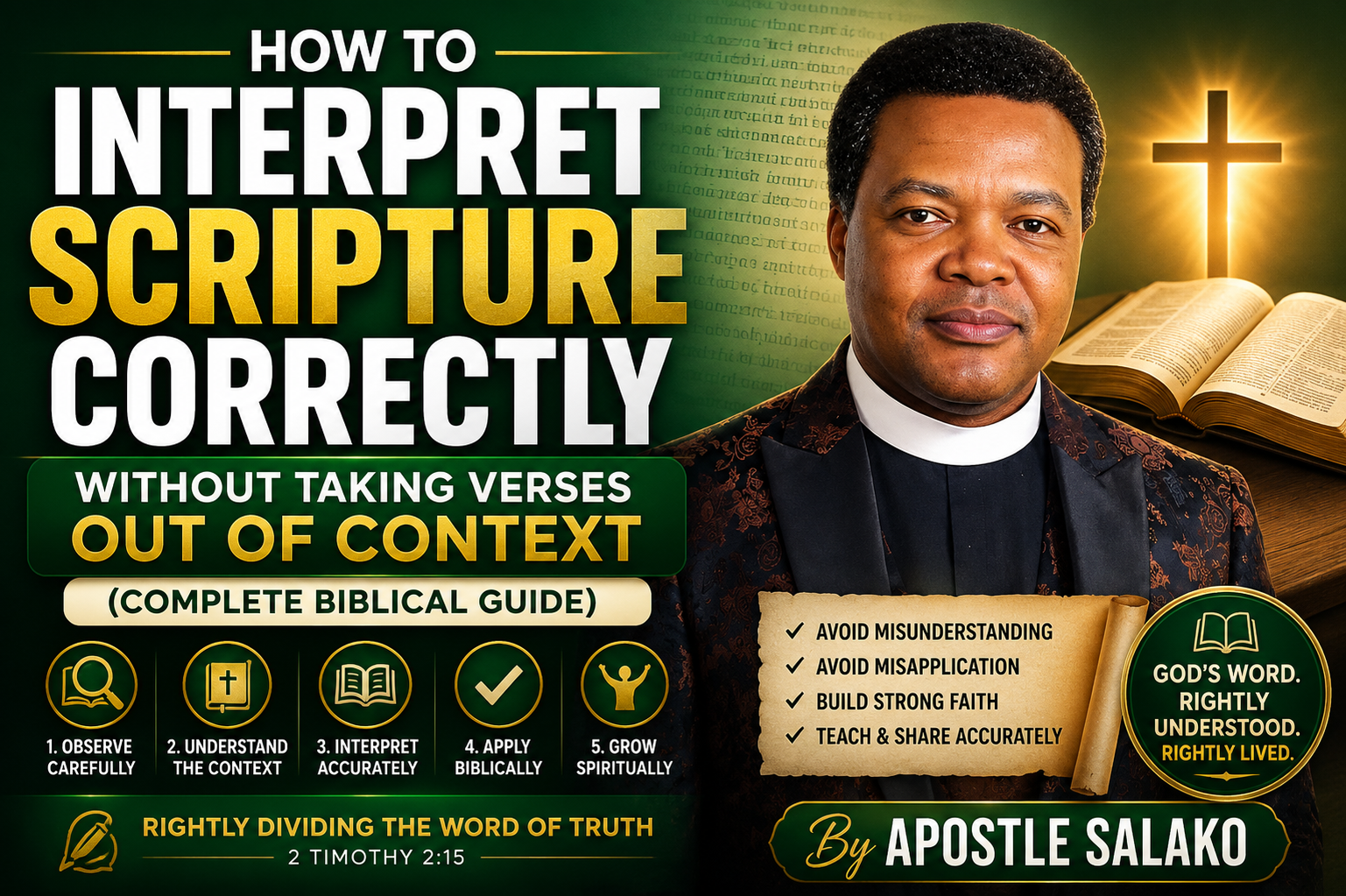
Introduction
One of the greatest blessings God has given His people is the written Word of God. Through the Scriptures, He reveals His character, His will, His plan of salvation, and His purposes for humanity. Yet having access to the Bible is not enough. Christians must also learn to interpret it faithfully.
The Apostle Paul instructed Timothy:
"Study to shew thyself approved unto God, a workman that needeth not to be ashamed, rightly dividing the word of truth." — 2 Timothy 2:15 (KJV)
The phrase "rightly dividing the word of truth" reminds us that there is both a right way and a wrong way to handle Scripture. Throughout history, false teachings have often arisen not because people rejected the Bible outright, but because they misunderstood, misapplied, or isolated verses from their intended context.
In today's digital age, Bible verses are frequently shared on social media, printed on greeting cards, quoted in sermons, and displayed on posters. While this can encourage believers, it also carries a risk. A verse removed from its literary, historical, or theological context may communicate something very different from what God originally intended.
This article will help you develop sound habits of biblical interpretation. You will learn what context means, why it matters, how to avoid common interpretive errors, and how to handle God's Word with reverence and accuracy. Whether you are a new believer, a Bible study leader, or a seasoned minister, these principles will strengthen your understanding of Scripture and deepen your confidence in God's truth.
Why Biblical Interpretation Matters
Every believer interprets the Bible in some way. The question is not whether we interpret Scripture, but how we interpret it.
Sound interpretation matters because it affects our understanding of God, our doctrine, our Christian conduct, our worship, our witness, our decisions, and our ability to teach others faithfully.
When Scripture is interpreted correctly, it leads to truth, spiritual growth, and obedience. When it is misinterpreted, it can result in confusion, legalism, false assurance, or even destructive teaching.
Peter warned that some people distort the Scriptures:
"As also in all his epistles... in which are some things hard to be understood, which they that are unlearned and unstable wrest... unto their own destruction." — 2 Peter 3:16 (KJV)
This sober warning reminds us that mishandling God's Word has serious consequences.
What Does "Context" Mean in the Bible?
The word context refers to everything surrounding a particular passage that helps determine its meaning. A text without its context can easily be misunderstood. Just as a sentence in a conversation can be misunderstood if you hear only one phrase, a Bible verse can be misunderstood if it is separated from the larger message of Scripture.
1. Immediate Context — includes the verses directly before and after the passage you are studying. Words like "therefore," "for," "because," or "but" connect the author's flow of thought and must not be ignored.
2. Chapter Context — each chapter develops the author's argument or narrative. Read the whole chapter before focusing on a single verse.
3. Book Context — every book has a unique author, audience, historical setting, and purpose. John emphasizes that Jesus is the Son of God (John 20:30–31); James emphasizes practical Christian living; Romans presents a systematic explanation of the Gospel.
4. Historical Context — the Bible was written across centuries in specific cultural, political, and geographical settings. Ask who wrote it, to whom, under what circumstances, and what customs shaped the audience.
5. Literary Context — Scripture contains narrative, poetry, wisdom, prophecy, parables, Gospels, epistles, and apocalyptic literature. Each genre must be interpreted according to its characteristics.
6. Biblical Context — no verse stands alone. The Bible is a unified revelation. Scripture interprets Scripture; when a passage is difficult, compare it with clearer passages on the same subject.
Why People Misinterpret Scripture
Reading personal meaning into the text — asking "what does this mean to me?" before asking "what did the author intend?" Application must follow interpretation, not replace it.
Ignoring the original audience — the Bible was written to real people in real historical situations.
Isolating favorite verses — popular verses are often quoted without the surrounding context.
Depending on emotions rather than careful study — God's Word interprets our experiences, not the other way around.
Building doctrine on a single verse — major doctrines must be established by the consistent teaching of Scripture.
The Dangers of Taking Verses Out of Context
Misinterpretation produces false doctrine, misplaced expectations, spiritual discouragement, misrepresentation of God's character, and a weakened Christian witness. We must handle God's Word with humility, diligence, and reverence.
Seven Foundational Principles of Biblical Interpretation
Biblical interpretation, often called hermeneutics, is the discipline of discovering the meaning God intended through the human authors of Scripture. The goal is not to make the Bible say what we want, but to understand what God has already said.
Principle #1 — Pray for the Holy Spirit's Illumination
Bible study is both intellectual and spiritual. Spiritual understanding ultimately comes from God. Before opening the Scriptures, ask the Holy Spirit for wisdom, humility, and discernment.
"Open thou mine eyes, that I may behold wondrous things out of thy law." — Psalm 119:18 (KJV)
The Holy Spirit does not reveal new doctrines that contradict Scripture; He helps believers understand and apply truths already revealed. Illumination differs from inspiration: the biblical authors were inspired to write Scripture (2 Timothy 3:16); believers are illuminated to understand and obey it.
Principle #2 — Read the Passage in Its Context
A text without its context becomes a pretext. Never stop at a single verse. Philippians 4:13 ("I can do all things through Christ which strengtheneth me") is often used to promise personal achievement, but verses 10–19 show Paul is speaking about learning contentment in abundance and in need.
Every book has a central purpose. Ask who wrote it, why, to whom, and what themes recur — this prevents isolated interpretations.
Principle #3 — Interpret Scripture with Scripture
Because God is the ultimate Author, Scripture is internally consistent. Difficult passages should be interpreted in light of clearer ones. The Bereans modeled this:
"These were more noble than those in Thessalonica... and searched the scriptures daily, whether those things were so." — Acts 17:11 (KJV)
For example, when studying salvation, compare John 3:16; Romans 3:23–24; Romans 5:8; Ephesians 2:8–9; Titus 3:5; and 1 Peter 1:18–19. Together they present a fuller picture of salvation by grace through faith in Christ.
Principle #4 — Understand the Historical and Cultural Setting
God's Word is timeless, but revealed in real settings. Ask about political events, customs, religious practices, and geography. The parable of the Good Samaritan (Luke 10) gains full force when we understand the hostility between Jews and Samaritans. Paul's letters make more sense when we grasp the persecution, false teaching, and division facing early churches.
Bible dictionaries, atlases, historical introductions, trusted commentaries, and maps enrich our understanding without replacing Scripture's authority.
Principle #5 — Identify the Literary Genre
Historical narrative (Genesis, Joshua, 1 Samuel, Acts) records events. Poetry (Psalms, Proverbs, Song of Solomon) uses imagery and parallelism — "The LORD is my shepherd" (Psalm 23:1) is a metaphor of loving care, not a literal claim.
Prophecy (Isaiah, Jeremiah, Ezekiel) combines historical messages with future promises. Epistles (Romans, Ephesians, James) explain doctrine and practical living. Apocalyptic literature (Daniel, Revelation) uses symbolic language and visionary imagery.
Principle #6 — Discover the Author's Intended Meaning
Every biblical author wrote with a specific purpose under the Holy Spirit's inspiration. Follow the sequence Observation → Interpretation → Application. Ask what the passage actually says, what it meant to the original audience, and only then how it should shape your life today.
Principle #7 — Apply Scripture Faithfully
"But be ye doers of the word, and not hearers only, deceiving your own selves." — James 1:22 (KJV)
Ask: What should I believe? Confess? Trust? Obey? Follow? Avoid? A passage has one intended meaning but may have many faithful applications. Move from Meaning → Principle → Application.
Commonly Misused Bible Verses
Jeremiah 29:11 was written to Jewish exiles in Babylon promising restoration after seventy years — its timeless principle is God's faithfulness through seasons of discipline, not a guarantee of ease.
Philippians 4:13 speaks of Christ-given strength for contentment in every circumstance, not a guarantee of every personal ambition.
Matthew 7:1 ("Judge not") forbids hypocritical judgment, not all discernment. Jesus also said, "Judge not according to the appearance, but judge righteous judgment" (John 7:24).
Proverbs 29:18 ("Where there is no vision, the people perish") speaks of divine revelation — the second half explains: "but he that keepeth the law, happy is he."
3 John 2 is a personal pastoral greeting to Gaius, not a universal promise of wealth and health.
Romans 8:28 — the "good" is God's purpose of conforming believers to Christ's image (Romans 8:29), not immediate comfort.
Matthew 18:20 addresses church discipline and restoration, not a limitation of Christ's presence. Christ promises His continual presence to every believer (Matthew 28:20).
Revelation 3:20 is Christ's call to the lukewarm church of Laodicea, addressed to complacent believers before it is ever applied evangelistically.
How Jesus Interpreted Scripture
Jesus recognized the complete authority of Scripture. In the wilderness He answered every temptation, "It is written" (Matthew 4:4). Satan too quoted Scripture, but selectively; Jesus corrected the misuse by interpreting Scripture with Scripture.
Jesus always considered context. At Nazareth He read Isaiah and declared, "This day is this scripture fulfilled in your ears" (Luke 4:21). On marriage He returned to Genesis, showing God's original design must guide interpretation.
Jesus pointed people to the whole counsel of God: "Search the scriptures... they are they which testify of me" (John 5:39). Correct interpretation ultimately leads us to the Savior. And Jesus balanced truth with application — "whosoever heareth these sayings of mine, and doeth them" (Matthew 7:24).
How the Apostles Interpreted Scripture
The apostles interpreted Scripture Christ-centeredly. Peter's Pentecost sermon (Acts 2) quotes Joel, the Psalms, and David to show they pointed to Jesus as Messiah.
They interpreted Scripture canonically. Paul explains Abraham's faith in Genesis, Romans 4, and Galatians 3; James emphasizes obedient works (James 2). Together they present a balanced view of justification and living faith.
They interpreted Scripture carefully. Peter warned, "no prophecy of the scripture is of any private interpretation" (2 Peter 1:20) — Scripture must be interpreted according to God's intended meaning, not human imagination.
A Step-by-Step Bible Interpretation Workflow
Step 1 — Pray. Ask God for humility, discernment, teachability, and obedience (Psalm 119:18).
Step 2 — Read repeatedly. Read slowly and carefully; many observations become clear only after repeated reading.
Step 3 — Observe. Ask who, what, where, when, why, and how. Notice repeated words, commands, promises, contrasts, cause-and-effect, and key themes.
Step 4 — Understand the context: immediate, chapter, book, historical, and literary.
Step 5 — Compare Scripture with Scripture using cross-references, concordances, and parallel passages. Never build doctrine on one isolated verse.
Step 6 — Identify the main idea. Summarize the passage in one sentence.
Step 7 — Discover timeless principles. Separate timeless truth from temporary circumstances. Paul asking for his cloak (2 Timothy 4:13) was personal, yet the passage models perseverance and faithful ministry under hardship.
Step 8 — Apply the passage. What should I believe, confess, obey, avoid, and change? Application transforms information into spiritual formation.
A helpful formula: Observation → Interpretation → Correlation → Application.
Practical Habits That Strengthen Biblical Interpretation
Read entire books of the Bible to grasp the author's flow of thought. Keep a Bible study journal recording observations, questions, cross-references, applications, and prayers. Learn the big story — creation, fall, redemption, restoration. Study within the church, where pastors and teachers safeguard against personal misinterpretation (Ephesians 4:11–12). Maintain humility — approach Scripture to be transformed, not to prove yourself right.
Common Interpretation Mistakes Every Christian Should Avoid
Reading a single verse without its context. Reading personal opinions into the text (eisegesis) rather than drawing out its meaning (exegesis). Ignoring historical background. Building doctrine on one verse — Paul declared, "For I have not shunned to declare unto you all the counsel of God" (Acts 20:27). Ignoring literary genre. Neglecting personal obedience — "be ye doers of the word, and not hearers only" (James 1:22).
Recommended Bible Study Resources
Essential tools: a faithful Bible (KJV), a study Bible, concordance, Bible dictionary, atlas, cross-reference Bible, handbook, timeline, and a journal. Helpful advanced resources: Greek and Hebrew word study tools, historical commentaries, archaeological resources, maps, theology dictionaries, and original-language lexicons. Let Scripture remain the final authority.
A Simple Bible Interpretation Checklist
Have I prayed for wisdom? Read the surrounding verses and full chapter? Understood the book's purpose? Considered the historical setting? Identified the literary genre? Compared Scripture with Scripture? Sought the author's intended meaning? Can I support my interpretation from the broader teaching of Scripture? How should I apply this truth in obedience today?
Frequently Asked Questions
What does taking a verse out of context mean? Using a verse in a way that ignores its surrounding passage, historical setting, literary form, or the author's intended meaning.
Why is context so important? Context reveals how a verse fits within the chapter, book, and the overall message of the Bible, showing what God intended to communicate.
Can Christians interpret the Bible differently? Believers may differ on secondary issues, but the essential doctrines are grounded in the clear teaching of Scripture. Faithful interpretation seeks the author's intended meaning rather than personal preference.
Do I need formal theological training? No. Every Christian can grow by reading prayerfully, studying diligently, and learning within a faithful local church.
What is the difference between interpretation and application? Interpretation asks what the passage meant to its original audience; application asks how that truth should shape life today. One meaning, many faithful applications.
What is the difference between exegesis and eisegesis? Exegesis draws meaning out of the text; eisegesis reads personal ideas into it. Faithful Bible study pursues exegesis.
Final Encouragement
The Bible is God's inspired, trustworthy, and life-giving Word. It was not given merely to increase our knowledge but to transform our hearts and conform us to Christ. God delights to reveal Himself to those who seek Him with humility and perseverance. Even Peter acknowledged that some of Paul's writings are "hard to be understood" (2 Peter 3:16), yet the Holy Spirit guides believers into truth.
"Thy word is a lamp unto my feet, and a light unto my path." — Psalm 119:105 (KJV)
A Prayer for Understanding God's Word
Heavenly Father, thank You for giving us the priceless treasure of Your Holy Word. Grant us humble hearts that hunger for truth. Guard us from pride, carelessness, and the temptation to twist Your Word for our own purposes. Teach us to interpret the Scriptures faithfully, to compare Scripture with Scripture, and to seek the meaning You intended through the inspired writers. Fill us with the wisdom and illumination of the Holy Spirit. Help us to be diligent students of Your Word, faithful servants of Your truth, and joyful doers of all that You command. May our study deepen our love for Christ, strengthen our witness, and build up Your Church until the day we see our Savior face to face. In the precious name of Jesus Christ we pray. Amen.
Conclusion
Learning to interpret Scripture correctly is one of the greatest investments a Christian can make. Prayerful dependence on the Holy Spirit, careful attention to context, comparing Scripture with Scripture, understanding historical and literary settings, and applying God's truth faithfully — these form a strong foundation for lifelong Bible study.
"Study to shew thyself approved unto God, a workman that needeth not to be ashamed, rightly dividing the word of truth." — 2 Timothy 2:15 (KJV)
Article written by Apostle Salako Adedamola.
Apostle Adedamola Salako
Founder of Apostle Salako Studios — pastor, recording artist, and teacher on faith, music, and stewardship.
Frequently Asked Questions
QWhat does taking a Bible verse out of context mean?
It means using a verse in a way that ignores its surrounding passage, historical setting, literary form, or the author's intended meaning — often leading to misunderstanding or misapplication.
QWhy is context so important when interpreting Scripture?
Context reveals how a verse fits within the chapter, book, and overall message of the Bible. It helps us understand what God intended to communicate through the inspired writer.
QDo I need formal theological training to interpret the Bible?
No. Every Christian can grow in understanding by reading prayerfully, studying diligently, and learning within the fellowship of a faithful local church.
QWhat is the difference between interpretation and application?
Interpretation asks what a passage meant to its original audience; application asks how that truth should shape life today. A passage has one intended meaning but many faithful applications.
QWhat is the difference between exegesis and eisegesis?
Exegesis draws the meaning out of the text by examining context, language, and purpose. Eisegesis reads personal ideas into the text. Faithful Bible study pursues exegesis.
Enjoyed this article?
Get the next one straight to your inbox. One thoughtful email a week.
Comments (0)
Comments are stored locally in your browser. For published responses, email us via the Contact page.
You may also like

How to Study the Bible Effectively: A Complete Beginner's Guide (Step-by-Step Biblical Method)
A practical, biblical roadmap for studying Scripture — preparation, tools, the 12-step and Inductive methods, interpretation, and a 30-day plan.

25 Bible Study Methods Every Christian Should Know (Complete Biblical Guide for Spiritual Growth)
Discover 25 proven Bible study methods every Christian should know. Learn how to understand Scripture correctly, grow spiritually, and deepen your walk with Christ using practical, biblical techniques.

Understanding the Bible: How the Old and New Testaments Work Together
Learn how the Old and New Testaments work together to reveal God's complete plan of redemption through Jesus Christ — covenants, prophecy, law, grace, and practical Christian living from a KJV foundation.