
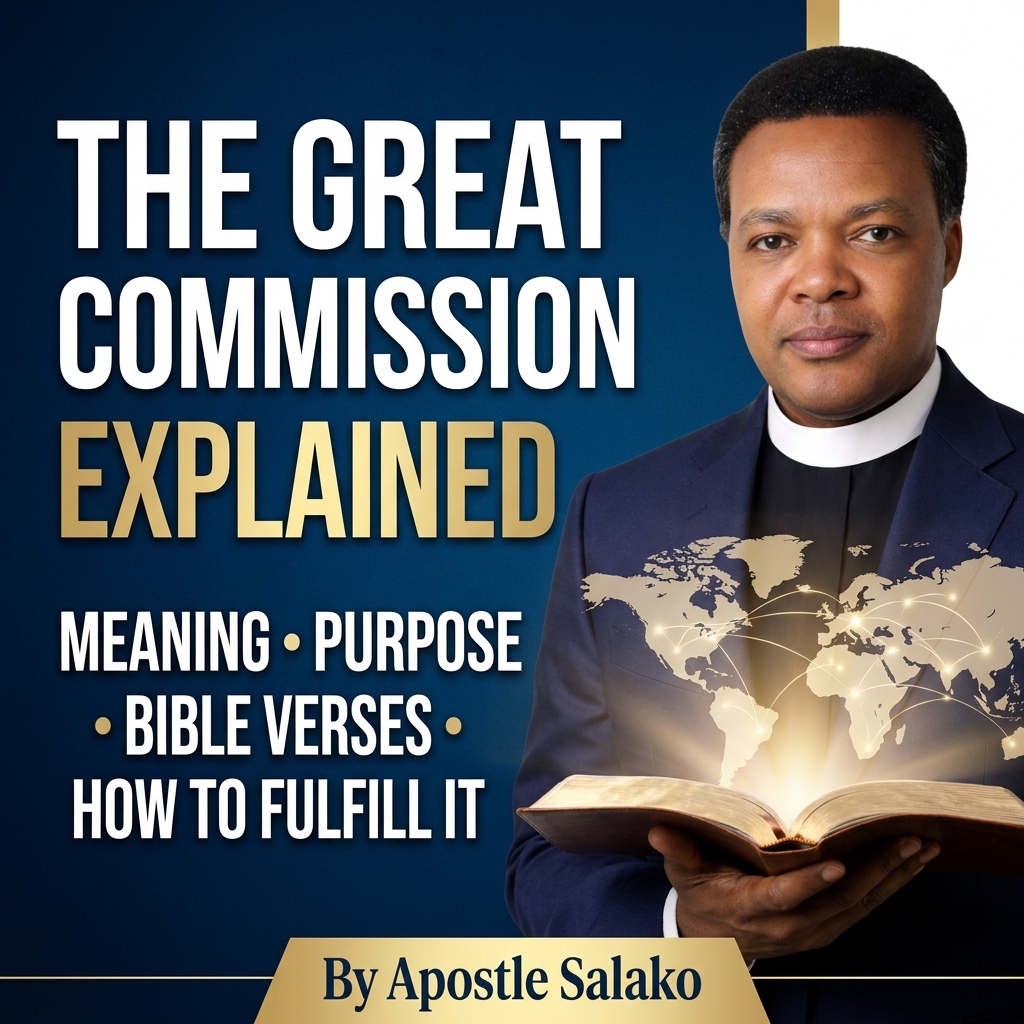
The Great Commission is one of the clearest and most important assignments Jesus Christ gave to His followers after His resurrection. It is a call to proclaim the gospel, make disciples, baptize believers, teach them the commands of Christ, and carry the message of salvation to people everywhere.
When many Christians hear the words “Great Commission,” they immediately think of Matthew 28:19–20, and appropriately so, because these verses contain one of the clearest expressions of Christ's command to His disciples.
“Go ye therefore, and teach all nations, baptizing them in the name of the Father, and of the Son, and of the Holy Ghost: Teaching them to observe all things whatsoever I have commanded you: and, lo, I am with you alway, even unto the end of the world. Amen.” — Matthew 28:19–20, KJV
Yet the Great Commission is broader than two verses. The same missionary mandate appears in complementary forms throughout the New Testament. Jesus told His followers to preach the gospel, call people to repentance, make disciples, bear witness to Him, and take the message from their immediate surroundings to the ends of the earth. Acts 1:8 emphasizes that this work would be accomplished through the power of the Holy Spirit.
The Great Commission is therefore not simply a command for pastors, evangelists, missionaries, or professional ministers. It is central to the identity and mission of the Church. Every Christian should ask: Who am I reaching? Who am I discipling? Who am I helping to know Jesus? Am I living as a witness for Christ where God has placed me?
The Great Commission is not merely an event on a church calendar. It is a lifestyle of obedience to Jesus Christ.
What Is the Great Commission?
The Great Commission is the command of Jesus Christ for His followers to proclaim the gospel and make disciples among all peoples. The word commission refers to an authoritative instruction or assignment given to someone. When Christians speak about the Great Commission, they are referring to Christ's authoritative assignment to His disciples.
Matthew 28:18–20 provides the central passage. Jesus first declared His authority: “All power is given unto me in heaven and in earth” (Matthew 28:18). He then gave the command: “Go ye therefore, and teach all nations...” (Matthew 28:19). Finally, He gave the promise: “...lo, I am with you alway, even unto the end of the world” (Matthew 28:20).
This structure is extremely important: Authority → Assignment → Assurance. Jesus has authority. Jesus gives the assignment. Jesus promises His presence. The Great Commission therefore does not begin with human ability. It begins with Christ's authority.
The believer does not go into the world merely because he or she has a strong personality, excellent communication skills, theological knowledge, or a desire to help people. The believer goes because Jesus Christ has commanded it.
Where Is the Great Commission Found in the Bible?
Matthew 28:18–20 is commonly called the Great Commission, but the missionary command of Christ appears in several New Testament passages. Matthew 28:18–20 emphasizes Christ's authority, making disciples, all nations, baptism, teaching obedience, and Christ's continuing presence.
Mark 16:15 says, “Go ye into all the world, and preach the gospel to every creature.” The emphasis is on worldwide gospel proclamation. Luke 24:46–49 explains that repentance and remission of sins should be preached among all nations, and connects the mission with the promised power from above.
John 20:21 says, “As my Father hath sent me, even so send I you.” The disciples are sent as representatives of Christ. Acts 1:8 declares, “But ye shall receive power, after that the Holy Ghost is come upon you: and ye shall be witnesses unto me both in Jerusalem, and in all Judaea, and in Samaria, and unto the uttermost part of the earth.”
These passages should not be treated as competing commissions. Matthew emphasizes discipleship, Mark emphasizes proclamation, Luke emphasizes repentance, forgiveness and empowerment, John emphasizes being sent, and Acts emphasizes Spirit-empowered witness. Together they give a comprehensive understanding of Christ's missionary mandate.
The Historical Setting of the Great Commission
To understand the Great Commission, we must understand what happened before Jesus gave it. Jesus had been crucified. His disciples had witnessed His death. Their hopes appeared shattered. But on the third day, Jesus rose from the dead. The resurrection changed everything. The disciples were no longer following a dead teacher; they were witnesses of the risen Christ.
Matthew 28 describes the disciples coming to the mountain in Galilee where Jesus had instructed them to meet Him. Some worshipped Him, while others struggled with doubt. Jesus then approached them and announced His authority before giving the commission.
This setting teaches us something important: the Great Commission is a resurrection assignment. Christian mission is rooted in the historical claim that Jesus Christ died, rose again, and reigns as Lord. The gospel is not simply advice about becoming a better person; it is the proclamation of what God has accomplished through Jesus Christ.
“For I delivered unto you first of all that which I also received, how that Christ died for our sins according to the scriptures; And that he was buried, and that he rose again the third day according to the scriptures.” — 1 Corinthians 15:3–4, KJV
Jesus Has All Authority
Before Jesus commanded His disciples to go, He said, “All power is given unto me in heaven and in earth” (Matthew 28:18). This statement establishes the foundation of the Great Commission. Jesus does not send His followers as powerless representatives. He sends them under His authority.
This matters because evangelism can appear intimidating. You may think: I am not educated enough. I do not know enough Bible verses. I am afraid people will reject me. I do not know how to answer difficult questions. I am not a preacher.
But the Great Commission does not begin with “Look at how powerful you are.” It begins with “All authority belongs to Christ.” The confidence of the Christian witness must rest in Christ. Our responsibility is faithfulness; the result belongs to God. Paul explains this in 1 Corinthians 3:6: “I have planted, Apollos watered; but God gave the increase.”
This does not mean we should be careless. We should study, prepare, communicate wisely, and demonstrate Christlike character. But we should never assume that salvation depends upon our personal perfection. Christ is Lord of the mission.
The Command to Go
Jesus said, “Go ye therefore...” The Great Commission contains movement. The Church must not become so comfortable inside its buildings that it forgets the people outside.
The command to go may involve traveling to another nation. But it can also involve crossing the street, visiting a neighbor, speaking with a colleague, encouraging a friend, discipling a young believer, helping someone understand Scripture, or using digital media to communicate the gospel. Going is not always geographical; sometimes going means intentionally moving toward people.
Jesus consistently moved toward people. He spoke to the overlooked. He touched the hurting. He taught the crowds. He visited homes. He ate with people. He confronted religious hypocrisy. He welcomed sinners who were willing to repent.
The Great Commission calls believers to develop a similar missionary mindset. Instead of asking only, “Why are people not coming to church?” we should also ask, “How can the Church go to the people?”
The Command to Make Disciples
One of the most important truths about the Great Commission is that Jesus did not merely say, “Go and collect decisions.” He commanded His followers to make disciples. A disciple is a learner and follower of Jesus, and discipleship involves transformation.
A person hears the gospel, responds to Christ, learns His teachings, grows in faith, develops Christian character, and increasingly orders his or her life around Christ. Therefore, successful ministry should not be measured only by the number of people who attended an evangelistic event.
We should also ask: How many people are becoming followers of Jesus? How many are growing spiritually? How many understand Scripture? How many are learning to pray? How many are becoming obedient to Christ? How many are helping others follow Jesus?
A crowd is not necessarily a church. A decision is not necessarily discipleship. An audience is not necessarily a community of believers. The Great Commission requires disciple-making.
The Meaning of “All Nations”
Jesus commanded His disciples to make disciples of all nations. This demonstrates the universal scope of the gospel. The gospel is not restricted to one ethnic group, social class, nationality, language, or geographical region. Jesus is Lord of all.
The Christian mission must therefore cross boundaries. The Church should care about people in cities and villages, young and older people, professionals and students, families and immigrants, people from different cultures, people who are wealthy and people who are poor, people who are highly educated and people who have little formal education.
The gospel addresses the deepest human need: reconciliation with God through Jesus Christ. Acts 1:8 presents a similar progression — Jerusalem, Judea, Samaria, and the uttermost part of the earth. Mission begins where we are, but it must never end there.
The Importance of Baptism
Matthew 28:19 includes baptism as part of the disciple-making process. Jesus commanded His disciples to baptize believers in the name of the Father, Son, and Holy Ghost. Baptism is an important public expression of Christian faith and identification with Christ.
Romans 6:3–4 explains the connection between baptism and identification with Christ's death and resurrection. Baptism should therefore not be treated as an empty religious ceremony; it points toward a transformed relationship with Christ.
However, baptism should also be understood in its proper place. The Great Commission does not say, “Make baptism the final goal.” It says to make disciples, baptize them, and teach them. Baptism belongs within a broader process of discipleship. Churches should help new believers understand what baptism means and how it relates to their new life in Christ.
Teaching People to Follow Christ
Jesus continued, “Teaching them to observe all things whatsoever I have commanded you...” (Matthew 28:20). This is one of the most frequently overlooked dimensions of the Great Commission. Evangelism without discipleship produces immature believers, and discipleship without evangelism can become inward-looking Christianity. Jesus commands both.
New believers must be taught. They need to understand salvation, faith, prayer, Scripture, holiness, love, forgiveness, Christian fellowship, stewardship, spiritual gifts, service, evangelism, perseverance, and obedience.
Christian discipleship is not merely transferring information. Jesus said to teach people to observe His commands, which means Christian education should produce obedience. The goal is not simply “I know what the Bible says,” but “I know what the Bible says, and by God's grace I am learning to live it.”
The Great Commission and the Gospel
The Great Commission cannot be separated from the gospel. The gospel means good news. The central message is that Jesus Christ died for our sins, was buried, and rose again. The gospel announces God's saving work through Christ.
Evangelism therefore requires more than motivational speeches. Christian communication should ultimately point people toward Jesus. We can speak about purpose, marriage, finances, leadership, mental resilience, family, success, relationships, and personal development, but Christian ministry must not lose the gospel.
People need more than improved circumstances. They need reconciliation with God. The gospel addresses sin, grace, repentance, forgiveness, faith, redemption, and eternal life. Paul summarized his preaching ministry in 1 Corinthians 2:2: “For I determined not to know any thing among you, save Jesus Christ, and him crucified.” Christ must remain at the center.
The Role of the Holy Spirit
The Great Commission cannot be fulfilled effectively through human strength alone. Before His ascension, Jesus told His disciples, “But ye shall receive power, after that the Holy Ghost is come upon you...” (Acts 1:8). The Holy Spirit empowers believers to witness, which means Christian evangelism should be prayerful and Spirit-dependent.
We need the Holy Spirit for boldness, wisdom, conviction, discernment, spiritual strength, effective communication, perseverance, love for people, and sensitivity to divine opportunities.
The early Church demonstrated this dependence. In Acts 4:31, after the believers prayed, they were filled with the Holy Ghost and spoke the word of God with boldness. Notice that they prayed for boldness; they did not simply assume that courage would automatically appear. They sought God. Before going out to speak for Christ, learn to pray for the people you will reach.
Jerusalem, Judea, Samaria, and the Ends of the Earth
Acts 1:8 gives a helpful framework for Christian mission: “...both in Jerusalem, and in all Judaea, and in Samaria, and unto the uttermost part of the earth.” This can be understood as a movement from the immediate to the global.
Jerusalem represents your immediate environment — your family, your neighborhood, your workplace, your school, your church community, and your friends. Judea represents people within your broader community and geographical area.
Samaria represents cross-cultural mission, and it is particularly significant because of the historical tension between Jews and Samaritans. The gospel crosses barriers. Sometimes the mission field is not simply far away; it is the person we have difficulty understanding.
The ends of the earth represent global mission. The gospel ultimately belongs among all peoples. Modern technology has made global communication easier than ever. A Christian sitting in Africa can potentially communicate biblical teaching to someone in Asia, Europe, North America, South America, or another part of Africa. The world has become connected, and the missionary opportunity is enormous.
The Great Commission Is More Than Winning Converts
There is an important distinction between conversion and discipleship. Conversion is a person's response to the gospel and turning to Christ. Discipleship is the ongoing process of becoming more like Christ. Both matter.
The Great Commission is therefore not fulfilled simply because someone raised a hand, repeated a prayer, or responded to an altar call. Those moments can be meaningful, but they should lead into continued spiritual growth.
A new believer needs fellowship, teaching, prayer, pastoral care, biblical foundations, accountability, opportunities to serve, and encouragement during difficulties. The Church must therefore build systems that help new believers grow. Evangelism brings people into the doorway; discipleship teaches them how to walk with Christ.
Evangelism and Discipleship: What Is the Difference?
Evangelism announces the good news. Discipleship helps believers grow in the good news. A simple way to understand the relationship is: evangelism leads to conversion, conversion to baptism, baptism to teaching, teaching to spiritual growth, and spiritual growth to multiplication.
“And the things that thou hast heard of me among many witnesses, the same commit thou to faithful men, who shall be able to teach others also.” — 2 Timothy 2:2, KJV
This is multiplication. Paul taught Timothy. Timothy was expected to teach faithful people. Those people would teach others. The gospel therefore spreads through multiplication, and the Great Commission becomes sustainable when disciples become disciple-makers.
Why Every Christian Should Participate
Some Christians believe evangelism is only for pastors. Others think missionaries are the people responsible for the Great Commission. But Scripture presents believers as witnesses.
Not everyone has the same ministry role. Not everyone is called to be an evangelist in the vocational sense. Not everyone will travel internationally. But every Christian can participate in Christ's mission.
You can pray, give, encourage, disciple, teach, share your testimony, invite people to church, create Christian content, support missionaries, mentor young believers, visit people, serve your community, and demonstrate Christlike love. The Great Commission is a shared mission, and different believers contribute in different ways.
How to Share the Gospel Without Fear
Fear is one of the greatest obstacles to evangelism. People may fear rejection, embarrassment, difficult questions, persecution, being misunderstood, appearing strange, or not knowing enough Bible. But fear should not control obedience.
First, pray before you speak, asking God for wisdom and boldness. Second, know the gospel, being able to explain simply who God is, what sin is, why humanity needs salvation, who Jesus is, what Christ accomplished, what repentance means, what faith means, and what it means to follow Jesus.
Third, listen. Evangelism is not merely talking; listen to people's stories, understand their questions, and ask thoughtful questions. Fourth, avoid needless arguments. You do not have to win every debate; your responsibility is to represent Christ faithfully.
Fifth, share your testimony, explaining how Christ has changed your life. Sixth, use Scripture, because human opinions have limitations while God's Word provides the biblical foundation. Seventh, be respectful: 1 Peter 3:15 teaches believers to give an answer with meekness and fear. Truth and love should work together.
The Great Commission in Everyday Life
You do not have to wait for a special evangelistic program. Everyday life contains missionary opportunities. At home, parents can disciple children, husbands and wives can encourage one another spiritually, and families can pray together.
At work, Christian integrity can create opportunities for conversations as you demonstrate honesty, humility, excellence, and compassion. At school, students can be witnesses through character, relationships, and respectful conversations. In business, Christian entrepreneurs can demonstrate ethical leadership and generosity.
Online, social media can become a mission field. Christian content can answer questions, explain Scripture, encourage believers, and introduce seekers to Christ. The key is intentionality. Ask: “Lord, who can I influence for Christ today?”
Using Technology for the Great Commission
Technology has transformed communication. The early disciples walked from city to city. Today, a Christian can communicate through websites, blogs, YouTube, podcasts, livestreams, social media, digital Bible studies, online courses, Christian music, and video teaching.
This creates tremendous opportunities. However, technology should be treated as a tool, not the mission itself. The mission is still Christ. The objective is still disciple-making. The technology simply expands reach.
A Christian blog can explain Scripture. A YouTube sermon can teach biblical truth. A podcast can answer spiritual questions. A livestream can reach people who cannot attend a physical service. A social media post can encourage someone who is discouraged. But digital ministry should maintain the same standards as physical ministry: truth, integrity, love, biblical faithfulness, humility, and accountability.
Common Obstacles to Fulfilling the Great Commission
Fear can cause believers to remain silent; the answer is prayer, preparation, and dependence on the Holy Spirit. Distraction is another obstacle, as people can become consumed with personal ambitions, while the Great Commission reminds us that life has eternal significance.
Lack of biblical knowledge can be addressed through intentional Bible study. Spiritual apathy sets in when a believer becomes comfortable and loses compassion for unbelievers; prayer can renew spiritual burden. Perfectionism convinces some Christians they must know everything before speaking, yet you can faithfully share what you know while continuing to grow.
Rejection will come, because not everyone will respond positively; Jesus Himself was rejected, and our responsibility is faithfulness, not controlling people's decisions. Poor character can undermine an effective message through hypocrisy, so our conduct matters. Finally, a lack of discipleship structures means churches may evangelize without providing adequate follow-up. Effective Great Commission ministry requires both outreach and spiritual formation.
The Great Commission and Christian Character
Evangelism cannot be separated from character. Jesus taught that His followers should be recognized by their fruit. If our message says, “Jesus changes lives,” but our lives consistently display dishonesty, hatred, pride, exploitation, or unforgiveness, our witness becomes confusing.
Christian character supports Christian proclamation. This does not mean believers must be perfect before witnessing — if perfection were required, nobody could preach. It means we should sincerely pursue holiness and repentance.
A Christian witness should demonstrate love, honesty, humility, purity, patience, forgiveness, generosity, compassion, and integrity. The messenger does not replace the message, but the messenger's character can either strengthen or weaken the credibility of the message.
How the Local Church Can Fulfill the Great Commission
The local church has a major role in disciple-making. A healthy Great Commission church should consider five areas: evangelism, creating opportunities for people to hear the gospel; discipleship, providing structured biblical teaching; prayer, praying for workers and those who need Christ; training, equipping members to evangelize and disciple others; and mission, supporting local and international gospel work.
Churches should not measure success only by attendance. Other questions matter: Are people growing spiritually? Are members serving? Are believers discipling others? Are new converts being followed up? Are people being equipped to share the gospel? Is the church reaching its community? Is the church sending workers?
A church that understands the Great Commission will develop a missionary culture.
The Cost of the Great Commission
The Great Commission is glorious, but it is not always comfortable. Jesus never promised His disciples an easy assignment. Some believers will experience rejection. Some missionaries face persecution. Some Christians sacrifice time, money, comfort, and opportunities. Paul experienced suffering because of his gospel ministry.
“If any man will come after me, let him deny himself, and take up his cross daily, and follow me.” — Luke 9:23, KJV
Mission requires sacrifice. However, sacrifice should not be confused with recklessness. Christians should use wisdom. Missionary service requires planning, accountability, prayer, preparation, and appropriate care. The goal is not to seek suffering; the goal is faithful obedience.
The Reward of Faithful Gospel Work
God values faithful service. Paul wrote in 1 Corinthians 15:58, “Therefore, my beloved brethren, be ye stedfast, unmoveable, always abounding in the work of the Lord...forasmuch as ye know that your labour is not in vain in the Lord.”
Sometimes you may preach and see little visible response. You may disciple someone who later seems to forget what you taught. You may create Christian content and receive little engagement. You may pray for people for years without seeing immediate results.
Do not conclude that your labor is meaningless. God sees faithfulness. The Great Commission should be pursued with eternal perspective.
Practical Steps for Fulfilling the Great Commission
Step 1: Know Christ personally, because you cannot effectively represent someone you do not know. Step 2: Study the Bible and know the message you are communicating. Step 3: Pray for people, making a prayer list of those who need Christ. Step 4: Identify your mission field, starting with your Jerusalem — who is around you?
Step 5: Build genuine relationships, remembering that people are not projects. Step 6: Learn to share your testimony by preparing a simple explanation of how you encountered Christ. Step 7: Learn the gospel clearly so you can explain salvation simply. Step 8: Ask spiritual questions such as, “Do you ever think about spiritual things?” or “What do you believe about God?” or “Have you ever read the teachings of Jesus?”
Step 9: Invite people to explore Scripture, since a Bible study can provide a safe environment for spiritual discovery. Step 10: Follow up and do not abandon people after they respond. Step 11: Disciple others, teaching new believers to pray, study Scripture, obey Christ, and serve. Step 12: Help them become disciple-makers, because the ultimate goal is multiplication.
A Simple Great Commission Model
The following model can help individuals and churches remember the mission. CONNECT: build genuine relationships. COMMUNICATE: share the gospel clearly. CALL: invite people to respond to Christ. CONFIRM: help new believers establish biblical foundations. CULTIVATE: disciple them toward spiritual maturity. COMMISSION: train them to make disciples themselves.
This creates a multiplication cycle: disciple becomes disciple-maker, who produces more disciples. That is how the gospel can spread from one generation to another.
The Great Commission and the Love of God
The Great Commission must be motivated by love. If evangelism becomes merely a competition for numbers, something has gone wrong. We are dealing with people created in God's image. People have stories, fears, families, questions, wounds, and hopes. People need truth and grace.
Therefore, gospel ministry should be conducted with compassion. Jesus looked upon the crowds with compassion. Christian evangelism should not communicate, “I am better than you.” It should communicate, “I have encountered the grace of God, and I want you to know the hope found in Jesus Christ.” Grace should produce humility.
The Great Commission and Prayer
Prayer is essential to mission. Jesus told His disciples in Matthew 9:38, “Pray ye therefore the Lord of the harvest, that he will send forth labourers into his harvest.” Notice the language: Lord of the harvest. The harvest belongs to God. The workers belong to God. The mission belongs to God.
Therefore, mission should begin with prayer. Pray for open hearts, open doors, faithful workers, wisdom, boldness, protection, spiritual discernment, new believers, churches, missionaries, and unreached communities. A praying church becomes a sending church.
The Great Commission and the Family
The Great Commission begins close to home. Parents have an important discipleship responsibility. Deuteronomy 6:6–7 describes the responsibility of teaching God's words diligently to children.
Christian parents should not assume that the church alone is responsible for their children's spiritual development. Families can read Scripture, pray together, discuss biblical principles, serve others, practice generosity, talk about evangelism, and encourage children to ask spiritual questions. The home can become a discipleship center.
The Great Commission and Young People
Young Christians should not be treated merely as the future of the Church. They are also part of the Church's present mission. Young believers can share Christ with friends, create biblical content, participate in outreach, mentor younger children, serve in church, pray for classmates, and use their talents for God's purposes.
“Let no man despise thy youth; but be thou an example of the believers...” — 1 Timothy 4:12, KJV
Age does not disqualify someone from being a witness. Faithfulness matters.
The Great Commission and Business
Business can become a platform for Christian witness. A Christian businessperson can demonstrate honesty, excellence, fairness, responsible leadership, compassion, generosity, and integrity.
The goal is not to turn every business interaction into an aggressive religious conversation. Rather, Christian principles should shape how business is conducted. When appropriate opportunities arise, believers can explain the faith that motivates their values. Our workplace can become part of our mission field.
The Great Commission and Christian Content Creation
Christian content creators have a unique opportunity. A blog article can answer a spiritual question someone is searching for at midnight. A YouTube video can explain a difficult Bible passage. A podcast can encourage someone during a difficult season. A short video can introduce someone to a biblical truth. A worship song can direct someone's heart toward God.
But content creators should remember that views are not the same as disciples, followers are not the same as disciples, and viral reach is not the same as spiritual transformation. Christian creators should pursue both reach and depth. Ask: “Is this content merely attracting attention, or is it helping people follow Jesus?” That question can transform Christian digital ministry.
How to Avoid Manipulation in Evangelism
The Great Commission does not give Christians permission to manipulate people. We should not use deceptive promises, financial pressure, exaggerated claims, fear tactics, fabricated miracles, false testimonies, emotional manipulation, or misleading statistics. The gospel is powerful enough to be presented truthfully.
Christian ministry should respect people's dignity. We can passionately preach truth without manipulating people. We can call people to repentance without humiliating them. We can preach salvation without inventing stories. We can teach biblical stewardship without promising instant wealth. We can pray for healing without making guarantees Scripture does not make. Integrity matters.
The Great Commission and Cultural Sensitivity
The gospel is universal, but cultures are diverse. Effective missionaries learn to communicate biblical truth in ways people can understand. Paul demonstrated contextual awareness without compromising the gospel; in 1 Corinthians 9:22 he explained his willingness to adapt his approach for the sake of reaching people.
This teaches an important principle: change the method when necessary, but do not change the message. The gospel remains the gospel, but the way we explain it may vary according to language, age, culture, education, context, questions, and communication medium. The goal is clarity.
The Great Commission Is a Lifestyle
The greatest mistake is treating the Great Commission as a once-a-year program. Evangelism should become part of Christian life. A believer should continually ask, “Where is God already working, and how can I participate?”
Your mission field may be your home, your office, your business, your neighborhood, your school, your social media audience, your church, your community, or another nation. The Great Commission is not necessarily about doing something extraordinary. It is about doing ordinary things with extraordinary intentionality.
Frequently Asked Questions
What is the Great Commission in simple terms? It is Jesus Christ's command for His followers to proclaim the gospel, make disciples, baptize believers, teach them to obey His commands, and take the gospel to all peoples.
What Bible verse is the Great Commission? Matthew 28:18–20 is the passage most commonly called the Great Commission. Acts 1:8 and related passages provide complementary expressions of the same missionary mandate.
Who gave the Great Commission? Jesus Christ gave the Great Commission to His disciples following His resurrection.
Does the Great Commission apply to every Christian? The specific ministry roles of Christians differ, but every believer is called to be a witness for Christ and participate in the mission of making disciples.
What does “go into all the world” mean? It means the gospel is intended for all peoples and should not be restricted to one nation, culture, social group, or geographical area.
What is the difference between evangelism and discipleship? Evangelism focuses on proclaiming the gospel and calling people to Christ. Discipleship involves helping believers grow in obedience, maturity, character, and service.
Why is the Holy Spirit important in the Great Commission? Acts 1:8 teaches that the disciples would receive power from the Holy Spirit and become Christ's witnesses from Jerusalem to the ends of the earth.
Does fulfilling the Great Commission require becoming a missionary? No. Christians can participate through prayer, giving, evangelism, discipleship, service, Christian content, hospitality, mentoring, and many other forms of ministry.
How can I start fulfilling the Great Commission today? Start with people around you. Pray for them, build genuine relationships, learn how to explain the gospel, share your testimony, invite people to explore Scripture, and help new believers grow.
What if I am afraid to evangelize? Pray for boldness and depend on the Holy Spirit. You do not need to know everything before beginning. Continue studying Scripture while faithfully sharing what you know.
A Great Commission Prayer
Heavenly Father, thank You for sending Your Son, Jesus Christ, to bring salvation to humanity. Thank You for the privilege of knowing Christ and for the responsibility of sharing His gospel. Give me a heart for people. Remove fear, selfishness, distraction, and spiritual apathy from my life.
Fill me with the power and wisdom of the Holy Spirit. Give me boldness to speak the truth in love. Help me recognize the people You have placed around me. Teach me to listen, to love, to serve, and to preach the gospel faithfully. Help me make disciples rather than merely gather crowds.
Help me disciple my family, encourage other believers, and reach those who do not yet know Christ. Open doors for the gospel. Give me wisdom to use technology, relationships, resources, and opportunities for Your glory. Make my life a testimony of Your grace. Help me remain faithful when results are not immediately visible.
Let my words and conduct point people toward Jesus. Raise up faithful disciples who will make other disciples. May the gospel go from my Jerusalem to Judea, from Judea to Samaria, and from Samaria to the uttermost parts of the earth. I surrender my gifts, time, resources, influence, and future to You. Let my life contribute to the fulfillment of the Great Commission. In the name of Jesus Christ, Amen.
Conclusion
The Great Commission is not merely a famous Bible passage. It is the missionary heartbeat of the Church. Jesus Christ, possessing all authority in heaven and earth, commanded His followers to go, make disciples, baptize believers, and teach them to observe His commands. He promised His continuing presence, and Acts 1:8 shows that His followers would receive power through the Holy Spirit to become witnesses from Jerusalem to the ends of the earth.
The Great Commission therefore contains several essential truths. Christ has authority. The Church has an assignment. The world is the mission field. The gospel is the message. Discipleship is the goal. The Holy Spirit is the empowerment. Prayer is essential. Christ's presence is the assurance. And every believer has a part to play.
You may not stand behind a pulpit. You may never travel overseas. You may not have thousands of followers. You may not have a large ministry. But you have influence, relationships, opportunities, a testimony, and access to God's Word. You can pray, serve, encourage, teach, share, disciple, and live for Christ.
The question is not whether you are important enough to participate in the Great Commission. The question is whether you are willing to obey the One who gave it.
“Go ye therefore, and teach all nations... and, lo, I am with you alway, even unto the end of the world. Amen.” — Matthew 28:19–20, KJV
The Great Commission begins with Christ, depends upon Christ, points people to Christ, and will ultimately be fulfilled under Christ's authority. Therefore, let us go. Let us preach. Let us love. Let us disciple. Let us teach. Let us serve. Let us pray. Let us make disciples who make disciples, and faithfully proclaim the gospel until every opportunity God gives us has been used for His glory. The Great Commission is not simply something we talk about. It is something we obey.
About the Author
Apostle Salako Adedamola is a Christian preacher, teacher, mentor, and Bible communicator passionate about helping people understand God's Word and apply biblical principles to everyday Christian life. Through biblical teaching, discipleship, Christian media, and practical spiritual instruction, his ministry seeks to encourage believers to grow in faith, develop Christlike character, understand Scripture, and fulfill their God-given purpose.
Apostle Adedamola Salako
Founder of Apostle Salako Studios — pastor, recording artist, and teacher on faith, music, and stewardship.
Frequently Asked Questions
QWhat is the Great Commission in simple terms?
It is Jesus Christ's command for His followers to proclaim the gospel, make disciples, baptize believers, teach them to obey His commands, and take the gospel to all peoples.
QWhat Bible verse is the Great Commission?
Matthew 28:18–20 is the passage most commonly called the Great Commission. Acts 1:8, Mark 16:15, Luke 24:46–49, and John 20:21 give complementary expressions of the same mandate.
QWho gave the Great Commission?
Jesus Christ gave the Great Commission to His disciples following His resurrection.
QDoes the Great Commission apply to every Christian?
Ministry roles differ, but every believer is called to be a witness for Christ and to participate in the mission of making disciples.
QWhat does “go into all the world” mean?
It means the gospel is intended for all peoples and should not be restricted to one nation, culture, social group, or geographical area.
QWhat is the difference between evangelism and discipleship?
Evangelism proclaims the gospel and calls people to Christ. Discipleship helps believers grow in obedience, maturity, character, and service.
QWhy is the Holy Spirit important in the Great Commission?
Acts 1:8 teaches that the disciples would receive power from the Holy Spirit and become Christ's witnesses from Jerusalem to the ends of the earth.
QDoes fulfilling the Great Commission require becoming a missionary?
No. Christians can participate through prayer, giving, evangelism, discipleship, service, Christian content, hospitality, mentoring, and many other forms of ministry.
QHow can I start fulfilling the Great Commission today?
Start with people around you. Pray for them, build genuine relationships, learn to explain the gospel, share your testimony, invite people to explore Scripture, and help new believers grow.
QWhat if I am afraid to evangelize?
Pray for boldness and depend on the Holy Spirit. You do not need to know everything before beginning. Continue studying Scripture while faithfully sharing what you know.
Enjoyed this article?
Get the next one straight to your inbox. One thoughtful email a week.
Comments (0)
Comments are stored locally in your browser. For published responses, email us via the Contact page.
You may also like
Walking with God Every Day: The Complete Biblical Guide to Daily Christian Living (2026)
Discover how to walk with God every day through prayer, Bible study, obedience, faith, worship, and the Holy Spirit. A complete biblical guide by Apostle Salako Adedamola.
Understanding the Bible: How the Old and New Testaments Work Together
Learn how the Old and New Testaments work together to reveal God's complete plan of redemption through Jesus Christ — covenants, prophecy, law, grace, and practical Christian living from a KJV foundation.
How to Pray According to the Bible (Complete Biblical Prayer Guide for Christians)
Learn how to pray according to the Bible with this complete Christian guide — Jesus' teaching on prayer, biblical principles, powerful examples, and practical steps to deepen your walk with God.