
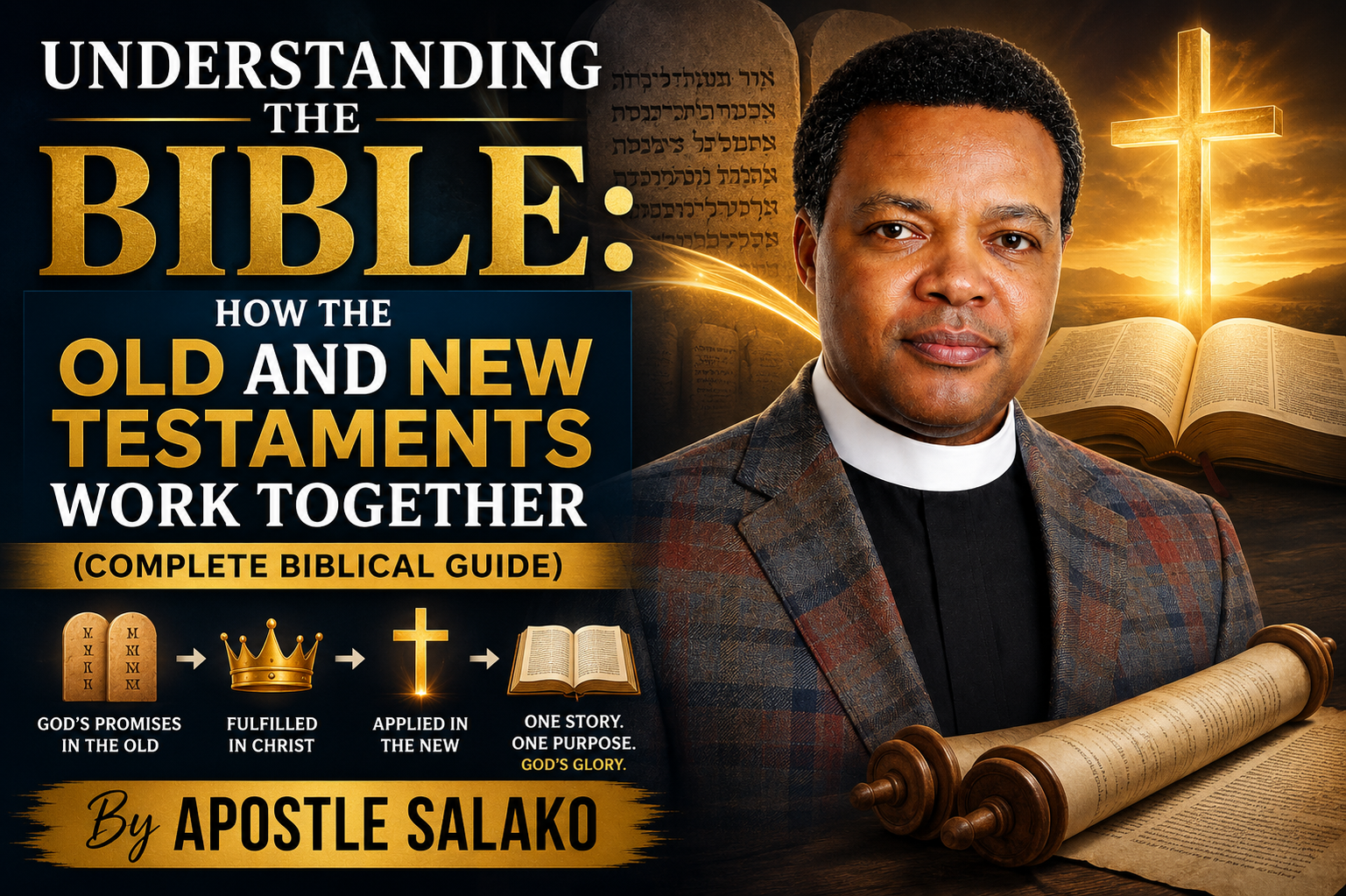
Introduction
Many Christians faithfully read the Bible every day yet struggle to understand how its sixty-six books fit together. Some believers devote themselves almost exclusively to the New Testament because it speaks directly about Jesus Christ and the Church. Others spend considerable time in the Old Testament but find it difficult to relate ancient laws, sacrifices, and prophecies to present-day Christian living.
These challenges often produce an incomplete understanding of God's Word.
The Bible was never intended to be read as two separate books with unrelated messages. Rather, it is one divine revelation unfolding through history. The Old Testament prepares the way for Christ, while the New Testament reveals Christ as the fulfillment of everything that God promised from the beginning.
When believers understand how these two Testaments work together, the Scriptures become more meaningful. Prophecies come alive, biblical symbols gain clarity, and God's plan of redemption unfolds with remarkable consistency.
From Genesis to Revelation, there is one Author—God the Holy Ghost—who inspired many human writers over approximately fifteen centuries to reveal one glorious purpose: the redemption of mankind through Jesus Christ.
Paul wrote:
"All scripture is given by inspiration of God, and is profitable for doctrine, for reproof, for correction, for instruction in righteousness: That the man of God may be perfect, thoroughly furnished unto all good works." — 2 Timothy 3:16–17 (KJV)
Notice that when Paul wrote these words, much of what we now call the New Testament had not yet been completed. He affirmed the divine inspiration of Scripture as a whole. Today, that same truth applies to the complete canon of sixty-six books.
Every page of Scripture reveals the character of God — His holiness, His justice, His mercy, and His eternal purpose. The believer who understands both Testaments will read the Bible with greater confidence, teach it with greater accuracy, and apply it with greater wisdom.
Why Understanding the Whole Bible Matters
Many doctrinal errors arise because people isolate individual verses instead of interpreting them within the larger story of Scripture. The Bible tells one continuous story.
It begins with creation and ends with a new creation. It begins in a garden and ends in a glorious city. It begins with man's fellowship with God and ends with eternal fellowship restored. It begins with the tragedy of sin and ends with the complete victory of Christ.
Every major doctrine develops progressively throughout Scripture — creation, sin, redemption, faith, covenant, priesthood, worship, holiness, kingdom, resurrection, and eternal life. The Old Testament introduces these truths; the New Testament explains their fulfillment.
Without the Old Testament, the New Testament loses much of its historical and theological foundation. Without the New Testament, the Old Testament remains an unfinished expectation awaiting fulfillment.
Jesus Himself declared:
"Search the scriptures; for in them ye think ye have eternal life: and they are they which testify of me." — John 5:39 (KJV)
Everything ultimately points to Christ.
What Is the Bible?
The word "Bible" comes from a Greek word meaning "books." Although composed of sixty-six individual books, Scripture is one unified revelation. It contains 39 Old Testament books and 27 New Testament books, written by more than forty human authors from diverse backgrounds — kings, prophets, priests, shepherds, fishermen, physicians, and government officials. Yet despite this diversity, its message remains perfectly consistent.
This unity itself serves as evidence of divine inspiration. Peter explains:
"Knowing this first, that no prophecy of the scripture is of any private interpretation. For the prophecy came not in old time by the will of man: but holy men of God spake as they were moved by the Holy Ghost." — 2 Peter 1:20–21 (KJV)
The Bible is not merely a religious book. It is God's revelation of Himself to humanity.
How the Bible Is Organized
Understanding the Bible's structure makes study much easier. The Old Testament contains thirty-nine books grouped into five major sections: The Law (Genesis, Exodus, Leviticus, Numbers, Deuteronomy), the Historical Books, Wisdom Literature (Job, Psalms, Proverbs, Ecclesiastes, Song of Solomon), the Major Prophets (Isaiah, Jeremiah, Lamentations, Ezekiel, Daniel), and the Minor Prophets.
The Pentateuch describes creation, the Fall, the Flood, Abraham, Israel's formation, God's covenant, and the giving of the Law. The Historical Books record Israel's national history from Joshua's conquest through the kingdoms, exile, and return. Wisdom Literature teaches practical wisdom, worship, suffering, relationships, and the fear of the Lord. The Prophets addressed national repentance while revealing future events concerning Christ, Israel, and God's Kingdom.
The New Testament contains twenty-seven books divided into five sections: the Gospels (Matthew, Mark, Luke, John), History (Acts), the Epistles (Romans through Jude), and Prophecy (Revelation). The Gospels present four complementary portraits of Jesus Christ. Acts records the birth and expansion of the early Church through the ministry of the Holy Ghost. The Epistles explain Christian doctrine, practical living, church leadership, and spiritual growth. Revelation concludes God's written revelation by unveiling Christ's ultimate victory and the establishment of His everlasting Kingdom.
The Unity of Scripture
One of the strongest evidences of divine inspiration is the remarkable unity found throughout the Bible. Despite being written across fifteen centuries, by over forty authors, on three continents, and in three languages, it tells one consistent story.
Genesis introduces the Seed; the Gospels reveal the Seed; Revelation celebrates the triumph of the Seed. Genesis introduces Paradise; Revelation restores Paradise. Genesis begins with marriage; Revelation concludes with the Marriage Supper of the Lamb. Genesis records Satan's entrance; Revelation records Satan's final defeat. This remarkable harmony cannot be explained merely by human effort — it demonstrates the wisdom of the divine Author.
Why Many Christians Misunderstand the Bible
Several common mistakes hinder believers from grasping the unity of Scripture. Many read isolated verses while ignoring the surrounding chapters — but context determines meaning. Others ignore the historical background; the Bible was written to real people in real settings, and understanding the original audience often clarifies difficult passages.
Some Christians believe the Old Testament is irrelevant today, while others focus almost exclusively on Old Testament laws while neglecting Christ's fulfillment. Both approaches create imbalance. Finally, many ignore progressive revelation — God did not reveal everything at once; He gradually unfolded His plan through history. What begins as a promise in Genesis develops through the Law, the Prophets, and the Writings before reaching its fulfillment in Jesus Christ.
The Purpose of the Old Testament
The Old Testament is much more than ancient history. It reveals God's character — His holiness, justice, mercy, patience, faithfulness, and sovereign power. From creation to the prophets, God's character never changes.
"For I am the LORD, I change not..." — Malachi 3:6 (KJV)
The same holy God who judged sin in Genesis is the gracious Father revealed through Jesus Christ. His methods of administration may differ across covenants, but His nature remains constant.
The Old Testament also reveals humanity's need for a Savior. From Adam's disobedience onward, it demonstrates that humanity cannot save itself. The repeated cycle of sin, judgment, repentance, and restoration in Israel's history points to the need for a perfect Redeemer. Paul summarizes this purpose:
"Wherefore the law was our schoolmaster to bring us unto Christ, that we might be justified by faith." — Galatians 3:24 (KJV)
The Law exposes sin; Christ provides salvation.
God's Progressive Revelation
God revealed His redemptive plan progressively rather than all at once. Early promises are expanded through later revelation until they reach their fulfillment in Christ. In Genesis 3:15, God promises the Seed who will crush the serpent. With Abraham, God promises that all nations will be blessed through his seed. Through Moses, God establishes the sacrificial system that foreshadows the atoning work of Christ. Through David, God promises an everlasting King. Through the prophets, God foretells a New Covenant, the coming Messiah, and the outpouring of the Holy Spirit.
Each stage builds upon the previous one, revealing more of God's purpose without contradicting what came before. Every covenant, prophecy, and promise contributes to the grand narrative of redemption that culminates in Jesus Christ.
The Purpose of the New Testament
The New Testament is not a replacement for the Old Testament; it is its fulfillment. It reveals the person and work of Jesus Christ, establishes the New Covenant, records the birth and growth of the Church, and points believers toward the glorious return of Christ.
"Think not that I am come to destroy the law, or the prophets: I am not come to destroy, but to fulfil." — Matthew 5:17 (KJV)
The four Gospels present Jesus from complementary perspectives. Matthew presents Him as the promised King and Messiah. Mark portrays Him as the Servant of the Lord. Luke emphasizes His perfect humanity as the Son of Man. John reveals His divine nature as the eternal Son of God. Together, these accounts demonstrate that Jesus fulfilled the promises, prophecies, and expectations of the Old Testament.
The Book of Acts records the fulfillment of Christ's promise concerning the coming of the Holy Ghost.
"But ye shall receive power, after that the Holy Ghost is come upon you: and ye shall be witnesses unto me..." — Acts 1:8 (KJV)
On the Day of Pentecost, believers experienced the outpouring of the Holy Ghost, empowering them to proclaim the Gospel throughout the world. The Church did not replace God's plan; rather, it became the community through which the message of Christ would reach every nation.
The Epistles explain the practical implications of Christ's finished work — salvation, justification, sanctification, adoption, spiritual gifts, prayer, worship, Christian leadership, marriage and family, stewardship, spiritual warfare, and the hope of eternal life. The apostles consistently grounded their teaching in the Old Testament, showing that Christianity rests upon God's unchanging revelation.
Revelation concludes the biblical story. What Genesis begins, Revelation completes. Sin is finally judged. Satan is defeated forever. Death is destroyed. God's people dwell eternally with Him. A new heaven and a new earth are established.
"And God shall wipe away all tears from their eyes; and there shall be no more death, neither sorrow, nor crying..." — Revelation 21:4 (KJV)
The Bible ends exactly where God's eternal purpose was always moving — from creation to redemption to eternal restoration.
How Jesus Fulfilled the Old Testament
The most important bridge between the Old and New Testaments is Jesus Christ Himself. Every major section of the Old Testament points toward Him. The prophets foretold numerous details concerning the Messiah — His virgin birth (Isaiah 7:14), His birthplace (Micah 5:2), His ministry in Galilee (Isaiah 9:1–2), His miracles (Isaiah 35:5–6), His rejection (Isaiah 53:3), His betrayal (Zechariah 11:12–13), His crucifixion (Psalm 22), and His resurrection (Psalm 16:10).
Following His resurrection, Jesus explained this truth to His disciples:
"And beginning at Moses and all the prophets, he expounded unto them in all the scriptures the things concerning himself." — Luke 24:27 (KJV)
Jesus perfectly obeyed every command of God's Law. He fulfilled its righteous requirements, its moral standards, its ceremonial symbols, and its sacrificial system. The Law revealed God's holiness and humanity's inability to achieve righteousness through personal effort. Christ fulfilled what mankind never could.
"For Christ is the end of the law for righteousness to every one that believeth." — Romans 10:4 (KJV)
The Old Testament sacrifices pointed forward to a greater sacrifice. Every lamb offered upon Israel's altars foreshadowed Jesus. John the Baptist proclaimed:
"Behold the Lamb of God, which taketh away the sin of the world." — John 1:29 (KJV)
The blood of animals temporarily covered sin; the blood of Christ completely removes sin for those who believe.
"For it is not possible that the blood of bulls and of goats should take away sins." — Hebrews 10:4 (KJV)
Only Christ's sacrifice could accomplish eternal redemption.
Understanding Law and Grace
One of the most misunderstood subjects in Bible study is the relationship between law and grace. Some believers conclude that the Old Testament represents only law while the New Testament represents only grace. Scripture presents a richer and more balanced picture.
Grace appears throughout the Old Testament. Noah "found grace in the eyes of the LORD" (Genesis 6:8). Abraham was justified by faith. David experienced God's mercy. The prophets proclaimed divine compassion. Likewise, the New Testament still emphasizes God's holiness, righteousness, and obedience. Grace does not eliminate holy living — instead, grace empowers it.
"Shall we continue in sin, that grace may abound? God forbid." — Romans 6:1–2 (KJV)
Grace is not permission to sin. Grace is God's power enabling believers to live in obedience.
Understanding the Biblical Covenants
Throughout Scripture, God relates to humanity through covenants. Each covenant reveals another aspect of His redemptive plan.
The Edenic Covenant established humanity's original relationship with God in Eden. Although Adam sinned, God immediately promised redemption through the coming Seed. The Noahic Covenant followed the Flood: God promised never again to destroy the earth by water, and the rainbow became the sign of His covenant faithfulness.
The Abrahamic Covenant promised Abraham a great nation, a special land, and a blessing extending to all nations — ultimately reaching the world through Jesus Christ. The Mosaic Covenant gave Israel God's Law through Moses, distinguishing Israel from surrounding nations and revealing God's holiness. The Davidic Covenant promised David an everlasting kingdom, which finds its ultimate fulfillment in Jesus, the Son of David.
Through Christ's death and resurrection, God established the New Covenant foretold by Jeremiah. Jesus declared:
"This cup is the new testament in my blood..." — Luke 22:20 (KJV)
The New Covenant provides forgiveness of sins, a transformed heart, the indwelling Holy Ghost, and direct access to God through Christ.
The Tabernacle: A Picture of Christ
The Tabernacle was much more than Israel's portable place of worship. It was a prophetic illustration of God's plan of redemption. Every detail pointed toward Jesus Christ. There was only one gate — Jesus declared, "I am the door..." (John 10:9). The brazen altar, where sacrifices were offered for sin, foreshadowed Christ's sacrifice upon the Cross. The laver, where priests washed before entering God's presence, symbolizes cleansing through God's Word and the sanctifying work of the Holy Spirit.
In the Holy Place, the Lampstand points to Christ as the Light of the world, the Table of Shewbread points to Christ as the Bread of Life, and the Altar of Incense represents prayer and continual fellowship with God. In the Most Holy Place stood the Ark of the Covenant beneath the mercy seat, entered only by the High Priest once each year. When Jesus died, the temple veil was torn from top to bottom, signifying open access into God's presence through His finished work.
The Priesthood Points to Christ
Under the Old Covenant, priests represented the people before God. Jesus became the perfect and eternal High Priest.
"Wherefore he is able also to save them to the uttermost that come unto God by him..." — Hebrews 7:25 (KJV)
Unlike earthly priests, Christ never sins, never dies, never needs a successor, and continually intercedes for His people. The priesthood of the Old Testament prepared believers to understand Christ's perfect ministry.
The Feasts of Israel and Their Fulfillment
God gave Israel seven annual feasts, each revealing a prophetic aspect of Christ's work. Passover points to Christ's sacrificial death. Unleavened Bread symbolizes His sinless life. Firstfruits foreshadows His resurrection. Pentecost anticipates the outpouring of the Holy Ghost. Trumpets points toward God's future gathering of His people. The Day of Atonement emphasizes repentance and reconciliation. Tabernacles anticipates God's eternal dwelling with His redeemed people. The feasts demonstrate that God's redemptive plan was woven into Israel's worship long before Christ came.
Major Themes That Unite Both Testaments
Although written across many centuries, the Bible consistently develops several unifying themes: the holiness of God, humanity's sinfulness, redemption through sacrifice, faith rather than self-righteousness, God's covenant faithfulness, the promised Messiah, the Kingdom of God, the work of the Holy Spirit, resurrection hope, and eternal fellowship with God. Each theme begins in the Old Testament, grows through progressive revelation, and reaches its fullest expression in the New Testament. When believers study Scripture with these themes in view, the Bible becomes one unified testimony of God's saving purpose in Jesus Christ.
Types and Shadows: Seeing Christ Throughout the Old Testament
One of the most exciting aspects of studying the Bible is discovering that many Old Testament people, events, institutions, and objects foreshadow the coming of Jesus Christ. The New Testament often refers to these as "types," "figures," or "shadows."
"Which are a shadow of things to come; but the body is of Christ." — Colossians 2:17 (KJV)
Adam was the first man and the representative head of humanity. Through his disobedience, sin entered the world. Paul contrasts Adam with Jesus: "For as in Adam all die, even so in Christ shall all be made alive." — 1 Corinthians 15:22 (KJV). Where Adam brought condemnation, Christ brings justification.
Isaac's miraculous birth to Abraham and Sarah foreshadowed the miraculous birth of Christ. When Abraham willingly offered Isaac upon Mount Moriah (Genesis 22), he prophetically portrayed the Father's willingness to offer His only begotten Son. Yet God provided a substitute for Isaac; there was no substitute for Jesus — He became the sacrifice for the sins of the world.
Joseph's life contains remarkable parallels with Christ: loved by his father, rejected by his brothers, sold for pieces of silver, wrongly accused, suffered though innocent, exalted to a position of authority, became the means of salvation during famine, and ultimately reconciled with those who rejected him. These similarities are not accidental — they demonstrate God's sovereign design throughout Scripture.
Moses delivered Israel from Egyptian bondage and mediated God's covenant at Mount Sinai. Jesus delivers humanity from the bondage of sin and mediates a better covenant.
"But now hath he obtained a more excellent ministry, by how much also he is the mediator of a better covenant..." — Hebrews 8:6 (KJV)
David was a shepherd who became Israel's greatest king. Jesus is both the Good Shepherd (John 10:11) and the King of kings (Revelation 19:16). God's covenant with David ultimately finds its fulfillment in Christ's everlasting kingdom.
Prophecies Fulfilled in Jesus Christ
One of the strongest evidences for the divine inspiration of Scripture is fulfilled prophecy. Centuries before Jesus was born, God revealed specific details about the coming Messiah: born of a virgin (Isaiah 7:14), born in Bethlehem (Micah 5:2), descendant of David (Jeremiah 23:5), entering Jerusalem on a donkey (Zechariah 9:9), betrayed for thirty pieces of silver (Zechariah 11:12–13), silent before His accusers (Isaiah 53:7), hands and feet pierced (Psalm 22:16), buried with the rich (Isaiah 53:9), and raised from the dead (Psalm 16:10).
The precise fulfillment of these prophecies demonstrates that the Bible is not merely a collection of religious writings but the inspired Word of God. Peter proclaimed:
"To him give all the prophets witness, that through his name whosoever believeth in him shall receive remission of sins." — Acts 10:43 (KJV)
Why Christians Should Study Both Testaments
Some believers ask, "Since we are under the New Covenant, why should we study the Old Testament?" The answer is simple: because Jesus and the apostles did.
The Old Testament helps believers understand God's character, recognize the seriousness of sin, appreciate God's holiness, understand biblical worship, discover the background of the Gospel, interpret New Testament teaching correctly, strengthen their faith through fulfilled prophecy, and grow in wisdom through biblical examples. Paul wrote:
"For whatsoever things were written aforetime were written for our learning..." — Romans 15:4 (KJV)
The Old Testament remains an indispensable part of Christian discipleship.
Practical Principles for Reading the Bible as One Story
Understanding the unity of Scripture transforms the way believers approach Bible study. Always read in context — never build doctrine on an isolated verse; read the surrounding chapter, book, and broader biblical narrative. Look for Christ — Jesus taught that the Scriptures testify of Him (John 5:39). Understand progressive revelation — earlier passages often introduce truths that later passages explain more fully.
Distinguish between description and command — not every event recorded in Scripture is presented as an example to imitate. Compare Scripture with Scripture — the Bible is its own best interpreter, and difficult passages should be understood in light of clearer ones. Depend upon the Holy Spirit — Bible study is more than an intellectual exercise.
"Howbeit when he, the Spirit of truth, is come, he will guide you into all truth..." — John 16:13 (KJV)
Prayerful dependence upon God produces deeper understanding than mere academic knowledge.
Common Misunderstandings About the Testaments
Some imagine that the Old Testament reveals a God of wrath while the New Testament reveals a God of love. The Bible teaches otherwise — God's holiness, justice, mercy, patience, and love are displayed throughout both Testaments.
Although Christians are under the New Covenant, the Old Testament remains inspired Scripture. Its ceremonial system found fulfillment in Christ, but its revelation continues to teach, correct, and encourage believers.
Scripture consistently teaches salvation by grace through faith. Of Abraham it says, "And he believed in the LORD; and he counted it to him for righteousness." — Genesis 15:6 (KJV). Paul cites this very verse in Romans 4 to demonstrate that justification has always been by faith.
Grace never lowers God's standard. Rather, grace enables believers to pursue holiness through the power of the Holy Spirit.
Frequently Asked Questions
Why did God give the Law if no one could keep it? The Law reveals God's holiness, exposes humanity's sinfulness, restrains evil, and points people to their need for Christ.
Are Christians required to keep the ceremonial laws of Moses? The ceremonial laws — including sacrifices, priesthood, and ritual observances — were fulfilled in Jesus Christ. Believers now approach God through Christ, our perfect High Priest.
Why are there two Testaments instead of one? The Old Testament prepares for the coming of Christ; the New Testament reveals His person, work, and the blessings of the New Covenant. Together they tell one unified story of redemption.
Can the Old Testament be understood without the New Testament? It can be read historically, but many of its symbols, prophecies, and types become fully clear only in light of Christ and the apostolic teaching.
Where should a new believer begin reading? Many begin with the Gospel of John to know Christ personally, then continue through Acts and the Epistles. At the same time, reading Genesis, Psalms, and selected Old Testament books alongside the New Testament helps build a balanced understanding of the whole Bible.
Conclusion
The Bible is not two competing books. It is one divine revelation written across centuries by many human authors under the inspiration of the Holy Ghost. The Old Testament lays the foundation; the New Testament completes the revelation. The Old Testament contains promises; the New Testament reveals their fulfillment. The Old Testament anticipates the Messiah; the New Testament proclaims the Messiah. The Old Testament points forward to the Cross; the New Testament proclaims the finished work of the Cross and the empty tomb.
From Genesis to Revelation, one message shines above all others: God has provided redemption through His Son, Jesus Christ. When believers study the Bible as one unified story, they grow in spiritual maturity, doctrinal stability, and confidence in God's unchanging Word. They see that every covenant, sacrifice, prophecy, king, priest, prophet, and promise ultimately points to Christ.
As disciples of Jesus, we should treasure the whole counsel of God. Let us read the Scriptures diligently, meditate on them prayerfully, obey them faithfully, and teach them accurately so that others may come to know the Savior revealed from the first page of Genesis to the final chapter of Revelation.
Key Takeaways
The Bible is one unified revelation with one divine Author. The Old Testament prepares for Christ; the New Testament reveals Him. Jesus fulfilled the Law, the Prophets, and the promises of the Old Testament. God's plan of salvation has always been by grace through faith. The Old Testament remains essential for understanding the New Testament. Every believer should study the entire Bible to grow in wisdom, faith, and spiritual maturity.
Closing Prayer
Heavenly Father, thank You for giving us Your inspired Word. Open our eyes to understand the unity of the Scriptures and to see Your Son, Jesus Christ, throughout the Bible. Help us to love Your truth, obey Your commands, and rightly divide the Word of truth. May Your Holy Spirit guide us into all truth, strengthen our faith, and transform our lives for Your glory. In the mighty name of Jesus Christ we pray. Amen.
Article written by Apostle Salako Adedamola.
Apostle Adedamola Salako
Founder of Apostle Salako Studios — pastor, recording artist, and teacher on faith, music, and stewardship.
Frequently Asked Questions
QWhy did God give the Law if no one could keep it?
The Law reveals God's holiness, exposes humanity's sinfulness, restrains evil, and points people to their need for Christ (Galatians 3:24).
QAre Christians required to keep the ceremonial laws of Moses?
No. The ceremonial laws — sacrifices, priesthood, and ritual observances — were fulfilled in Jesus Christ. Believers now approach God through Him, our perfect High Priest.
QWhy are there two Testaments instead of one?
The Old Testament prepares for the coming of Christ; the New Testament reveals His person, work, and the blessings of the New Covenant. Together they tell one unified story of redemption.
QCan the Old Testament be understood without the New Testament?
It can be read historically, but many of its symbols, prophecies, and types become fully clear only in light of Christ and the apostolic teaching.
QWhere should a new believer begin reading?
Many begin with the Gospel of John, then continue through Acts and the Epistles, while reading Genesis, Psalms, and selected Old Testament books alongside to build a balanced understanding of the whole Bible.
Enjoyed this article?
Get the next one straight to your inbox. One thoughtful email a week.
Comments (0)
Comments are stored locally in your browser. For published responses, email us via the Contact page.
You may also like
The Great Commission Explained: Meaning, Purpose, Bible Verses and How to Fulfill It
Jesus commanded His followers to go, make disciples, baptize, and teach. Here is what Matthew 28:18–20 and Acts 1:8 mean, and how to fulfill the Great Commission today.
25 Bible Study Methods Every Christian Should Know (Complete Biblical Guide for Spiritual Growth)
Discover 25 proven Bible study methods every Christian should know. Learn how to understand Scripture correctly, grow spiritually, and deepen your walk with Christ using practical, biblical techniques.
The Complete Guide to Understanding Bible Prophecy (2026): Meaning, Types, Fulfillment & End-Time Prophecies Explained
A complete biblical guide to understanding Bible prophecy — its purpose, types, fulfilled prophecies, end-time events, and how to interpret prophecy according to Scripture.