
Introduction
Many people desire transformation. They read books, attend seminars, listen to motivational speakers, and set ambitious goals, yet lasting change often remains elusive. The reason is simple: transformation is not produced by occasional inspiration but by consistent habits.
The Bible repeatedly demonstrates that God works through faithful, daily obedience. Great men and women of faith were not transformed by isolated moments but by lifelong patterns of devotion. Abraham consistently obeyed God. Moses regularly sought God's presence. David cultivated worship. Daniel maintained a disciplined prayer life. The apostles devoted themselves to prayer, fellowship, and the teaching of God's Word.
God is far more interested in shaping our character than merely changing our circumstances. Character is developed one decision at a time, and those decisions become habits. Over time, our habits shape our destiny.
The Apostle Paul instructed believers to "walk in the Spirit," "pray without ceasing," and "continue in the faith." These are not one-time events but ongoing lifestyles. Every Christian who desires spiritual maturity must intentionally cultivate habits that align with God's Word.
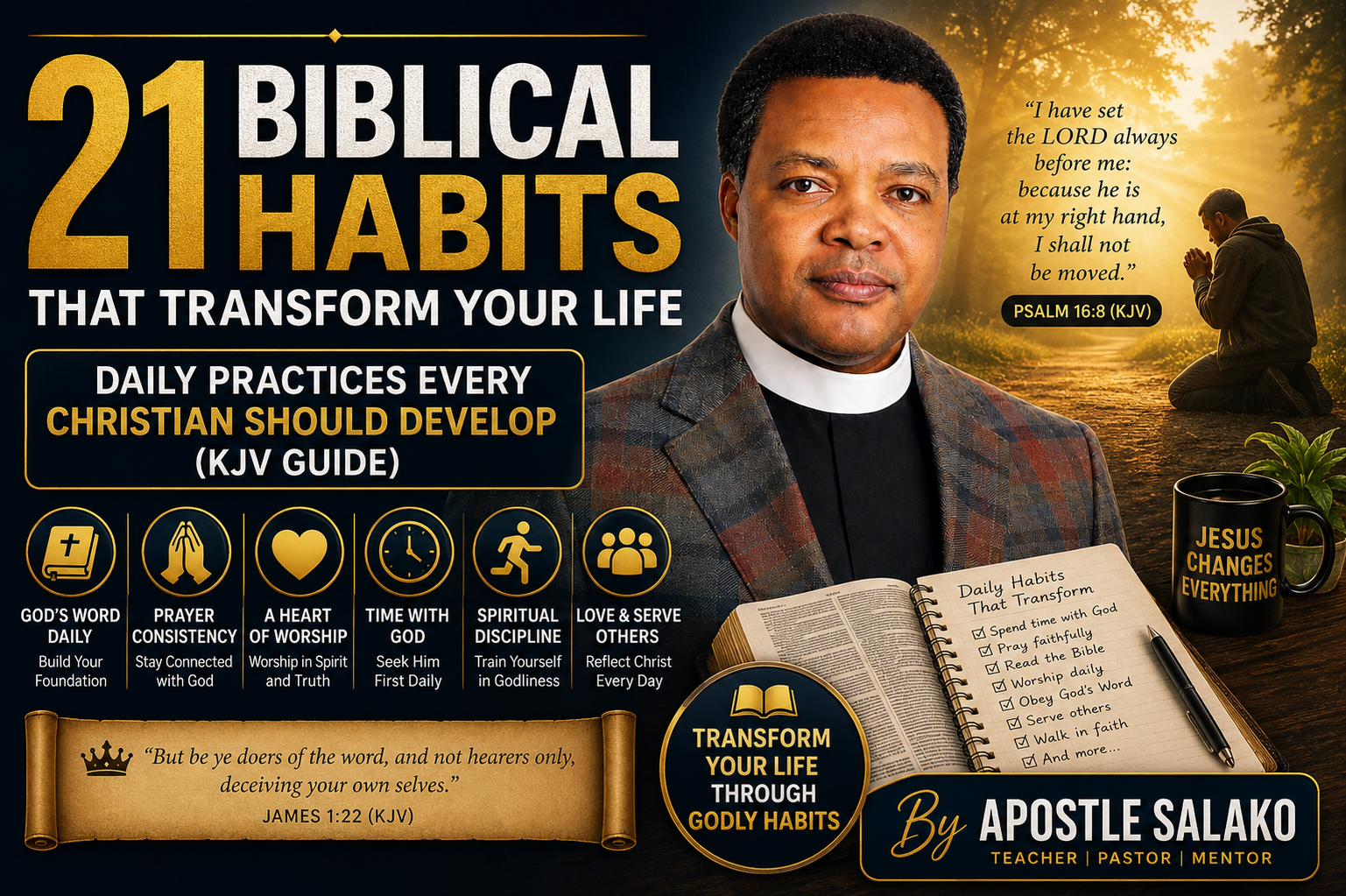
This guide explores 21 biblical habits that have transformed believers throughout history. Each habit is grounded in Scripture, illustrated with biblical examples, and accompanied by practical applications you can begin implementing today.
Why Habits Matter Spiritually
God designed life around rhythms and repetition. The sun rises daily, seasons change predictably, and our bodies function through consistent biological patterns. In the same way, spiritual growth is nurtured through regular practices rather than sporadic efforts.
Spiritual habits are not a means of earning God's favor; salvation is by grace through faith. Rather, they are the natural response of those who have been transformed by God's grace and desire to grow in holiness.
"But be ye doers of the word, and not hearers only, deceiving your own selves." — James 1:22 (KJV)
Habit #1 – Put God First Every Day
"But seek ye first the kingdom of God, and his righteousness; and all these things shall be added unto you." — Matthew 6:33 (KJV)
Putting God first is the foundation of every other biblical habit. Before work, family responsibilities, ministry, or personal ambitions, our hearts should be set on honoring God. When He occupies first place, every other area of life falls into proper order.
Many believers struggle spiritually because they attempt to fit God into their schedules rather than building their schedules around Him. Jesus taught that the Kingdom of God must take precedence over earthly concerns.
Practical application: Begin each morning with thanksgiving. Read a portion of Scripture before checking your phone. Commit your plans to God in prayer. Ask the Holy Spirit to guide every decision throughout the day.
Habit #2 – Spend Time in Daily Prayer
"Pray without ceasing." — 1 Thessalonians 5:17 (KJV)
Prayer is the believer's lifeline. Through prayer we communicate with God, receive direction, confess sin, intercede for others, and express gratitude. Jesus Himself modeled a disciplined prayer life, often withdrawing to solitary places to commune with the Father.
Practical application: Set a regular time for prayer each day. Include praise, confession, thanksgiving, and intercession. Pray for family, church leaders, your community, and nations. End each day by reflecting on God's faithfulness.
Habit #3 – Read and Meditate on God's Word
"Thy word have I hid in mine heart, that I might not sin against thee." — Psalm 119:11 (KJV)
The Bible is God's revealed truth and the primary means by which He instructs, corrects, and transforms His people. Reading Scripture consistently renews the mind, strengthens faith, and provides wisdom for every area of life. Meditation goes beyond reading — it involves reflecting carefully, memorizing key verses, and considering how they apply to daily living.
Practical application: Follow a daily Bible reading plan. Memorize one verse each week. Journal insights and applications. Study passages in context to understand their meaning accurately.
Habit #4 – Walk in Obedience
"If ye love me, keep my commandments." — John 14:15 (KJV)
Love for God is demonstrated through obedience. Obedience is not legalism; it is the joyful response of a heart transformed by grace. Noah obeyed and was preserved. Joshua obeyed and Jericho fell. Mary submitted to God's call despite uncertainty.
Practical application: Respond promptly when convicted by Scripture. Avoid delaying obedience. Trust God's wisdom above your own understanding. Remember that small acts of faithfulness prepare you for greater responsibilities.
Habit #5 – Live by Faith Instead of Feelings
"For we walk by faith, not by sight." — 2 Corinthians 5:7 (KJV)
Feelings fluctuate with circumstances, but God's promises remain constant. Living by faith means trusting God's character and His Word even when emotions suggest otherwise. Abraham believed God's promise despite his old age. Peter stepped out of the boat because he trusted Jesus' command.
Practical application: Replace fearful thoughts with Scripture. Recall past instances of God's faithfulness. Refuse to make major decisions based solely on emotions. Declare God's promises during difficult seasons.
Habit #6 – Practice Daily Repentance
"If we confess our sins, he is faithful and just to forgive us our sins, and to cleanse us from all unrighteousness." — 1 John 1:9 (KJV)
Repentance is not merely an event that occurs at conversion; it is an ongoing attitude of humility before God. Daily repentance keeps our fellowship with God vibrant and our conscience clear. King David's response after his sin with Bathsheba illustrates genuine repentance — rather than hiding his sin, he confessed it wholeheartedly and sought God's cleansing.
Practical application: Examine your heart each evening. Confess sins specifically to God. Seek reconciliation with those you have wronged. Ask the Holy Spirit to reveal hidden attitudes that need correction.
Habit #7 – Guard Your Heart
"Keep thy heart with all diligence; for out of it are the issues of life." — Proverbs 4:23 (KJV)
The heart is the control center of a person's life — our thoughts, desires, motives, and affections. Everything we do flows from what we allow into our hearts. In today's digital world, believers are constantly exposed to influences; while not everything is sinful, not everything is beneficial (1 Corinthians 10:23).
Practical application: Limit content that promotes ungodly values. Surround yourself with spiritually mature believers. Memorize Scripture to renew your mind. Ask yourself daily, "Does this draw me closer to Christ?"
Habit #8 – Develop a Thankful Spirit
"In every thing give thanks: for this is the will of God in Christ Jesus concerning you." — 1 Thessalonians 5:18 (KJV)
Gratitude changes perspective. Thankfulness reminds us that every good gift comes from God and protects us from bitterness, pride, envy, and discouragement. Jesus consistently gave thanks — even before feeding the five thousand. Paul and Silas sang praises in prison.
Practical application: Begin each day by thanking God for at least five blessings. Keep a gratitude journal. Thank God even during difficult seasons. Express appreciation to family members and church leaders regularly.
Habit #9 – Forgive Quickly
"And be ye kind one to another, tenderhearted, forgiving one another, even as God for Christ's sake hath forgiven you." — Ephesians 4:32 (KJV)
Few habits transform a believer's life more profoundly than forgiveness. Holding onto resentment damages our fellowship with God and others. Jesus demonstrated perfect forgiveness on the cross: "Father, forgive them; for they know not what they do" (Luke 23:34). Forgiveness releases the offender into God's hands and frees the believer from carrying the burden of hatred.
Practical application: Pray for those who have hurt you. Refuse to rehearse past offenses. Seek reconciliation where possible. Remember how much Christ has forgiven you.
Habit #10 – Walk in Love
"And walk in love, as Christ also hath loved us." — Ephesians 5:2 (KJV)
Love is the defining mark of a follower of Jesus Christ. "By this shall all men know that ye are my disciples, if ye have love one to another" (John 13:35). Biblical love goes beyond emotion — it is an intentional commitment to seek another person's highest good.
Practical application: Perform one act of kindness each day. Speak words that encourage rather than criticize. Pray for opportunities to serve others. Love people regardless of whether they can repay you.
Habit #11 – Practice Humility
"Humble yourselves therefore under the mighty hand of God, that he may exalt you in due time." — 1 Peter 5:6 (KJV)
Humility is not thinking less of yourself — it is thinking of yourself less. Jesus, the King of kings, washed His disciples' feet, demonstrating that greatness in God's Kingdom is measured by service. "God resisteth the proud, but giveth grace unto the humble" (James 4:6).
Practical application: Admit mistakes quickly. Give God the glory for every success. Welcome wise correction. Celebrate others' accomplishments without jealousy.
Habit #12 – Live a Holy Life
"Be ye holy; for I am holy." — 1 Peter 1:16 (KJV)
Holiness means being set apart for God's purposes. It is not merely avoiding sinful behavior; it is living in a way that reflects God's character. Holiness touches speech, thoughts, relationships, entertainment, finances, business practices, sexual purity, worship, and integrity.
"Be not conformed to this world: but be ye transformed by the renewing of your mind..." — Romans 12:2 (KJV)
Practical application: Evaluate areas where compromise has crept into your life. Choose purity in speech and conduct. Invite accountability from mature believers. Depend daily on the Holy Spirit for strength.
Habit #13 – Be Filled with the Holy Spirit
"And be not drunk with wine, wherein is excess; but be filled with the Spirit." — Ephesians 5:18 (KJV)
The Christian life is not meant to be lived through human strength alone. Paul says "be filled," indicating continual dependence rather than a one-time experience. When believers are filled with the Spirit, they increasingly display the fruit described in Galatians 5:22–23: love, joy, peace, longsuffering, gentleness, goodness, faith, meekness, and temperance.
Practical application: Begin each day by surrendering yourself to God. Invite the Holy Spirit to guide your words and actions. Obey His promptings as revealed through Scripture. Avoid attitudes and behaviors that grieve the Holy Spirit (Ephesians 4:30).
Habit #14 – Serve Others
"For even the Son of man came not to be ministered unto, but to minister." — Mark 10:45 (KJV)
Jesus redefined greatness. In God's Kingdom, greatness is measured by humble service. Every believer has received gifts, abilities, and opportunities to bless others — in the local church, among neighbors, mentoring younger believers, or encouraging someone in need.
Practical application: Volunteer in your local church. Look for unnoticed needs around you. Use your spiritual gifts to bless others. Serve without seeking recognition or praise.
Habit #15 – Give Generously
"It is more blessed to give than to receive." — Acts 20:35 (KJV)
Generosity reflects the heart of God, who freely gave His Son for our salvation. The New Testament encourages believers to give willingly, cheerfully, and sacrificially. The widow's two mites (Mark 12:41–44) show that God values the heart behind the gift more than the amount given.
Practical application: Budget intentionally for giving. Support faithful gospel ministry. Help those facing genuine hardship. Practice generosity with your time, encouragement, and hospitality as well as your finances.
Habit #16 – Practice Self-Control
"He that is slow to anger is better than the mighty; and he that ruleth his spirit than he that taketh a city." — Proverbs 16:32 (KJV)
Self-control is the ability, empowered by the Holy Spirit, to govern our desires, emotions, words, and actions according to God's will. Paul compared the Christian life to an athlete who trains with discipline to receive a prize (1 Corinthians 9:24–27). Self-control affects speech, finances, eating habits, time management, sexual purity, entertainment, emotional responses, and social media use.
Practical application: Pause before reacting in anger. Set healthy boundaries for media and technology. Develop consistent daily routines. Pray for strength when facing temptation.
Habit #17 – Seek God's Wisdom
"If any of you lack wisdom, let him ask of God... and it shall be given him." — James 1:5 (KJV)
Knowledge provides information, but wisdom teaches us how to apply truth rightly. King Solomon became renowned because he valued wisdom above wealth and power. Believers seek wisdom through prayer, Scripture, counsel from mature Christians, experience, and walking closely with the Holy Spirit.
Practical application: Pray for wisdom before making major decisions. Study biblical principles rather than relying solely on opinions. Seek counsel from spiritually mature believers. Be teachable and willing to learn.
Habit #18 – Fellowship with Believers
"And let us consider one another to provoke unto love and to good works: Not forsaking the assembling of ourselves together..." — Hebrews 10:24–25 (KJV)
Christianity was never intended to be lived in isolation. The early church devoted themselves to the apostles' doctrine, fellowship, breaking of bread, and prayer (Acts 2:42). Their unity strengthened their witness and nurtured spiritual growth.
Practical application: Attend your local church faithfully. Join a Bible study or small group. Build friendships with believers who encourage spiritual growth. Support and pray for fellow Christians throughout the week.
Habit #19 – Share the Gospel
"Go ye therefore, and teach all nations..." — Matthew 28:19 (KJV)
Evangelism is not reserved for pastors or missionaries alone — it is the privilege of every Christian. Sharing the gospel can happen in everyday conversations, acts of kindness, personal testimonies, community outreach, or digital platforms. "For I am not ashamed of the gospel of Christ: for it is the power of God unto salvation..." (Romans 1:16).
Practical application: Pray daily for opportunities to witness. Learn to explain the gospel clearly and biblically. Share your testimony with humility. Support local and global missions through prayer and generosity. Use online platforms to spread biblical truth with grace and integrity.
Habit #20 – Persevere Through Trials
"My brethren, count it all joy when ye fall into divers temptations." — James 1:2 (KJV)
Trials are an unavoidable part of the Christian life. Faith is often refined in seasons of difficulty. Consider Joseph, Job, Ruth, and the Apostle Paul — each endured suffering, yet each witnessed God's faithfulness in remarkable ways. Perseverance means continuing to trust and obey God even when circumstances are painful or uncertain.
Practical application: Anchor your hope in God's promises rather than your circumstances. Pray honestly, bringing your fears and questions before God. Seek encouragement from mature believers during difficult seasons. Remember that God often uses trials to shape Christlike character.
Habit #21 – Finish Well
"I have fought a good fight, I have finished my course, I have kept the faith." — 2 Timothy 4:7 (KJV)
The Christian life is not a sprint but a lifelong journey of faithful discipleship. Paul looked back on his life with confidence — not because he was perfect, but because he had persevered in obedience to Christ. Finishing well means remaining committed to Christ through every season and continuing to grow, serve, and love God wholeheartedly until He calls us home.
Practical application: Evaluate your spiritual priorities regularly. Continue learning and growing in God's Word. Invest in discipling younger believers. Keep your eyes fixed on Christ, the author and finisher of our faith (Hebrews 12:2).
Frequently Asked Questions
What are biblical habits? Biblical habits are consistent, Scripture-based practices that help believers grow in their relationship with God and reflect the character of Christ.
How long does it take to develop godly habits? There is no fixed timeline. Growth varies, but consistent dependence on God's grace and daily obedience will gradually shape Christlike character.
Are these habits a way to earn salvation? No. Salvation is a gift of God's grace through faith in Jesus Christ (Ephesians 2:8–9). These habits are the fruit of a transformed life, not the basis of acceptance before God.
What should I do if I fail? Confess your sin to God, receive His forgiveness, and continue walking with Him. Spiritual growth includes learning to rely on God's grace rather than your own strength.
Which habit should I begin with? Start with daily prayer and regular Bible reading. These foundational disciplines strengthen every other area of the Christian life.
Bringing the 21 Habits Together
These habits are not isolated activities. Putting God first fuels prayer; prayer deepens Scripture; Scripture leads to obedience; obedience strengthens faith; faith encourages perseverance; perseverance shapes character; and character equips you to serve, love, forgive, and share the gospel. As these habits become part of your daily rhythm, they will transform not only your actions but your attitudes, relationships, and witness.
Final Challenge
Transformation rarely happens overnight. Instead of trying to master all twenty-one habits at once, choose one or two to focus on over the coming weeks. Pray for God's help, study the relevant Scriptures, and practice them consistently. As you yield yourself to God day by day, He will continue the good work He has begun in you (Philippians 1:6).
Closing Prayer
Heavenly Father, thank You for Your unfailing love and for the gift of Your Word, which guides us into truth. Thank You for the Holy Spirit, who empowers us to grow in holiness and faithfully follow Jesus. Help us to develop habits that honor You in every area of life. Teach us to seek You first, pray continually, treasure Your Word, walk in obedience, forgive freely, love sincerely, serve humbly, give generously, and persevere through every trial. Transform our hearts so that our lives reflect the character of Christ. Strengthen us to remain faithful until the end, bringing glory to Your name and pointing others to the hope found in Jesus. In Jesus' name we pray. Amen.
Conclusion
A transformed life is built one faithful decision at a time. As you consistently cultivate these habits through the power of the Holy Spirit, you will grow in spiritual maturity, strengthen your witness, and become increasingly conformed to the image of Jesus.
"But grow in grace, and in the knowledge of our Lord and Saviour Jesus Christ." — 2 Peter 3:18 (KJV)
Article by Apostle Salako Adedamola.
Apostle Adedamola Salako
Founder of Apostle Salako Studios — pastor, recording artist, and teacher on faith, music, and stewardship.
Frequently Asked Questions
QWhat are biblical habits?
Biblical habits are consistent, Scripture-based practices — like prayer, Bible study, obedience, generosity, forgiveness, and fellowship — that help believers grow in relationship with God and reflect the character of Christ.
QHow long does it take to develop godly habits?
There is no fixed timeline. Growth varies from person to person, but consistent dependence on God's grace and daily obedience will gradually shape Christlike character.
QAre these habits a way to earn salvation?
No. Salvation is a gift of God's grace through faith in Jesus Christ (Ephesians 2:8–9). These habits are the fruit of a transformed life, not the basis of acceptance before God.
QWhat should I do if I fail?
Confess your sin to God, receive His forgiveness, and continue walking with Him. Spiritual growth includes learning to rely on God's grace rather than your own strength.
QWhich habit should I begin with?
Start by prioritizing daily prayer and regular Bible reading. These foundational disciplines strengthen every other area of the Christian life.
Enjoyed this article?
Get the next one straight to your inbox. One thoughtful email a week.
Comments (0)
Comments are stored locally in your browser. For published responses, email us via the Contact page.
You may also like
Who Is the Holy Spirit? A Complete Biblical Guide to Knowing the Person, Power, and Work of the Holy Spirit
30 min read
Walking with God Every Day: The Complete Biblical Guide to Daily Christian Living (2026)
24 min read
The Baptism of the Holy Spirit Explained: Meaning, Power, Evidence, and Biblical Truth
30 min read