
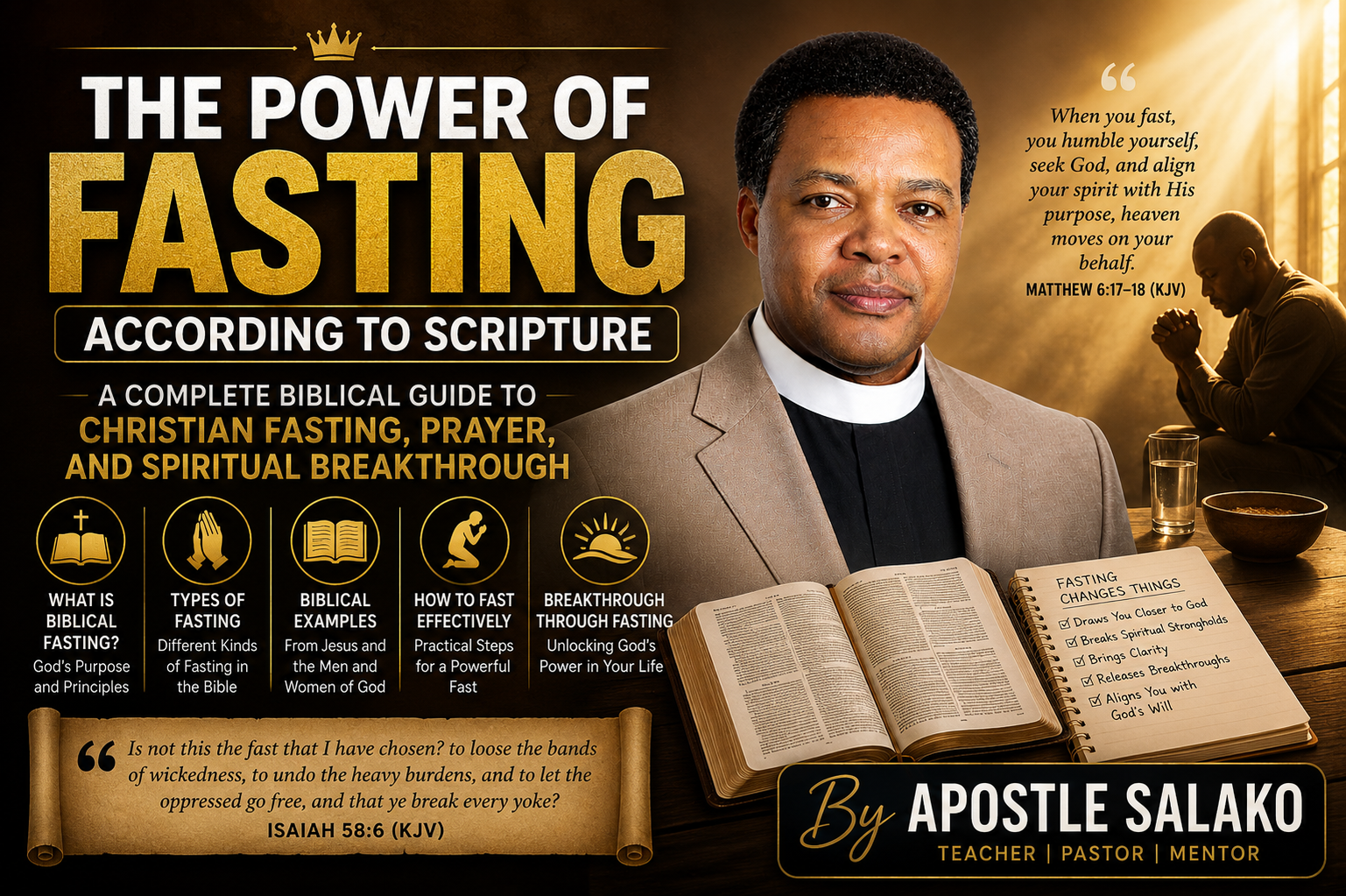
Throughout the history of God's people, fasting has been one of the most powerful spiritual disciplines practiced by believers who desired a deeper relationship with God. From Moses on Mount Sinai to Elijah in the wilderness, from Queen Esther before approaching the king to Daniel seeking divine revelation, fasting consistently appears in Scripture as a means of humbling oneself before God, seeking His guidance, and preparing for divine intervention.
In the New Testament, Jesus Christ not only practiced fasting Himself but also assumed that His followers would continue the discipline after His earthly ministry. His words in Matthew 6:16 begin with "When ye fast," not "If ye fast," indicating that fasting should be a normal part of the Christian life.
Unfortunately, many believers today either misunderstand fasting or neglect it entirely. Some view fasting merely as abstaining from food, while others believe it is a method of forcing God to answer prayers. Neither perspective reflects the full biblical picture.
Biblical fasting is not about manipulating God or earning His favor. Instead, it is a voluntary act of humility, worship, repentance, dependence, and spiritual focus. It is a practice that redirects our attention from physical appetites to the presence and purposes of God.
This comprehensive guide explores the power of fasting according to Scripture. You will discover what fasting truly is, why it matters, how Jesus practiced it, the different types of biblical fasting, the blessings associated with it, common misconceptions, and practical guidance for incorporating fasting into your spiritual life.
Whether you are a new believer seeking to understand biblical fasting or a mature Christian desiring renewed spiritual passion, this guide will help you approach fasting with wisdom, faith, and biblical balance.
What Is Biblical Fasting?
Biblical fasting is the voluntary abstinence from food—and, in some cases, other legitimate comforts—for a specific period in order to seek God with greater focus through prayer, worship, repentance, and dependence on Him.
At its core, fasting is an act of worship. It is a declaration that communion with God is more valuable than physical satisfaction.
Jesus said:
"Man shall not live by bread alone, but by every word that proceedeth out of the mouth of God."
— Matthew 4:4 (KJV)
This statement reveals the heart of fasting. Physical food sustains the body, but God's Word sustains the soul.
Biblical fasting is never an attempt to twist God's arm or compel Him to act. Instead, it positions the believer to become more attentive, humble, and receptive to God's will.
Key Characteristics of Biblical Fasting
A biblical fast involves several important elements:
Seeking God above personal comfort.
Combining fasting with sincere prayer.
Repentance from known sin.
Humility before God.
Greater dependence upon the Holy Spirit.
Desire to know God's will.
Worship and meditation on Scripture.
Without these elements, fasting becomes merely a physical exercise rather than a spiritual discipline.
Why God Commands His People to Fast
Throughout Scripture, fasting accompanies significant moments in the life of God's people. Although not commanded as a daily practice, it is consistently presented as an appropriate response during seasons of:
Seeking Direction
When important decisions needed to be made, God's people often fasted.
The early church fasted before appointing leaders.
"And when they had fasted and prayed... they sent them away."
— Acts 13:3
Fasting demonstrates our dependence on God's wisdom rather than human understanding.
Repentance
The prophet Joel called the nation of Israel to repentance through fasting.
"Turn ye even to me with all your heart, and with fasting..."
— Joel 2:12
True fasting involves inward transformation, not merely outward sacrifice.
Humility
King David declared:
"I humbled my soul with fasting."
Psalm 35:13
Fasting weakens pride because it reminds us of our dependence upon God for every breath and every blessing.
Spiritual Renewal
Many believers testify that fasting rekindles passion for God.
As distractions are reduced, spiritual sensitivity often increases.
Prayer becomes more intentional.
Scripture becomes more meaningful.
Worship becomes more heartfelt.
Intercession
Throughout the Bible, fasting frequently accompanies earnest prayer for others.
Examples include:
National revival
Deliverance
Healing
Protection
Divine mercy
Rather than replacing prayer, fasting intensifies our focus during prayer.
The Difference Between Dieting and Biblical Fasting
Many people confuse fasting with dieting.
While both involve restricting food, their purposes are entirely different.
Dieting | Biblical Fasting Physical health | Spiritual growth Lose weight | Draw nearer to God Improve appearance | Humble oneself Physical discipline | Spiritual discipline Self-centered goals | God-centered purpose
Weight loss may occur during a fast, but it is never the primary objective of biblical fasting.
When fasting becomes focused on physical appearance rather than spiritual devotion, it has departed from its biblical purpose.
Jesus' Teaching on Fasting
Jesus addressed fasting in one of His most well-known sermons.
"Moreover when ye fast, be not, as the hypocrites, of a sad countenance..."
— Matthew 6:16 (KJV)
Notice that Jesus did not say "if."
He said when.
This indicates that fasting was expected among His followers.
Jesus warned against fasting for public recognition. The religious leaders of His day intentionally looked weak and miserable so others would admire their spirituality.
Instead, Jesus instructed believers to:
Wash their face.
Maintain personal cleanliness.
Avoid drawing attention.
Fast for God rather than for public praise.
True fasting seeks God's approval rather than human applause.
Why Jesus Fasted for Forty Days
Before beginning His public ministry, Jesus fasted for forty days in the wilderness.
This event carries profound spiritual significance.
His fast demonstrated:
Complete dependence upon the Father.
Preparation for ministry.
Victory over temptation.
Submission to God's timing.
Spiritual readiness before public service.
Immediately after His fast, Jesus confronted Satan's temptations.
Each temptation centered on immediate gratification, pride, and worldly power.
Jesus overcame each temptation through unwavering trust in God's Word.
His example teaches believers that spiritual preparation often precedes spiritual assignment.
Old Testament Examples of Fasting
The Old Testament provides numerous examples of fasting in different circumstances. While each fast occurred in a unique context, they all reveal one central truth: God responds to humble hearts that seek Him sincerely.
Studying these examples helps believers understand not only when people fasted but also why they fasted and what spiritual principles remain relevant today.
1. Moses' Forty-Day Fast
Key Scriptures: Exodus 34:28; Deuteronomy 9:9–18
Moses experienced one of the most extraordinary fasts recorded in Scripture. While on Mount Sinai receiving God's covenant and the Ten Commandments, he remained in God's presence for forty days and forty nights without eating bread or drinking water.
"And he was there with the LORD forty days and forty nights; he did neither eat bread, nor drink water..." (Exodus 34:28, KJV)
Why Did Moses Fast?
His fast was not self-initiated for personal gain. It occurred in the overwhelming presence of God as he received divine revelation and interceded for Israel after their idolatry with the golden calf.
Lessons from Moses' Fast
God's presence becomes our greatest source of spiritual strength.
Fasting prepares believers to receive divine instruction.
Spiritual leaders should intercede sacrificially for God's people.
Intimacy with God transforms a person's life and ministry.
2. David's Fast of Repentance
Key Scripture: 2 Samuel 12:16–23
After Nathan confronted David concerning his sin with Bathsheba, David humbled himself before God through fasting and prayer.
He pleaded for mercy on behalf of the child born from that sinful relationship.
Although the child eventually died, David's response demonstrated genuine repentance rather than rebellion.
Lessons
Fasting cannot erase the earthly consequences of sin.
God values genuine repentance over religious rituals.
Repentance involves humility, not self-justification.
3. Jehoshaphat's National Fast
Key Scripture: 2 Chronicles 20:1–30
When Judah faced invasion from a vast enemy army, King Jehoshaphat proclaimed a nationwide fast.
Rather than trusting military strength, the nation sought God's intervention.
God responded by giving victory without Judah fighting the battle themselves.
Principles
Fasting acknowledges our inability apart from God.
National prayer can bring national deliverance.
God fights battles for those who depend upon Him.
4. Ezra's Fast for Protection
Key Scripture: Ezra 8:21–23
Before leading the returning exiles to Jerusalem, Ezra proclaimed a fast beside the River Ahava.
He desired God's protection during the dangerous journey.
Instead of requesting military escorts from Persia, Ezra trusted God's care.
"So we fasted and besought our God for this: and he was intreated of us." (Ezra 8:23)
Lessons
Fasting expresses confidence in God's protection.
Prayer should precede significant journeys and decisions.
Faith grows when we depend upon God rather than human security.
5. Esther's Fast Before Approaching the King
Key Scripture: Esther 4:15–17
Queen Esther faced an impossible situation.
The Jewish people faced extermination under Haman's wicked decree.
Before approaching King Ahasuerus—a move that could cost her life—Esther requested that all the Jews fast for three days.
"Fast ye for me..."
This corporate fast preceded one of the greatest deliverances recorded in Scripture.
Lessons
Fasting prepares believers for courageous obedience.
God's people should unite in seasons of crisis.
Divine favor often follows sincere dependence upon God.
6. Daniel's Partial Fast
Key Scripture: Daniel 10:2–3
Daniel mourned and sought understanding from God concerning future events.
During twenty-one days he abstained from delicacies, meat, and wine.
This passage forms the biblical basis for what many Christians call the Daniel Fast.
Results
God granted Daniel:
Greater revelation
Angelic visitation
Understanding of future prophecy
Spiritual insight
Lessons
God honors persistent seeking.
Some answers require perseverance in prayer and fasting.
7. The People of Nineveh
Key Scripture: Jonah 3
After Jonah preached God's warning, the people of Nineveh believed God's message.
The king proclaimed a citywide fast.
Everyone—from rulers to servants—even animals were prevented from eating during the period of repentance.
God saw their humility and withheld immediate judgment.
Lessons
Genuine repentance changes lives.
God delights in mercy.
National humility invites divine compassion.
New Testament Examples of Fasting
The New Testament continues the biblical pattern of fasting but places even greater emphasis on spiritual intimacy with Christ and dependence upon the Holy Spirit.
Jesus' Forty-Day Fast
Matthew 4:1–11
Before beginning His earthly ministry, Jesus fasted forty days.
During this time Satan tempted Him repeatedly.
Each temptation was defeated through God's Word.
This teaches believers that fasting should always be accompanied by Scripture.
Jesus demonstrated that spiritual preparation precedes spiritual power.
Anna the Prophetess
Luke 2:36–38
Anna served God in the temple for many years.
Scripture says she worshipped:
"...with fastings and prayers night and day."
Her life of devotion positioned her to recognize Jesus immediately when Mary and Joseph brought Him to the temple.
Lesson
Consistent spiritual disciplines sharpen spiritual discernment.
The Church at Antioch
Acts 13:1–3
While the church worshipped and fasted, the Holy Spirit spoke clearly concerning Barnabas and Saul.
This moment launched Paul's missionary journeys that transformed the early church.
Lessons
Churches should fast when:
Appointing leaders
Seeking God's direction
Beginning new ministries
Making major decisions
Paul and Barnabas
Acts 14:23
When appointing elders in new churches, Paul and Barnabas prayed and fasted.
Leadership selection was never treated casually.
Instead, spiritual discernment guided every decision.
Cornelius
Although Scripture does not focus extensively on his fast, Cornelius devoted himself to prayer before receiving Peter's visit (Acts 10).
His seeking heart prepared him for one of history's greatest moments—the Gospel reaching the Gentiles.
Types of Biblical Fasting
Scripture records several different kinds of fasting.
Not every fast is identical.
God may lead believers differently depending on circumstances.
1. Normal Fast
This is the most common biblical fast.
The believer abstains from food while drinking water.
Jesus appears to have practiced this during His wilderness fast because Scripture later mentions His hunger rather than thirst.
Suitable For
Personal revival
Seeking guidance
Prayer retreats
Spiritual renewal
2. Absolute Fast
An absolute fast excludes both food and water.
Examples include:
Moses
Elijah (under unique divine circumstances)
Esther's three-day fast
Because dehydration becomes dangerous quickly, this type of fast should only be undertaken in exceptional circumstances and with great wisdom.
3. Partial Fast
A partial fast limits certain foods rather than eliminating all food.
Daniel avoided:
Meat
Wine
Rich foods
Delicacies
Many Christians today practice a Daniel Fast by emphasizing fruits, vegetables, legumes, and simple foods.
The purpose is spiritual focus—not merely dietary change.
4. Corporate Fast
Entire congregations or nations sometimes fast together.
Biblical examples include:
Nineveh
Judah under Jehoshaphat
Esther's call to the Jews
Corporate fasting strengthens unity and shared dependence on God.
5. Personal Fast
Many biblical fasts were private.
Jesus encouraged believers not to advertise their fasting.
Private fasting cultivates sincerity and intimacy with God.
Should Christians Fast Today?
The New Testament never abolishes fasting.
Instead, Jesus assumed His followers would continue the practice.
After Jesus spoke about fasting, He added:
"Then shall they fast..."
(Matthew 9:15)
The apostles continued fasting.
The early church continued fasting.
Church history records that faithful believers throughout the centuries continued fasting.
Therefore, fasting remains a valuable spiritual discipline—not as a means of earning salvation, but as a way of seeking God with humility and devotion.
Biblical Principles Learned from Every Fast
Across all these examples, several consistent truths emerge:
Fasting is always directed toward God.
Prayer and fasting belong together.
Humility precedes divine exaltation.
Fasting cannot replace obedience.
God looks at the heart more than the outward act.
Spiritual breakthroughs come through dependence upon God, not religious performance.
Fasting prepares believers for service, discernment, and faithful obedience.
The Spiritual Benefits of Fasting
Many believers ask, "What happens spiritually when I fast?" While fasting does not manipulate God or guarantee specific outcomes, Scripture consistently shows that it positions believers to grow in humility, spiritual sensitivity, and dependence on the Lord.
Fasting does not change God's character—He is always faithful. Instead, it often changes our hearts, aligning our desires more closely with His will.
Below are ten significant biblical benefits of fasting.
1. Fasting Deepens Your Relationship with God
The primary purpose of fasting is not to obtain blessings but to know God more intimately.
Throughout Scripture, those who fasted sincerely sought God's presence above all else. Moses desired to know God's ways. David longed for God's mercy. Daniel sought understanding. Jesus withdrew to commune with the Father before beginning His public ministry.
When we temporarily set aside food, we are reminded that our greatest need is not physical nourishment but spiritual fellowship with God.
"Draw nigh to God, and he will draw nigh to you." — James 4:8 (KJV)
Practical Application:
Dedicate extra time to prayer and Bible reading during your fast.
Reduce unnecessary distractions such as excessive social media or entertainment.
Spend moments of hunger in worship rather than merely enduring discomfort.
2. Fasting Cultivates Humility
One of the recurring themes in Scripture is that fasting humbles the soul before God.
David wrote:
"I humbled my soul with fasting." — Psalm 35:13 (KJV)
Physical hunger reminds us of our dependence upon God. It exposes our weakness and points us to His strength.
Humility is essential because:
God gives grace to the humble.
Pride hinders spiritual growth.
A teachable heart is more receptive to God's guidance.
Fasting is not about proving spiritual strength but acknowledging our need for God's grace.
3. Fasting Sharpens Spiritual Discernment
Many biblical leaders fasted when seeking God's direction.
Examples include:
Ezra before leading the exiles (Ezra 8)
The church at Antioch before commissioning missionaries (Acts 13)
Paul and Barnabas when appointing elders (Acts 14)
Periods of focused prayer and fasting can help believers become more attentive to Scripture and the guidance of the Holy Spirit.
This does not mean that fasting automatically results in visions or extraordinary revelations. Rather, it often quiets competing distractions so that believers can better discern God's leading through His Word and Spirit.
4. Fasting Strengthens Prayer
Prayer and fasting are closely connected throughout the Bible.
Fasting is never presented as a substitute for prayer. Instead, it intensifies our dependence on God during prayer.
When physical appetite is set aside, time and attention can be redirected toward:
Intercession
Thanksgiving
Confession
Worship
Meditation on Scripture
The result is often greater focus and perseverance in prayer.
5. Fasting Encourages Repentance
Joel proclaimed:
"Turn ye even to me with all your heart, and with fasting..." — Joel 2:12 (KJV)
Biblical fasting often accompanies genuine repentance.
However, fasting itself does not earn forgiveness. Salvation and forgiveness are received through God's grace by faith.
Instead, fasting provides an opportunity to:
Examine our hearts.
Confess known sin.
Seek renewed obedience.
Restore fellowship with God.
6. Fasting Helps Break the Grip of Sinful Habits
Although fasting is not a cure-all, it teaches self-control.
By saying "no" to legitimate physical desires for a season, believers can strengthen the discipline needed to resist sinful temptations.
The apostle Paul wrote:
"I keep under my body, and bring it into subjection..." — 1 Corinthians 9:27 (KJV)
Fasting reminds us that, by God's grace, our appetites do not have to control us.
7. Fasting Increases Compassion for Others
Isaiah 58 teaches that God desires fasting that results in practical love for people.
True fasting should lead believers to:
Care for the poor.
Share with those in need.
Seek justice.
Demonstrate mercy.
A fast that neglects love for others misses God's intention.
As Christians experience physical hunger, they are often reminded of those who face hunger daily, prompting greater generosity and compassion.
8. Fasting Prepares Believers for Ministry
Before Jesus began His public ministry, He fasted.
The early church fasted before sending missionaries.
Paul and Barnabas fasted before appointing leaders.
These examples remind us that significant ministry decisions should be approached with prayerful dependence upon God rather than self-confidence.
9. Fasting Teaches Contentment
Modern culture encourages instant gratification.
Biblical fasting teaches the opposite.
Waiting on God develops patience and trust.
Instead of demanding immediate satisfaction, believers learn to rest in God's provision and timing.
10. Fasting Reorients Our Priorities
Life often becomes crowded with responsibilities, entertainment, and constant activity.
Fasting creates intentional space to refocus on what matters most:
Loving God.
Loving others.
Growing in holiness.
Advancing God's kingdom.
By stepping away from normal routines, believers can evaluate whether their priorities align with Scripture.
How Prayer and Fasting Work Together
Prayer and fasting are distinct spiritual disciplines, yet they frequently appear together in Scripture.
Prayer is communication with God.
Fasting is voluntary self-denial that accompanies prayer.
Together they express wholehearted dependence upon the Lord.
Why Combine Prayer with Fasting?
Fasting without prayer becomes little more than going without food.
Prayer without fasting remains valuable and effective, but there are seasons when fasting can deepen our focus and perseverance.
Throughout Scripture, believers fasted while praying for:
Wisdom
Guidance
Deliverance
Repentance
Protection
Revival
Ministry decisions
The emphasis is always on seeking God, not manipulating Him.
Preparing for a Biblical Fast
A meaningful fast begins before the first meal is skipped.
Preparation helps ensure that the focus remains on God rather than on the mechanics of fasting.
1. Clarify Your Purpose
Ask yourself:
Am I seeking God's guidance?
Am I desiring deeper fellowship with Christ?
Am I repenting of sin?
Am I interceding for others?
Am I preparing for ministry?
A clear spiritual purpose helps maintain focus.
2. Pray Before You Begin
Invite God to:
Purify your motives.
Strengthen your faith.
Guide your time.
Help you remain dependent upon Him.
3. Plan Your Schedule
Whenever possible:
Reduce unnecessary commitments.
Allow extra time for Bible reading.
Create quiet moments for prayer.
Limit digital distractions.
The goal is not simply to eat less but to seek God more.
4. Read Scripture Intentionally
Helpful passages include:
Isaiah 58
Matthew 6
Matthew 4
Joel 2
Psalm 51
Psalm 63
Acts 13
James 4
Meditating on God's Word keeps the fast centered on Him.
5. Consider Health Wisely
Some individuals—including those with certain medical conditions, pregnant women, nursing mothers, or those taking medications—may need to modify their approach to fasting.
Seeking appropriate medical advice when necessary is a wise expression of stewardship, not a lack of faith.
Biblical fasting should never be reckless or harmful.
A Simple Guide for First-Time Christian Fasting
If you have never fasted before, begin with realistic and prayerful steps.
Step 1: Choose a Time
Many believers begin with:
One meal
Sunrise to sunset
A single day
A partial fast
Start modestly and focus on consistency rather than length.
Step 2: Set Spiritual Goals
Examples:
Read an entire Gospel.
Pray for your family.
Intercede for your church.
Seek wisdom for a decision.
Spend uninterrupted time worshipping.
Step 3: Replace Meals with Prayer
Instead of using meal times for other activities, dedicate those moments to communion with God.
Step 4: Stay Focused on Scripture
Allow God's Word—not emotions—to guide your thoughts.
Journal insights, prayers, and Scriptures that encourage you.
Step 5: End the Fast with Thanksgiving
When concluding the fast:
Thank God for His faithfulness.
Reflect on what you learned.
Resume eating gradually if you have completed a longer fast.
Continue the spiritual habits developed during the fast.
The Heart Behind Biblical Fasting
Scripture consistently teaches that God values the condition of our hearts more than the outward act of fasting.
A person may abstain from food while remaining proud, unforgiving, or indifferent to God's commands.
Isaiah 58 reminds us that the fast God delights in includes:
Justice
Mercy
Compassion
Generosity
Obedience
Love for others
True fasting produces transformed lives, not merely empty stomachs.
Common Mistakes Christians Make While Fasting
Fasting is one of the most meaningful spiritual disciplines taught in Scripture, but it can easily become misunderstood or misapplied. The Bible consistently emphasizes that the value of fasting lies not in the act itself but in the heart behind it.
Here are several common mistakes believers should avoid.
1. Fasting Without Prayer
The most common mistake is treating fasting as simply skipping meals.
Biblical fasting is always connected with seeking God. If a person abstains from food but does not devote time to prayer, worship, and Scripture, the fast has lost its central purpose.
Application: Replace the time you would normally spend eating with intentional prayer, Bible reading, worship, or quiet reflection.
2. Fasting to Impress Others
Jesus warned against practicing spiritual disciplines for public recognition.
"Moreover when ye fast, be not, as the hypocrites, of a sad countenance..." — Matthew 6:16 (KJV)
Some religious leaders intentionally looked miserable so others would admire their devotion.
Jesus instructed His followers to maintain normal personal care and seek the Father's approval rather than human praise.
Application: Let your fasting remain an act of worship directed toward God, not a performance for people.
3. Thinking Fasting Earns God's Favor
God's love, forgiveness, and salvation are gifts of grace through faith in Jesus Christ.
Fasting does not make God love us more, nor does it obligate Him to answer every request exactly as we desire.
Instead, fasting is a response to God's grace. It expresses dependence, humility, and a desire to know Him more deeply.
4. Ignoring Obedience
Isaiah 58 teaches that God rejected fasting when His people continued living in injustice, selfishness, and disobedience.
True fasting includes:
Repentance
Mercy
Justice
Compassion
Integrity
Without obedience, fasting becomes an empty ritual.
5. Making Fasting a Competition
The length of a fast does not determine a person's spiritual maturity.
A believer who faithfully fasts one meal with sincere devotion may honor God more than someone who undertakes a lengthy fast for selfish motives.
Avoid comparing your spiritual practices with others.
6. Neglecting Physical Wisdom
Scripture encourages believers to care for their bodies responsibly.
If you have medical conditions, are pregnant, nursing, elderly, or taking medication, consider appropriate adjustments and seek medical advice when necessary.
Wisdom and faith are not opposites.
Who Should Fast?
Fasting is an appropriate spiritual discipline for many Christians who desire to seek God with greater focus.
Believers may choose to fast during seasons such as:
Seeking God's direction.
Preparing for ministry.
Repenting of sin.
Interceding for others.
Praying for revival.
Growing in spiritual maturity.
Expressing dependence upon God.
The New Testament does not prescribe one universal schedule or duration. Instead, believers should approach fasting willingly, prayerfully, and with biblical wisdom.
Frequently Asked Questions
Is fasting required for Christians?
The New Testament does not command a fixed fasting schedule for all believers. However, Jesus' teaching ("when you fast") and the practice of the early church indicate that fasting remains a valuable spiritual discipline for Christians.
Does fasting guarantee answered prayer?
No.
God always answers according to His perfect wisdom, timing, and will.
Fasting is not a method of controlling God. Rather, it helps believers seek Him with humility and align their hearts with His purposes.
Can I drink water while fasting?
Many biblical fasts appear to have included water. Some exceptional fasts, such as Esther's three-day fast or Moses' forty-day fast, involved no food or water, but these are extraordinary biblical events rather than general patterns.
For most Christians, a normal fast that includes water is the wisest and safest approach.
Can I fast from something other than food?
While biblical fasting primarily refers to abstaining from food, Christians may also choose to temporarily abstain from certain legitimate activities—such as entertainment or social media—to devote additional time to prayer and Scripture.
These practices can support spiritual focus but should not be confused with the biblical definition of fasting from food.
How long should I fast?
Scripture records a variety of fasting durations:
One meal
One day
Three days
Seven days
Twenty-one days
Forty days
The appropriate length depends on the individual's circumstances, health, and spiritual purpose. Begin with wisdom rather than attempting an extended fast without preparation.
Should children fast?
Parents should exercise wisdom and care. While children can learn spiritual disciplines such as prayer and self-denial, extended food fasts are generally not appropriate without careful consideration.
Key Biblical Principles to Remember
As you reflect on the examples and teachings throughout Scripture, remember these foundational truths:
Fasting is about seeking God, not impressing people.
Prayer and Scripture should accompany every fast.
Humility is more important than duration.
Obedience matters more than outward sacrifice.
Fasting is a gift of grace, not a means of earning God's favor.
Spiritual maturity is measured by Christlike character, not by the number of days one abstains from food.
Final Thoughts
Throughout both the Old and New Testaments, fasting emerges as a powerful expression of humility, repentance, worship, and dependence upon God. Moses fasted while receiving God's covenant. David fasted in repentance. Esther called for a corporate fast before risking her life to intercede for her people. Daniel fasted while seeking understanding. Jesus fasted before beginning His public ministry. The early church fasted as they sought the Holy Spirit's guidance for mission and leadership.
Yet in every case, the emphasis is not on the physical act alone but on the heart turned toward God.
Fasting is not about spiritual prestige. It is not a formula for manipulating circumstances or compelling God to act according to our desires. Rather, it is an invitation to slow down, humble ourselves, seek God's face, and become more attentive to His voice through Scripture and prayer.
When practiced with sincerity, fasting can deepen our communion with Christ, sharpen our spiritual discernment, strengthen our prayers, and cultivate greater dependence on God's grace. It reminds us that our deepest hunger is ultimately satisfied not by bread alone but by every word that proceeds from the mouth of God.
As you consider incorporating fasting into your spiritual life, begin with prayer, approach it with wisdom, and keep your focus fixed on the Lord. May every fast lead not merely to temporary self-denial but to lasting transformation into the likeness of Jesus Christ.
A Prayer for Those Beginning a Fast
Heavenly Father,
Thank You for the gift of drawing near to You through prayer and fasting. I confess that I often depend on my own strength instead of seeking Your wisdom and grace.
As I set aside physical comforts for a season, help me to hunger even more for Your presence. Purify my motives, guard my heart from pride, and teach me to delight in Your Word.
Strengthen me to obey You faithfully, to love others generously, and to trust Your perfect timing in every circumstance. May this season of fasting deepen my relationship with Jesus Christ and produce the fruit of the Holy Spirit in my life.
Thank You for Your mercy, Your guidance, and Your unfailing love.
In the name of Jesus Christ, I pray.
Amen.
Key Takeaways
Biblical fasting is a voluntary abstinence from food for the purpose of seeking God through prayer, worship, repentance, and dependence on Him.
Scripture presents fasting as a recurring spiritual discipline practiced by God's people in both the Old and New Testaments.
Jesus assumed His followers would fast and modeled the practice before beginning His public ministry.
Fasting is most effective when combined with prayer, Scripture meditation, humility, and obedience.
The goal of fasting is not to earn God's favor but to grow in intimacy with Him and align our hearts with His will.
Apostle Adedamola Salako
Founder of Apostle Salako Studios — pastor, recording artist, and teacher on faith, music, and stewardship.
Frequently Asked Questions
QIs fasting required for Christians?
The New Testament does not command a fixed fasting schedule, but Jesus' teaching ('when you fast') and the practice of the early church show that fasting remains a valuable spiritual discipline for believers.
QDoes fasting guarantee answered prayer?
No. God always answers according to His perfect wisdom, timing, and will. Fasting helps believers seek Him with humility and align their hearts with His purposes, not control His responses.
QCan I drink water while fasting?
Many biblical fasts appear to have included water. A normal fast with water is generally the wisest and safest approach for most Christians today.
QHow long should I fast?
Scripture records fasts ranging from one meal to forty days. The appropriate length depends on your health, circumstances, and spiritual purpose. Begin with wisdom rather than attempting an extended fast unprepared.
QWhat is the main purpose of fasting?
The primary purpose of fasting is to seek God more intently through prayer, worship, repentance, and dependence on Him. It deepens intimacy with Christ and reorients our priorities around God's kingdom.
Enjoyed this article?
Get the next one straight to your inbox. One thoughtful email a week.
Comments (0)
Comments are stored locally in your browser. For published responses, email us via the Contact page.
You may also like
21 Biblical Habits That Transform Your Life: Daily Practices Every Christian Should Develop (KJV Guide)
28 min read

40 Powerful Prayer Points with Bible Verses (Complete Biblical Prayer Guide for Every Christian)
45 min read

Who Is the Holy Spirit? A Complete Biblical Guide to Knowing the Person, Power, and Work of the Holy Spirit
30 min read