
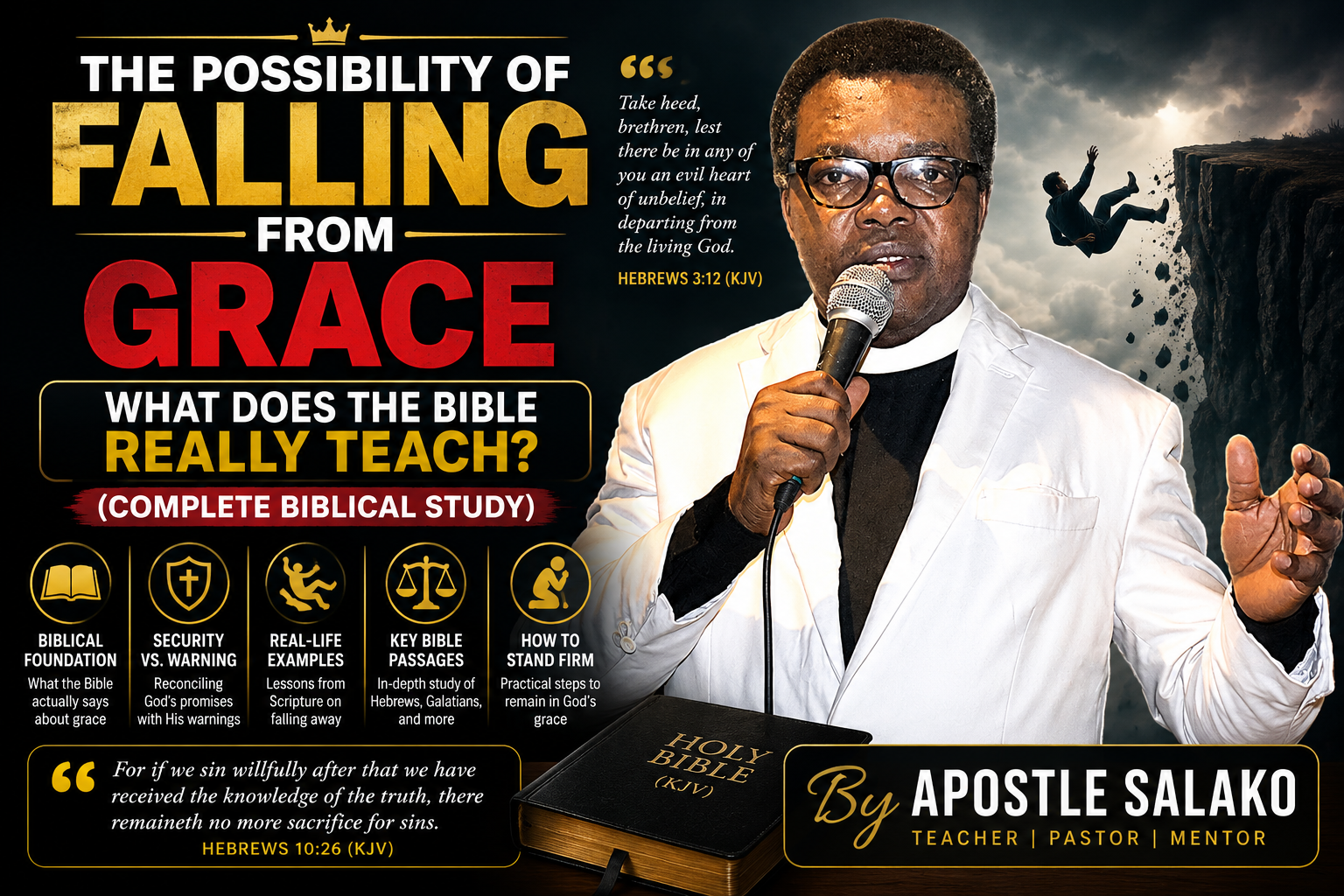
Few subjects have generated as much discussion among Bible teachers, pastors, and believers as the question: Can a Christian fall from grace? Some insist that once a person is genuinely saved, salvation can never be lost. Others believe that a believer who abandons Christ through persistent unbelief and rebellion can ultimately forfeit salvation.
This debate has continued for centuries because sincere Christians desire to remain faithful to the whole counsel of God. Rather than building doctrine on isolated verses, Scripture must be interpreted in context and allowed to explain itself. The Bible speaks powerfully about God's amazing grace and also contains solemn warnings against unbelief, deception, and falling away.
Throughout this study, all Scripture quotations are taken from the King James Version (KJV) unless otherwise noted.
What Does It Mean to Fall From Grace?
The expression 'fall from grace' appears only once in the Bible. Many people quote this verse without considering its context. Some assume it teaches that every sin causes a Christian to lose salvation. Others use it as proof that salvation is permanently lost. Neither conclusion faithfully reflects Paul's argument.
"Christ is become of no effect unto you, whosoever of you are justified by the law; ye are fallen from grace." — Galatians 5:4 (KJV)
The Crisis in Galatia
After Paul preached the gospel, many Gentiles believed in Jesus Christ and experienced the transforming work of the Holy Spirit. Later, false teachers arrived and insisted that faith alone was insufficient — Gentile believers also needed to observe the Law of Moses, especially circumcision, to be fully accepted by God.
Paul regarded this teaching as a corruption of the gospel. In Galatians 1:8–9 he pronounced a severe warning against anyone preaching 'another gospel.' The issue was not obedience to God in general, but the attempt to earn or maintain justification through human works instead of trusting wholly in Christ.
What Grace Means
Grace is God's unmerited favor shown to undeserving sinners. Paul explains it beautifully: 'For by grace are ye saved through faith; and that not of yourselves: it is the gift of God' (Ephesians 2:8). Grace means salvation is undeserved, freely given, purchased by Christ, received through faith, and never earned by human effort. Every believer stands before God because of Christ's righteousness — not personal merit.
Falling From Grace in Context
Paul says those seeking justification through the Law have 'fallen from grace.' He does not say they committed one terrible sin, lost God's love, or that God stopped offering forgiveness. Instead, Paul describes abandoning the principle of grace in favor of legalism — moving away from trusting Christ alone and placing confidence in religious performance.
"If righteousness come by the law, then Christ is dead in vain." — Galatians 2:21 (KJV)
Trying to earn salvation actually rejects the sufficiency of Christ's finished work.
Grace Is Not a License to Sin
One common misunderstanding is that if salvation is by grace, then obedience no longer matters. Paul rejects this idea immediately: 'Shall we continue in sin, that grace may abound? God forbid' (Romans 6:1–2). True grace transforms lives. Grace does not merely pardon sinners — it changes them. Those who truly know Christ increasingly desire holiness because the Holy Spirit lives within them.
Understanding the Grace of God
Grace calls: 'No man can come to me, except the Father which hath sent me draw him' (John 6:44). Grace saves: 'Being justified freely by his grace through the redemption that is in Christ Jesus' (Romans 3:24). Grace sanctifies: 'For the grace of God that bringeth salvation... teaching us that, denying ungodliness and worldly lusts, we should live soberly, righteously, and godly' (Titus 2:11–12). Grace sustains: 'By the grace of God I am what I am' (1 Corinthians 15:10).
Grace is not merely the doorway into Christianity. It is the atmosphere in which every believer lives. This is why Hebrews encourages believers to 'come boldly unto the throne of grace' (Hebrews 4:16).
What Does Galatians 5:4 Really Mean?
Paul writes, 'Stand fast therefore in the liberty wherewith Christ hath made us free.' His concern is freedom from legalistic bondage. He explains that anyone seeking justification through circumcision has obligated himself to keep the entire Law perfectly. Since no sinner can perfectly keep God's Law, this approach inevitably leads to condemnation rather than salvation.
Therefore, 'falling from grace' refers to abandoning the gospel of grace in favor of justification by works. It is not describing an ordinary believer who struggles with temptation, fails, repents, and continues trusting Christ. Instead, Paul warns against replacing Christ's finished work with human effort.
Can a True Believer Lose Salvation?
This question has given rise to two primary theological positions: the Eternal Security View (often summarized as 'Once Saved, Always Saved'), which teaches that every truly regenerated believer will be kept by God's power until the end; and the Conditional Security View, which teaches that believers must continue in faith and that deliberate, final apostasy can result in forfeiting salvation.
Faithful Christians have defended both positions using Scripture. One truth is undeniable: the Bible presents both glorious promises of God's preserving grace and serious warnings against falling away. A mature understanding must hold these truths together rather than ignoring one in favor of the other.
The Security of the Believer in Christ
"And I give unto them eternal life; and they shall never perish, neither shall any man pluck them out of my hand." — John 10:28 (KJV)
Eternal life is given, not earned. Christ Himself secures His sheep. No external force can remove believers from His hand. Jesus continues, 'My Father, which gave them me, is greater than all; and no man is able to pluck them out of my Father's hand' (John 10:29). If salvation depended solely upon human strength, no one would remain saved. But salvation rests upon God's faithfulness rather than human ability.
"Being confident of this very thing, that he which hath begun a good work in you will perform it until the day of Jesus Christ." — Philippians 1:6 (KJV)
Romans 8 concludes with one of the most triumphant declarations in Scripture: nothing 'shall be able to separate us from the love of God, which is in Christ Jesus our Lord' (Romans 8:38–39).
Why Then Does the Bible Contain Warnings?
If believers are secure in Christ, why do the New Testament writers repeatedly issue warnings in Hebrews 3, 6, and 10; Galatians 5; 1 Corinthians 10; Colossians 1; and Revelation 2–3? These warnings are not contradictions. They function as one of God's appointed means for preserving His people. Just as warning signs keep drivers from dangerous cliffs, biblical warnings call believers to vigilance, repentance, and perseverance.
The Difference Between Backsliding and Apostasy
Backsliding describes a believer who temporarily drifts from wholehearted obedience — spiritual coldness, neglected prayer, inconsistent worship, worldliness, or loss of spiritual passion. Although backsliding is dangerous, it is not identical to final rejection of Christ.
"Return, ye backsliding children, and I will heal your backslidings." — Jeremiah 3:22 (KJV)
Peter provides one of the greatest New Testament examples. He boldly promised he would never deny Christ, yet denied Him three times. Nevertheless, Jesus had already prayed, 'I have prayed for thee, that thy faith fail not' (Luke 22:32). Peter repented, wept bitterly, was restored, and later became one of the boldest leaders in the early church.
Apostasy is far more serious than temporary failure. Biblically, it refers to a decisive abandonment of the Christian faith after receiving significant knowledge of the truth — rejecting Christ, embracing unbelief, persistent rebellion, and refusal to repent. Judas illustrates that outward association with Christ is not identical to genuine conversion. Demas 'forsook' Paul, 'having loved this present world' (2 Timothy 4:10).
Biblical Examples of Believers Who Were Restored
David committed adultery and arranged Uriah's death, yet when confronted by Nathan he repented sincerely. Psalm 51 records his cry: 'Create in me a clean heart, O God' (Psalm 51:10). God disciplined him severely but restored fellowship.
Jonah deliberately fled from God's calling. God pursued him through a storm and a great fish. Jonah eventually repented and fulfilled his mission.
The Prodigal Son (Luke 15) squandered his inheritance and reached the lowest point imaginable. Yet when he returned, the father welcomed him with compassion, forgiveness, celebration, and restored sonship. The emphasis falls not upon the son's worthiness but upon the father's grace.
What Jesus Taught About Remaining in Him
"Abide in me, and I in you." — John 15:4 (KJV)
The Christian life is not sustained by occasional religious activity. It requires continual dependence upon Christ. 'He that abideth in me, and I in him, the same bringeth forth much fruit' (John 15:5). Fruit does not produce life — life produces fruit. Genuine believers increasingly display love, obedience, holiness, perseverance, and spiritual growth. These are not the basis of salvation but the evidence of genuine faith.
"He that shall endure unto the end, the same shall be saved." — Matthew 24:13 (KJV)
The Warning Passages in Hebrews
The book of Hebrews was written to Jewish Christians experiencing persecution and pressure to abandon Christ and return to the Old Covenant system. The writer repeatedly emphasizes that Jesus Christ is superior — greater than the prophets, angels, Moses, Joshua, Aaron, the Levitical priesthood, and the Old Covenant sacrifices. Because Christ is the perfect and final sacrifice, turning away from Him leaves no alternative means of salvation.
Hebrews 6:4–6 Explained
"For it is impossible for those who were once enlightened... If they shall fall away, to renew them again unto repentance..." — Hebrews 6:4–6 (KJV)
Three primary interpretations exist. View 1: genuine believers can lose salvation through decisive apostasy. View 2: those described experienced many blessings associated with the Christian community without ever being genuinely converted — comparable to Judas. View 3: the statement is hypothetical, emphasizing the seriousness of abandoning Christ while implying believers are preserved. Regardless of theological position, the central message is unmistakable — the writer warns against turning away from Jesus Christ.
Hebrews 10:26–31 Explained
"For if we sin wilfully after that we have received the knowledge of the truth, there remaineth no more sacrifice for sins." — Hebrews 10:26 (KJV)
The writer is not referring to ordinary daily sins that believers confess and forsake. Rather, he speaks about a deliberate, ongoing rejection of Christ's once-for-all sacrifice. After Christ's perfect sacrifice, there is no greater sacrifice available. If someone knowingly rejects Christ, no alternative means of salvation exists. 'It is a fearful thing to fall into the hands of the living God' (Hebrews 10:31). Grace does not eliminate God's holiness.
Paul's Personal Concern About Disqualification
'But I keep under my body, and bring it into subjection: lest... I myself should be a castaway' (1 Corinthians 9:27). The Greek word translated 'castaway' can also mean disqualified, particularly in athletic competition. Paul's concern is that after preaching to others he would not become spiritually ineffective or disqualified from faithful ministry. This fits the surrounding context better than uncertainty about God's saving grace.
Israel as a Warning to the Church
'Wherefore let him that thinketh he standeth take heed lest he fall' (1 Corinthians 10:12). The warning is against spiritual overconfidence. Confidence should rest in Christ — not in ourselves.
The Difference Between Struggling and Rejecting
A weak believer may battle temptation, struggle with doubts, experience spiritual dryness, fail repeatedly, and desire restoration. God patiently strengthens such believers. A hardened heart, however, is characterized by persistent unbelief, refusal to repent, rejection of biblical truth, contempt for Christ, and ongoing rebellion.
The Danger of Drifting
"Therefore we ought to give the more earnest heed... lest at any time we should let them slip." — Hebrews 2:1 (KJV)
Very few people wake up one morning and suddenly reject Christ. Spiritual decline usually happens gradually — neglected prayer, neglected Scripture, compromised obedience, worldly priorities, and isolation from Christian fellowship. Small compromises eventually produce significant spiritual decline.
Once Saved, Always Saved?
Although this exact phrase does not appear in the Bible, the concept is often associated with eternal security. Biblical eternal security does not teach that a person can profess faith, live in continual rebellion without repentance, and still expect salvation. It teaches that those who have been genuinely born again are preserved by God's power and will persevere in faith until the end. The emphasis is on God's faithfulness, not human perfection.
"Who are kept by the power of God through faith unto salvation ready to be revealed in the last time." — 1 Peter 1:5 (KJV)
Believers are kept by God's power and continue through faith. The Bible never encourages passive presumption. Instead, it presents divine preservation and human perseverance together.
The Perseverance of the Saints
Many theologians prefer 'Perseverance of the Saints' rather than 'Once Saved, Always Saved,' because the New Testament consistently describes true believers as people who continue trusting Christ. 'If ye continue in the faith grounded and settled, and be not moved away from the hope of the gospel' (Colossians 1:23). Perseverance is evidence of genuine faith. Saving faith continues because God sustains it.
Can a Christian Know They Are Saved?
"These things have I written unto you that believe on the name of the Son of God; that ye may know that ye have eternal life." — 1 John 5:13 (KJV)
Assurance rests upon God's promises, Christ's finished work, the witness of the Holy Spirit, and a transformed life that increasingly reflects Christ. This assurance is not based upon sinless perfection but upon God's unchanging faithfulness.
False Assurance
'Not every one that saith unto me, Lord, Lord, shall enter into the kingdom of heaven' (Matthew 7:21). Some possess religious language, ministry activity, impressive works, and public reputation yet lack genuine saving faith. Jesus does not say 'I knew you once,' but 'I never knew you' (Matthew 7:23). Outward profession alone is insufficient — true salvation involves a living relationship with Christ.
What About Those Who Leave the Faith?
"They went out from us, but they were not of us; for if they had been of us, they would no doubt have continued with us." — 1 John 2:19 (KJV)
John explains that some individuals leave the visible church because they were never truly united to Christ. Their departure reveals the true condition of their hearts. Only God knows the heart perfectly, but Scripture teaches that genuine faith produces perseverance.
Practical Signs of Spiritual Decline
1. Neglect of God's Word — when Scripture no longer shapes our thinking, spiritual weakness follows.
2. A fading prayer life — when believers cease praying regularly, self-reliance begins to replace faith.
3. Love for the world — 'Love not the world, neither the things that are in the world' (1 John 2:15). Anything that consistently competes with Christ for first place becomes spiritually dangerous.
4. Isolation from Christian fellowship — 'Not forsaking the assembling of ourselves together' (Hebrews 10:25). Isolation often makes temptation more effective.
5. An unrepentant attitude — every believer sins, but the child of God is grieved by sin and seeks forgiveness. Persistent refusal to repent hardens the heart.
How Believers Remain Steadfast
Abide in Christ: 'Without me ye can do nothing' (John 15:5). Live by the Spirit: 'Walk in the Spirit, and ye shall not fulfil the lust of the flesh' (Galatians 5:16). Feed on God's Word — meditation upon Scripture strengthens faith, exposes error, corrects sin, and encourages perseverance. Remain in fellowship — healthy churches help believers mature through preaching, worship, accountability, and discipleship. Keep your eyes on eternity — 'Our conversation is in heaven' (Philippians 3:20).
Can Someone Return After Falling Away?
"Therefore also now, saith the LORD, turn ye even to me with all your heart... And rend your heart, and not your garments." — Joel 2:12–13 (KJV)
Jesus gave this gracious promise: 'Him that cometh to me I will in no wise cast out' (John 6:37). Anyone who sincerely turns to Christ in faith can find mercy, forgiveness, and restoration.
Conviction Versus Condemnation
The Holy Spirit convicts believers to bring them back into fellowship with God — exposing sin, producing godly sorrow, leading to repentance, restoring fellowship, and pointing us toward Christ. 'Godly sorrow worketh repentance to salvation not to be repented of' (2 Corinthians 7:10).
Satan, however, seeks to discourage believers by whispering 'God has finished with you' and 'There is no hope.' The gospel answers with one glorious declaration: 'There is therefore now no condemnation to them which are in Christ Jesus' (Romans 8:1). While God convicts to restore, Satan condemns to destroy.
Common Misunderstandings About Falling From Grace
Misunderstanding 1 — Every sin causes a Christian to lose salvation. If this were true, believers would lose and regain salvation countless times. 'If any man sin, we have an advocate with the Father, Jesus Christ the righteous' (1 John 2:1).
Misunderstanding 2 — Grace means obedience is optional. Jude warned against those who 'turn the grace of our God into lasciviousness' (Jude 4). Grace never encourages sin; it empowers holy living.
Misunderstanding 3 — Good works earn salvation. 'Not by works of righteousness which we have done, but according to his mercy he saved us' (Titus 3:5). Good works are the fruit of salvation, not its foundation.
Misunderstanding 4 — Doubt equals apostasy. Thomas, Elijah, Asaph, and John the Baptist all experienced seasons of doubt. God patiently strengthened each of them. Temporary doubt is not the same as deliberate rejection of Christ.
Practical Steps to Remain in God's Grace
Keep Christ at the center: 'For to me to live is Christ' (Philippians 1:21). Develop a consistent prayer life — if the Son of God valued communion with the Father, how much more should we? Read and meditate on Scripture daily (Joshua 1:8). Walk in fellowship with other believers, because isolation magnifies temptation. Confess sin promptly, and depend upon the Holy Spirit for victory that willpower alone cannot achieve.
Living Daily in the Grace of God
Grace is not merely the starting point of the Christian life — it is the atmosphere in which believers live each day. We stand by grace. We grow by grace. We serve by grace. We persevere by grace. 'Grow in grace, and in the knowledge of our Lord and Saviour Jesus Christ' (2 Peter 3:18). The more we recognize our need for Him, the more we experience the sufficiency of His grace.
Final Biblical Conclusions
1. Salvation is entirely by grace. 'For by grace are ye saved through faith... not of works, lest any man should boast' (Ephesians 2:8–9).
2. Grace produces a changed life — love for Christ, love for God's Word, repentance from sin, growth in holiness, and perseverance in faith. These fruits do not earn salvation; they testify that God's saving work is active within the believer.
3. The warnings of Scripture must be taken seriously. They call believers to remain vigilant, reject false teaching, persevere in faith, avoid spiritual complacency, and continue trusting Christ.
4. Believers can have genuine assurance. Healthy assurance produces humility, gratitude, and faithful obedience — not carelessness.
5. Christ is able to keep His people.
"Now unto him that is able to keep you from falling, and to present you faultless before the presence of his glory with exceeding joy." — Jude 24 (KJV)
Our confidence is not in our ability to hold on to Christ but in Christ's ability to hold on to us.
How to Live Without Fear
If you belong to Christ, your focus should not be on constantly wondering whether you have fallen from grace. Instead, fix your eyes upon Jesus. Walk with Him daily. Trust His promises. Depend upon His grace. Remain sensitive to the leading of the Holy Spirit. The gospel calls believers neither to presumption nor to despair, but to confidence in Christ, humility before God, daily repentance, joyful obedience, and steadfast faith.
A Prayer for Steadfast Faith
Heavenly Father, thank You for Your amazing grace, revealed through the life, death, and resurrection of Jesus Christ. Thank You that salvation is Your gift and not the result of our own righteousness. Help us to remain steadfast in faith, rooted in Your Word, and sensitive to the leading of the Holy Spirit. Guard us from pride, deception, legalism, and spiritual complacency. When we stumble, grant us sincere repentance. When we grow weary, renew our strength. When we face temptation, provide the way of escape You have promised. Teach us to depend upon Your grace every day and to live lives that glorify Christ in thought, word, and deed. May we persevere faithfully until the day we stand before You with joy. In the mighty name of Jesus Christ our Lord. Amen.
Call to Salvation
If you have never placed your faith in Jesus Christ, today is the day of salvation. 'That if thou shalt confess with thy mouth the Lord Jesus, and shalt believe in thine heart that God hath raised him from the dead, thou shalt be saved' (Romans 10:9). No matter your past, Christ invites you to come. Turn from sin. Trust in Him alone. Receive His forgiveness. Begin a new life by His grace.
"I have fought a good fight, I have finished my course, I have kept the faith." — 2 Timothy 4:7 (KJV)
Article written by Apostle Salako Adedamola.
Apostle Adedamola Salako
Founder of Apostle Salako Studios — pastor, recording artist, and teacher on faith, music, and stewardship.
Frequently Asked Questions
QWhat does 'falling from grace' mean in Galatians 5:4?
In its immediate context, Paul refers to those seeking justification through the Law instead of trusting in Christ alone. The phrase primarily addresses abandoning grace as the basis of justification, not simply committing individual acts of sin.
QCan a Christian backslide?
Yes. Believers may experience periods of spiritual decline or disobedience. God lovingly calls His children to repentance and restoration (Jeremiah 3:22).
QIs backsliding the same as apostasy?
No. Backsliding describes temporary spiritual decline. Apostasy refers to a decisive rejection of Christ after receiving the knowledge of the truth.
QCan God restore someone who has wandered?
Yes. Throughout Scripture, God restored David, Peter, Jonah, Mark, and many others who repented sincerely. God remains rich in mercy toward those who return to Him.
QHow can I remain faithful to Christ?
Remain rooted in Scripture, prayer, obedience, fellowship with believers, dependence upon the Holy Spirit, and continual trust in God's grace (John 15:4–5).
QHave I committed the unpardonable sin?
The very concern often indicates a heart that still desires God. Those who have genuinely hardened themselves against the Holy Spirit show no desire for repentance. If you are grieved over sin and seeking Christ, continue to come to Him in faith.
Enjoyed this article?
Get the next one straight to your inbox. One thoughtful email a week.
Comments (0)
Comments are stored locally in your browser. For published responses, email us via the Contact page.
You may also like

Living a Christ-Centered Life in a Modern World (2026): A Complete Biblical Guide to Faith, Purpose, and Daily Victory
32 min read
Why God Answers Some Prayers and Delays Others (Biblical Truth About God's Timing)
28 min read
Trusting God During Difficult Times: A Complete Biblical Guide to Finding Peace, Strength, and Hope Through Every Storm
35 min read