
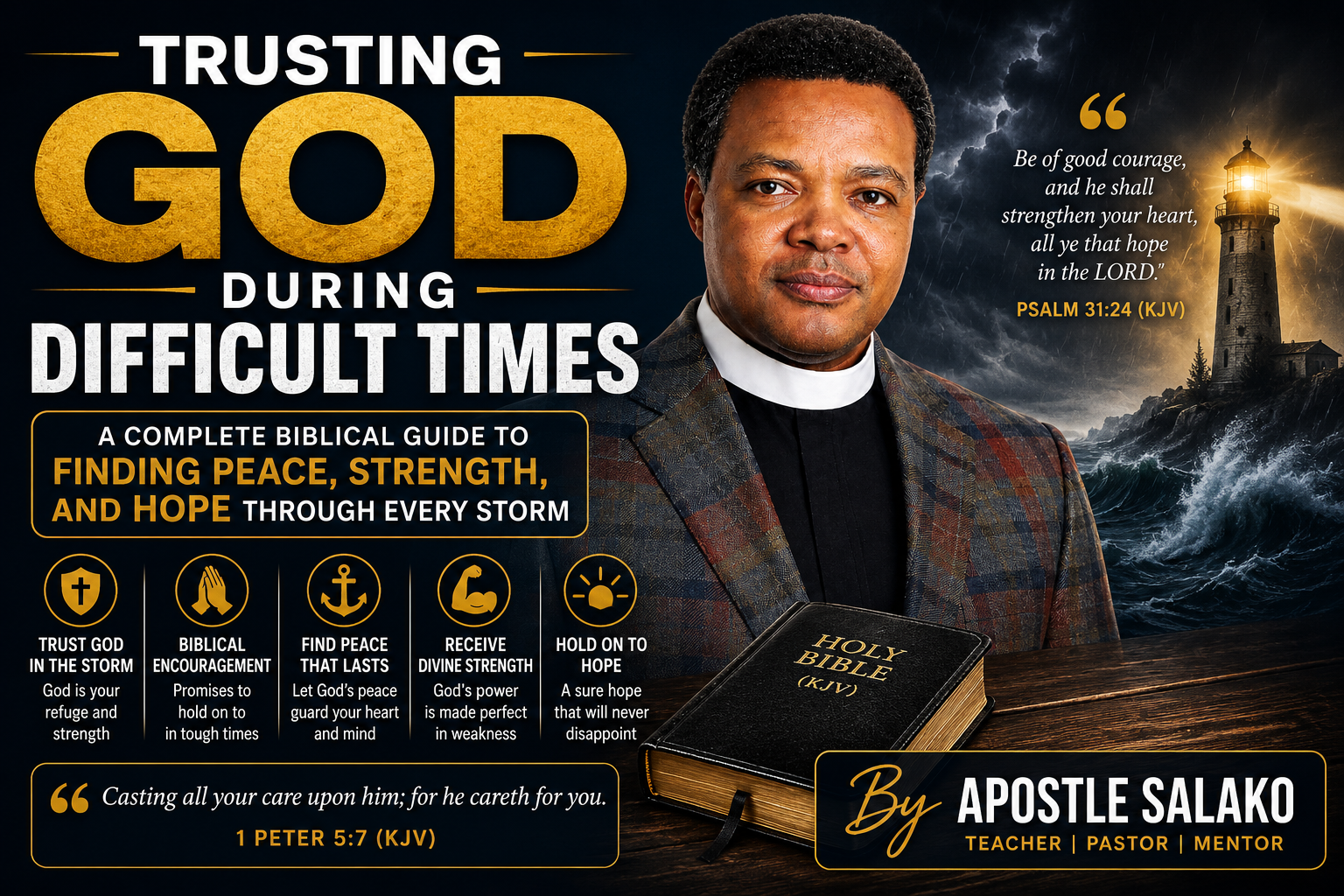
Life is filled with seasons we never expected — moments when the future appears uncertain, prayers seem unanswered, and every door we hoped would open suddenly closes. This complete biblical guide will help you trust God through every storm, drawing on Scripture, biblical examples, and practical daily habits that build unshakable faith.
Introduction
Life is filled with seasons we never expected. There are moments when the future appears uncertain, prayers seem unanswered, finances become unstable, sickness invades our homes, relationships fall apart, and every door we hoped would open suddenly closes.
It is during these moments that one question echoes through the heart of every believer: "Can I still trust God?" The answer from Scripture is an emphatic Yes.
Trusting God does not mean pretending that pain does not exist. It does not mean denying reality or ignoring suffering. Instead, trusting God means believing that even when life is confusing, painful, and unpredictable, God remains sovereign, faithful, loving, and completely in control.
The Bible never promises that believers will avoid hardship. Jesus Himself declared: "In the world ye shall have tribulation: but be of good cheer; I have overcome the world." (John 16:33, KJV)
Notice that Jesus did not say believers might experience trouble. He assured us that trials are part of life. Yet He also gave the greater promise — He has already overcome the world.
Throughout Scripture, we meet ordinary men and women who faced extraordinary difficulties. Joseph endured betrayal and imprisonment. Job lost nearly everything. David fled for his life. Daniel entered the lions' den. Paul suffered persecution. Above all, Jesus Christ endured the cross. None of them escaped hardship. Yet all of them discovered that God was faithful through every storm.
No matter what you are facing today, remember this timeless truth: God has never failed anyone who completely trusted Him.
What Does It Mean to Trust God?
Trust is one of the most fundamental themes throughout the entire Bible. The Hebrew and Greek words translated as "trust" carry meanings such as confidence, security, dependence, reliance, firm hope, and resting in another.
To trust God means placing your complete confidence in His character rather than your circumstances. It means believing that God knows what you cannot see, understands what you cannot explain, controls what you cannot change, and finishes what He begins.
Biblical faith is not optimism. Faith is confidence rooted in the character of God. Your circumstances may change daily. God never changes. Malachi 3:6 declares: "For I am the LORD, I change not..." Hebrews 13:8 reminds believers: "Jesus Christ the same yesterday, and to day, and for ever."
When everything around you changes, the unchanging nature of God becomes the anchor of your soul. Your storm may continue, but your foundation does not move.
God is faithful (Lamentations 3:22–23), good (Psalm 34:8), wise (Isaiah 55:8–9), and loving (Romans 8:32). If He willingly gave His Son for us, we can trust Him with everything else.
Why Does God Allow Difficult Times?
One of the oldest questions humanity has asked is: "If God is good, why does suffering exist?" The Bible provides several important answers.
1. Difficult times build mature faith. James 1:2–4 teaches that trials produce perseverance, and perseverance develops maturity. Just as muscles grow stronger through resistance, faith grows stronger through trials.
2. Trials draw us closer to God. Pain often removes distractions and teaches dependence. David wrote in Psalm 119:71: "It is good for me that I have been afflicted..." Sometimes suffering becomes the classroom where intimacy with God deepens.
3. Difficult seasons reveal our priorities. Storms reveal the strength of our spiritual foundation. Jesus compared two builders — both experienced storms, but only the house built upon the rock remained standing.
4. God uses trials to display His glory. In John 9, Jesus explained that a man was born blind so that the works of God would be revealed. When Lazarus died, Jesus delayed His arrival — and produced one of Scripture's greatest miracles. When God seems late, He is never absent.
5. Trials equip us to help others. Second Corinthians 1 teaches that the comfort we receive from God becomes the comfort we extend to others. Your present pain may become tomorrow's ministry. God rarely wastes suffering — He redeems it.
Biblical Examples of Trust During Trials
Joseph endured betrayal, slavery, false accusation, and prison, yet declared: "But as for you, ye thought evil against me; but God meant it unto good..." (Genesis 50:20, KJV). God can transform what others intend for evil into a testimony of His goodness.
Job lost his wealth, servants, livestock, children, health, and reputation, yet declared: "Though he slay me, yet will I trust in him..." (Job 13:15, KJV). His trust was rooted in God's character, not favorable circumstances. In the end, God restored Job abundantly (Job 42:10–17).
David was anointed king as a shepherd boy, yet years of rejection, isolation, and betrayal passed before he sat on the throne. Psalm 56:3 captures his attitude: "What time I am afraid, I will trust in thee." Faith is not the absence of fear — it is choosing God's promises over fear.
Daniel refused to compromise his prayer life even under a decree of death. Thrown into the lions' den, he discovered that trusting God does not exempt us from trials, but guarantees His presence within them.
Paul endured imprisonment, beatings, shipwrecks, hunger, and persecution, yet wrote: "And we know that all things work together for good to them that love God..." (Romans 8:28). God is not the author of evil, but He is powerful enough to redeem even the darkest circumstances for His glory and our good.
God's Promises for Difficult Seasons
God's promises are the believer's anchor during life's storms. Feelings change. Circumstances change. God's Word does not.
God promises His presence: "Fear thou not; for I am with thee: be not dismayed; for I am thy God..." (Isaiah 41:10). He does not merely promise solutions — He promises Himself.
God promises peace: "Peace I leave with you, my peace I give unto you..." (John 14:27). Biblical peace is not dependent on external conditions — it is an inward confidence that God remains in control.
God promises strength: "But they that wait upon the LORD shall renew their strength..." (Isaiah 40:31). Waiting is active dependence, not passive inactivity.
God promises wisdom: "If any of you lack wisdom, let him ask of God..." (James 1:5). Pray not only for God to remove the problem, but for wisdom to navigate it.
God promises provision. Matthew 6 reminds us our heavenly Father knows our needs before we ask Him. He gave manna in the wilderness, water from the rock, and food through ravens for Elijah — the same God still provides according to His wisdom and timing.
God promises eternal hope. "For our light affliction, which is but for a moment, worketh for us a far more exceeding and eternal weight of glory." (2 Corinthians 4:17)
How Fear Attacks Faith
Fear is one of Satan's most effective weapons. Its purpose is to shift our attention away from God and toward our circumstances. Fear magnifies problems. Faith magnifies God.
When Jesus invited Peter to walk on the water, Peter walked above his circumstances — until he focused on the wind and waves. The solution is not pretending the storm does not exist, but continually fixing our eyes upon Christ (Hebrews 12:2).
Fear often tells five common lies: (1) God has forgotten you — but Hebrews 13:5 says He will never leave you. (2) Your situation will never change — but Scripture is filled with impossible situations God changed. (3) You are facing this alone — but Psalm 23 promises His presence in every valley. (4) Your failure defines you — but God restored Peter, David, Jonah, and Mark. (5) There is no hope — but because Christ lives, believers always have hope.
Seven Biblical Principles for Trusting God
1. Know God through His Word. Faith comes by hearing the Word of God (Romans 10:17). When Jesus was tempted, He answered with Scripture. Make Bible reading a daily priority.
2. Pray before you panic. Philippians 4:6–7 instructs us to bring every concern to God with thanksgiving, and His peace will guard our hearts.
3. Obey God even when you don't understand. Noah built the ark before rain fell. Abraham left home without knowing his destination. Delayed understanding should never become delayed obedience.
4. Focus on God's promises, not your problems. Ten spies focused on giants; two focused on God's promise — only Joshua and Caleb entered the Promised Land.
5. Wait patiently on God's timing. "Wait on the LORD: be of good courage, and he shall strengthen thine heart." (Psalm 27:14) God's delays are not His denials.
6. Remember God's past faithfulness. David remembered God's deliverance from the lion and the bear before facing Goliath. The God who was faithful yesterday remains faithful today.
7. Rest in God's sovereignty. "Trust in the LORD with all thine heart; and lean not unto thine own understanding. In all thy ways acknowledge him, and he shall direct thy paths." (Proverbs 3:5–6)
Practical Daily Habits That Build Unshakable Faith
Begin each day with God's Word. Read Scripture before checking news, emails, or social media. Consider a Psalm, a chapter from the Gospels, or a passage from the Epistles each morning.
Maintain a prayer journal. Record prayer requests, encouraging Scriptures, answers to prayer, and lessons God teaches you. Looking back reveals God's faithfulness.
Practice daily gratitude. Paul encouraged believers to give thanks in every circumstance (1 Thessalonians 5:18). Write down three specific blessings each day.
Stay connected to other believers. Hebrews 10:24–25 encourages mutual encouragement through gathering. Isolation magnifies discouragement; fellowship strengthens faith.
Serve others during your own trials. Acts of kindness shift our attention away from ourselves and remind us that God can use us regardless of our circumstances.
How Prayer Deepens Trust
Prayer is more than presenting requests to God — it is cultivating a relationship with Him. As we know His heart, character, and faithfulness, trust naturally increases.
Come honestly. The Psalms are filled with raw expressions of grief, confusion, and hope. David cried out: "Why art thou cast down, O my soul?" (Psalm 42:5), yet continually redirected his heart toward hope in God.
Persist. Jesus taught persistence through the parable of the persistent widow (Luke 18). Persistence is not about persuading an unwilling God — it develops patient faith within us.
Prayer aligns our will with God's. Jesus demonstrated this perfectly in Gethsemane: "Nevertheless not my will, but thine, be done." (Luke 22:42) This is the highest expression of trust.
The Power of Worship in the Middle of the Storm
Worship is not reserved for moments of victory. Some of the most powerful worship occurs during hardship. Paul and Silas were imprisoned, beaten, and chained — yet at midnight they prayed and sang praises to God (Acts 16). The prison shook, chains were broken, and doors opened.
Worship changes perspective. When we focus only on our problems, they seem overwhelming. When we focus on God's majesty, our confidence grows. Isaiah saw the Lord "high and lifted up" (Isaiah 6) and was transformed.
True worship is an act of trust. It declares: "God, I still believe You. I still honor You. I still love You. I still trust Your plan." Even before circumstances change, worship affirms that God remains worthy.
What to Do When God Seems Silent
Many believers experience seasons when God's voice seems distant. Silence can be one of the greatest tests of faith. Yet throughout Scripture, God's silence never meant His absence. Joseph waited years. David waited years. Abraham waited decades.
If God seems silent: continue reading His Word, continue praying faithfully, continue obeying what you already know, continue worshipping, and continue trusting His timing.
Often God is accomplishing unseen work in your heart while preparing circumstances beyond your view. The teacher is often silent during the examination — but He is still present.
Common Mistakes Christians Make During Difficult Times
1. Depending on feelings instead of God's Word. Emotions are a gift, but they are unreliable guides. When your feelings contradict God's promises, choose to believe His Word (Jeremiah 17:9).
2. Comparing your journey with others. Jesus told Peter: "What is that to thee? follow thou me." (John 21:22) Your assignment is to remain faithful where God has placed you.
3. Giving up too soon. "And let us not be weary in well doing: for in due season we shall reap, if we faint not." (Galatians 6:9) What appears to be delay may be preparation.
4. Neglecting Christian fellowship. Withdrawing during pain increases discouragement. Accept help. Allow trusted believers to stand with you.
5. Forgetting past victories. Review answered prayers often. Celebrate God's faithfulness. Share testimonies with others.
6. Trying to carry every burden alone. "Come unto me, all ye that labour and are heavy laden, and I will give you rest." (Matthew 11:28)
Scriptures to Meditate on Daily
Trust and guidance: Proverbs 3:5–6; Psalm 37:5; Psalm 56:3; Isaiah 26:3; Psalm 125:1.
God's presence: Isaiah 41:10; Deuteronomy 31:8; Hebrews 13:5; Joshua 1:9; Psalm 23:4.
Strength: Isaiah 40:31; Philippians 4:13; Psalm 46:1; Nehemiah 8:10; 2 Corinthians 12:9.
Peace: John 14:27; Philippians 4:6–7; Colossians 3:15; Romans 15:13; Psalm 29:11.
Hope: Romans 8:28; Jeremiah 29:11; Lamentations 3:22–23; Psalm 34:17–19; 1 Peter 5:7.
Victory: Romans 8:37; 1 Corinthians 15:57; Psalm 91; Exodus 14:14; Revelation 21:4.
Spend time reading these passages aloud. As God's Word fills your mind, it gradually transforms your thinking and strengthens your trust.
A Practical Seven-Day Trust Challenge
Day One: Read Proverbs 3:5–6. Meditate on these verses throughout the day and ask God to help you trust Him with every area of your life.
Day Two: List at least ten ways God has provided for, protected, or blessed you in the past. Reflect on His consistency.
Day Three: Identify one concern you have been carrying. Pray specifically about it and consciously place it into God's hands.
Day Four: Call, visit, or send a message to someone who needs encouragement. Strengthening another's faith also strengthens your own.
Day Five: Spend at least thirty minutes worshipping God — reading a Psalm aloud, singing, and thanking Him for who He is.
Day Six: Memorize a promise such as Isaiah 41:10, Romans 8:28, or Philippians 4:6–7. Repeat it throughout the day.
Day Seven: Share your testimony. Tell someone how God has helped you through previous trials.
Final Encouragement
Perhaps you began reading this article while carrying a heavy burden — financial uncertainty, health challenges, grief, family conflict, or delayed answers to prayer.
God has not abandoned you. He sees every tear. He hears every prayer. He knows every fear. He understands every disappointment.
The God who carried His people through the Red Sea, sustained Elijah in the wilderness, protected Daniel in the lions' den, delivered Peter from prison, and raised Jesus Christ from the dead is the same God who walks beside you today.
Continue trusting Him. Continue obeying Him. Continue believing His promises. One day you will look back and discover that the God who seemed silent was working all along.
"I had fainted, unless I had believed to see the goodness of the LORD in the land of the living." (Psalm 27:13, KJV)
Prayer for Trust During Difficult Times
Heavenly Father, I come before You in the name of Jesus Christ. Thank You for Your unfailing love, mercy, and faithfulness. Even when I do not understand what You are doing, I choose to trust You.
Strengthen my faith when fear rises. Give me peace when my heart is troubled. Help me rely on Your promises instead of my emotions. Teach me to wait patiently for Your perfect timing.
I surrender every burden to You — my fears, my worries, my disappointments, and my unanswered questions. Fill me with the assurance that You are working all things together for my good and for Your glory. In Jesus' mighty name, Amen.
Invitation to Receive Jesus Christ
Trusting God begins with a personal relationship with Jesus Christ. The Bible declares that all have sinned and fall short of the glory of God (Romans 3:23). Yet God demonstrated His love by sending His Son to die for our sins and rise again, offering forgiveness and eternal life to all who believe.
If you have never placed your faith in Jesus, pray sincerely: "Lord Jesus, I confess that I am a sinner. I believe You died for my sins and rose again. I repent and ask You to forgive me. Come into my life, be my Lord and Savior, and help me follow You all the days of my life. Amen."
If you prayed this prayer with genuine faith, begin reading the Bible daily, pray regularly, and become part of a Bible-believing church where you can grow in your walk with Christ.
Apostle Adedamola Salako
Founder of Apostle Salako Studios — pastor, recording artist, and teacher on faith, music, and stewardship.
Frequently Asked Questions
QHow can I trust God when everything is going wrong?
Trust begins by focusing on God's character rather than your circumstances. Read His Word daily, pray honestly, remain connected to other believers, and remember His past faithfulness. God's promises remain true even when life feels uncertain.
QWhy does God allow Christians to suffer?
The Bible teaches that God uses trials to mature faith, develop perseverance, deepen dependence on Him, display His glory, and equip believers to comfort others. While not every reason is immediately understood, God works through suffering for His purposes and our good (Romans 8:28).
QDoes trusting God mean I should do nothing?
No. Biblical trust includes faithful action. Noah built the ark, Joseph served faithfully in prison, and Nehemiah rebuilt Jerusalem's walls. Trusting God means obeying Him while relying on His guidance and provision.
QHow long should I wait for God?
There is no universal timetable. God's timing differs for every person and every circumstance. Continue praying, obeying, and trusting Him while you wait. He is never late, even when His timing differs from yours.
QCan my faith become stronger through hardship?
Yes. James 1:2–4 teaches that trials produce perseverance, which leads to spiritual maturity. Throughout Scripture, many of God's servants emerged from suffering with deeper faith and greater usefulness.
QWhat if I have doubts?
Doubts do not automatically destroy faith. Bring your questions honestly to God, as many biblical figures did. Continue seeking Him through Scripture, prayer, and wise Christian counsel. Faith grows as we continually choose to trust God's truth over our uncertainties.
Enjoyed this article?
Get the next one straight to your inbox. One thoughtful email a week.
Comments (0)
Comments are stored locally in your browser. For published responses, email us via the Contact page.
You may also like

How to Pray According to the Bible (Complete Biblical Prayer Guide for Christians)
22 min read

Walking with God Every Day: The Complete Biblical Guide to Daily Christian Living (2026)
24 min read

21 Biblical Habits That Transform Your Life: Daily Practices Every Christian Should Develop (KJV Guide)
28 min read