
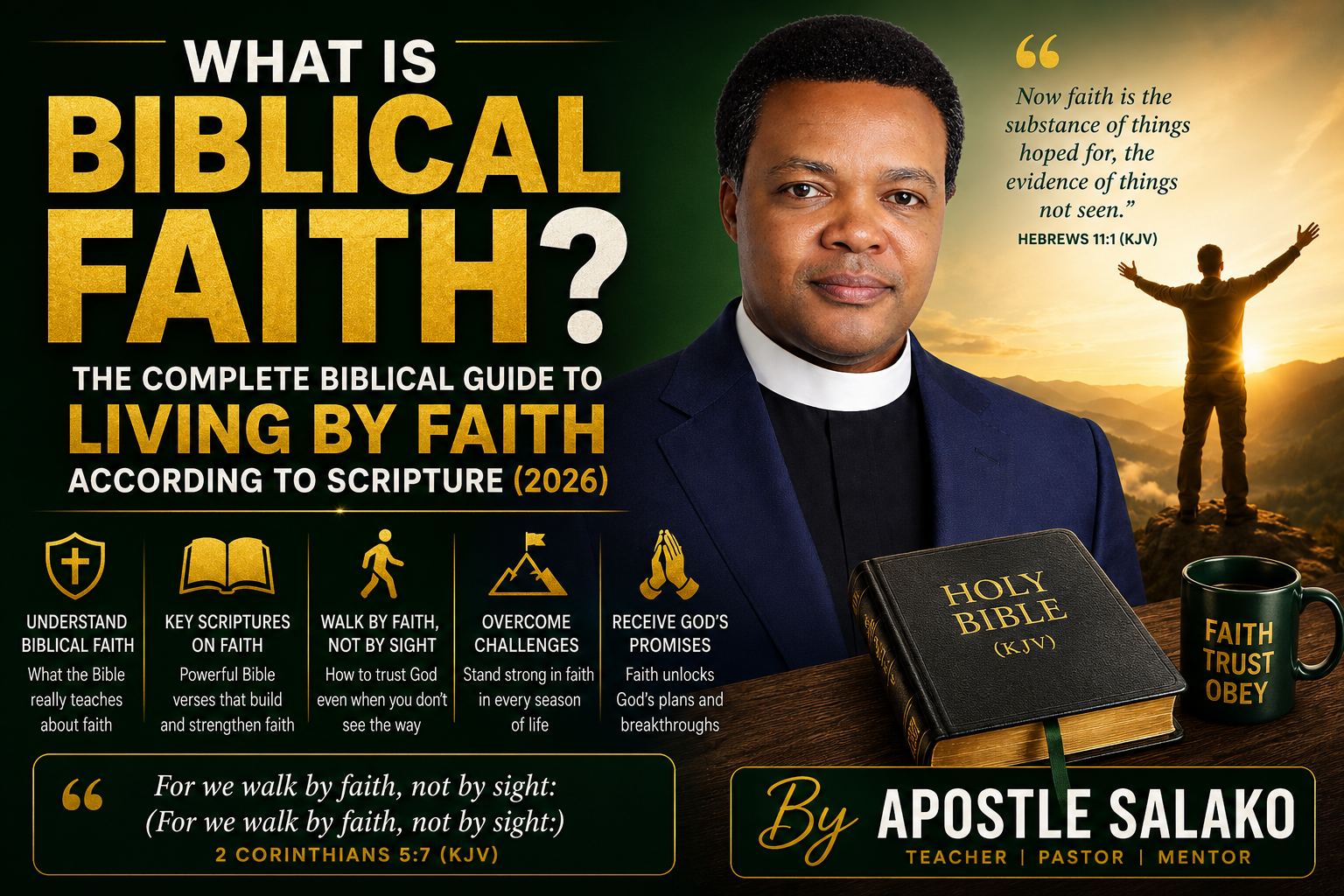
Introduction
Few words are used more often in Christian circles than faith, yet few words are more misunderstood.
People say,
"Just have faith."
Others believe faith is merely positive thinking.
Some imagine faith is the ability to convince themselves that everything will work out exactly as they desire.
Others think faith guarantees wealth, perfect health, or a life free from suffering.
But what does the Bible actually teach?
Biblical faith is much deeper than optimism, emotion, wishful thinking, or mental determination. It is the foundation of the Christian life, the means by which we receive salvation, the pathway through which we please God, and the confidence that enables believers to persevere through life's greatest challenges.
Without faith, Christianity cannot exist.
Faith connects the believer to Christ.
Faith receives God's grace.
Faith trusts God's promises.
Faith obeys God's commands.
Faith continues even when circumstances appear impossible.
Throughout Scripture, from Genesis to Revelation, God continually calls His people to walk by faith rather than by sight. Every great servant of God—from Abraham to Moses, from David to Daniel, from Peter to Paul—lived by trusting the Lord above their own understanding.
Yet biblical faith never asks us to believe without reason. Instead, it rests upon the trustworthy character of God, His revealed Word, and His unchanging promises.
This comprehensive guide explores what biblical faith truly is, how it develops, why it matters, and how every Christian can grow into a mature, steadfast believer who walks confidently with God.
What Does the Bible Mean by Faith?
The English word faith is translated from the Greek word pistis, meaning:
conviction
trust
confidence
reliance
assurance
steadfast belief
Biblical faith is not blind belief.
Instead, it is confident trust in the God who has already proven Himself faithful.
Faith is built upon God's character.
Because God cannot lie...
Because God never changes...
Because God's promises never fail...
His people can trust Him completely.
Faith always has an object.
Biblical faith is not faith in faith.
It is faith in God.
A person may have tremendous confidence in themselves, their finances, their education, or even religion—but unless their trust is placed in Jesus Christ, it is not saving biblical faith.
The Biblical Definition of Faith (Hebrews 11:1)
The clearest definition appears in Hebrews.
"Now faith is the substance of things hoped for, the evidence of things not seen." (Hebrews 11:1 KJV)
This single verse has inspired Christians for centuries.
Let us examine it carefully.
"Faith Is the Substance"
The word substance refers to assurance, confidence, or foundation.
Faith gives certainty to future promises.
Although believers have not yet seen heaven...
They possess confidence that heaven is real.
Although Christ has not yet visibly returned...
Faith rests confidently upon His promise.
Faith does not create reality.
Faith trusts the reality God has already declared.
"Things Hoped For"
Biblical hope differs greatly from worldly hope.
The world says,
"I hope things improve."
Meaning:
"I am uncertain."
Biblical hope means confident expectation.
God has promised eternal life.
Therefore Christians hope with certainty.
God has promised resurrection.
Therefore believers confidently expect it.
God has promised His return.
Therefore Christians wait expectantly.
Faith gives substance to these future realities.
"Evidence of Things Not Seen"
Many criticize Christianity because they believe faith ignores evidence.
Scripture teaches the opposite.
Faith recognizes evidence beyond physical sight.
No one has physically seen heaven.
Yet believers trust Christ's testimony.
No one watched God create the universe.
Yet Scripture reveals His creative power.
Faith accepts God's testimony as the highest authority.
Why Faith Is Essential for Every Christian
Faith is not merely one virtue among many.
It is central to every aspect of the Christian life.
Without faith:
salvation is impossible
prayer becomes empty
obedience becomes legalism
worship loses its purpose
hope disappears
perseverance becomes difficult
Scripture makes this unmistakably clear.
"But without faith it is impossible to please him..." (Hebrews 11:6 KJV)
Notice that the Bible does not say faith makes pleasing God easier.
It says pleasing God is impossible apart from faith.
Every act of genuine obedience flows from trusting God.
Faith Pleases God
Why does God value faith so highly?
Because faith honors His character.
When believers trust God despite unanswered questions, they declare:
God is truthful.
God is wise.
God is sovereign.
God is faithful.
God knows best.
Faith glorifies God because it acknowledges His perfection.
Faith Receives Salvation
One of the greatest truths in Christianity is that salvation is received—not earned.
Paul writes:
"For by grace are ye saved through faith; and that not of yourselves: it is the gift of God:" (Ephesians 2:8 KJV)
Notice the order:
Grace is God's gift.
Faith is the means by which we receive it.
Works do not produce salvation.
Instead, faith receives what Christ accomplished on the cross.
No sinner can purchase forgiveness.
No amount of good deeds removes guilt.
Only faith in Jesus Christ brings justification before God.
Faith Produces Peace
Life is filled with uncertainty.
Economic instability.
Family struggles.
Health concerns.
Unexpected disappointments.
Yet believers possess supernatural peace because their confidence rests not in changing circumstances but in God's unchanging nature.
Isaiah declared:
"Thou wilt keep him in perfect peace, whose mind is stayed on thee: because he trusteth in thee." (Isaiah 26:3 KJV)
Faith anchors the soul during life's storms.
The Difference Between Biblical Faith and Human Optimism
Many confuse faith with positive thinking.
The two are very different.
Human Optimism Says:
"I think everything will work out."
Biblical faith says:
"Even if circumstances become difficult, God remains faithful."
Optimism depends upon favorable outcomes.
Faith depends upon God's character.
Optimism disappears when circumstances worsen.
Faith often grows stronger during suffering.
Optimism trusts probability.
Faith trusts God's promises.
Faith Is Not Denial
Some imagine faith means pretending problems do not exist.
Scripture never teaches this.
David acknowledged danger.
Paul acknowledged suffering.
Job acknowledged pain.
Jesus acknowledged the cross.
Faith does not deny reality.
Faith declares that God's reality is greater than visible circumstances.
When David faced Goliath, he did not pretend the giant was small.
He simply believed God was greater.
Where Does Faith Come From?
A common question among believers is:
"How can I have stronger faith?"
The Bible answers clearly.
"So then faith cometh by hearing, and hearing by the word of God." (Romans 10:17 KJV)
Faith grows through God's Word.
Every time believers read Scripture...
Meditate upon God's promises...
Listen to biblical preaching...
Study the lives of faithful servants...
Their confidence in God increases.
Faith is nourished by divine truth.
Just as the body requires daily food, faith requires daily Scripture.
Neglecting God's Word weakens spiritual confidence.
Consistent exposure to God's truth strengthens the believer's trust and equips them to face trials with courage.
Faith Is Both God's Gift and the Believer's Responsibility
The Bible presents two complementary truths. Saving faith is a gift enabled by God's grace, yet believers are also commanded to grow in faith through obedience, prayer, fellowship, and continual dependence on the Holy Spirit.
This means that while no one can boast about possessing faith, every Christian has the responsibility to cultivate a deeper relationship with God through His Word and faithful living.
The Object of Biblical Faith
One of the greatest misconceptions about faith is the idea that faith itself has power. Scripture teaches something entirely different.
Faith is only as strong as the object in which it is placed.
Imagine two people crossing a bridge. One walks confidently but the bridge is weak. The other walks cautiously, yet the bridge is made of solid steel. The safety of both travelers depends not on the intensity of their confidence but on the strength of the bridge.
In the same way, biblical faith does not rest on our own confidence, emotions, or determination. It rests on the unchanging character of God.
Our faith is effective because God is faithful.
"If we believe not, yet he abideth faithful: he cannot deny himself." (2 Timothy 2:13 KJV)
This truth brings tremendous comfort. There will be days when your faith feels weak, your emotions fluctuate, and your understanding is limited. Yet God's promises remain unchanged.
The strength of Christianity lies not in the believer's perfection but in Christ's perfection.
Jesus Himself is the proper object of saving faith.
"Believe on the Lord Jesus Christ, and thou shalt be saved." (Acts 16:31 KJV)
Biblical faith looks away from self and fixes its eyes upon Jesus.
Faith Is Centered on Jesus Christ
The New Testament repeatedly directs believers to Christ.
He is:
the Author of our faith
the Finisher of our faith
our Great High Priest
our Redeemer
our Advocate
our Good Shepherd
the only Mediator between God and man
Hebrews reminds believers:
"Looking unto Jesus the author and finisher of our faith..." (Hebrews 12:2 KJV)
Notice that faith is not merely about believing facts concerning Jesus. It is entrusting your entire life to Him.
Saving faith includes:
believing His identity
trusting His finished work on the cross
depending upon His resurrection
submitting to His Lordship
following Him daily
Faith is personal.
It is not merely intellectual agreement.
Faith and Salvation
The doctrine of salvation is impossible to understand apart from faith.
From Genesis to Revelation, God has always justified sinners through faith.
Abraham lived before the Law of Moses.
Yet Scripture says:
"And he believed in the LORD; and he counted it to him for righteousness." (Genesis 15:6 KJV)
Paul uses Abraham as the great example that righteousness has always been received through faith rather than human effort.
We Are Not Saved by Good Works
Many people sincerely believe that if their good deeds outweigh their bad deeds, God will accept them.
The Bible teaches otherwise.
No one can earn salvation.
No amount of charity…
No religious ceremony…
No church attendance…
No financial giving…
No moral living…
can remove sin.
Paul writes:
"Not by works of righteousness which we have done, but according to his mercy he saved us..." (Titus 3:5 KJV)
This does not mean good works are unimportant.
Rather, good works are the result of salvation—not the cause of salvation.
Saving Faith Changes Lives
True faith always produces transformation.
James addresses those who claimed to possess faith while showing no evidence of obedience.
He writes:
"Faith without works is dead." (James 2:26 KJV)
James is not contradicting Paul.
Paul explains how people are saved.
James explains what genuine salvation looks like afterward.
Real faith produces:
love
obedience
generosity
holiness
compassion
forgiveness
perseverance
A changed life does not earn salvation.
It demonstrates salvation.
Living by Faith Every Day
Faith is not only the doorway into Christianity.
It is the pathway for the entire Christian journey.
Paul writes:
"The just shall live by faith." (Romans 1:17 KJV)
Living by faith affects every area of life.
Faith in Daily Decisions
Every day believers face choices.
Should I trust God with my finances?
Should I forgive someone who hurt me?
Should I obey Scripture even when culture disagrees?
Should I remain honest when dishonesty appears profitable?
Faith chooses obedience over convenience.
Faith asks:
"What does God say?"
rather than
"What feels easiest?"
Faith During Uncertainty
One reason many struggle with faith is the desire to know the future.
God rarely reveals every detail.
Instead, He asks His children to trust Him one step at a time.
Psalm 119 declares:
"Thy word is a lamp unto my feet, and a light unto my path." (Psalm 119:105 KJV)
Notice the imagery.
A lamp illuminates the next step—not the entire journey.
Faith walks even when tomorrow remains hidden.
Faith in Prayer
Prayer and faith are inseparable.
Jesus repeatedly emphasized believing prayer.
"What things soever ye desire, when ye pray, believe that ye receive them..." (Mark 11:24 KJV)
This does not mean demanding whatever we desire regardless of God's will.
Biblical faith prays confidently while submitting to God's wisdom.
Even Jesus prayed:
"Nevertheless not my will, but thine, be done." (Luke 22:42 KJV)
Faith trusts God whether the answer is:
Yes
No
Wait
Examples of Great Faith in the Bible
Scripture contains numerous examples of men and women whose faith continues to inspire believers today.
Their stories demonstrate that faith is practical, courageous, and persevering.
Abraham—Faith That Obeys
Abraham is called the father of faith.
When God instructed him to leave his homeland, Abraham obeyed without knowing where he was going.
"By faith Abraham... obeyed." (Hebrews 11:8 KJV)
Later, God promised Abraham a son despite his old age.
Human reasoning declared it impossible.
Faith believed God's promise.
Even when asked to offer Isaac, Abraham trusted that God could raise him from the dead.
Abraham teaches us that faith obeys before every question is answered.
Noah—Faith That Perseveres
Noah built the ark before rain had ever fallen upon the earth.
For decades he endured ridicule while faithfully obeying God.
"By faith Noah... prepared an ark." (Hebrews 11:7 KJV)
Faith often requires obedience long before visible results appear.
Moses—Faith That Chooses Eternity
Moses rejected the temporary pleasures of Egypt.
Instead, he chose suffering with God's people.
Scripture says:
"Choosing rather to suffer affliction with the people of God..." (Hebrews 11:25 KJV)
Faith values eternal rewards above temporary comfort.
David—Faith That Faces Giants
When David confronted Goliath, everyone else focused on the size of the giant.
David focused on the greatness of God.
His confidence was not in his sling.
It was in the Lord.
Faith does not ignore obstacles.
Faith remembers God's faithfulness.
Daniel—Faith Under Pressure
Daniel remained faithful despite political opposition.
Even when the king's decree threatened his life, Daniel continued praying.
His faith was demonstrated through consistent obedience.
God honored that faith by delivering him from the lions' den.
Daniel reminds believers that faithfulness is often tested before it is rewarded.
The Woman with the Issue of Blood
For twelve years this woman suffered physically, emotionally, socially, and financially.
Yet she believed that touching Jesus' garment would change everything.
Jesus declared:
"Thy faith hath made thee whole." (Mark 5:34 KJV)
Her story illustrates persistent faith that refuses to surrender despite years of disappointment.
The Roman Centurion
Jesus praised the Roman centurion for extraordinary faith.
The centurion understood authority.
He believed Jesus could heal with only a spoken word.
Christ responded:
"I have not found so great faith, no, not in Israel." (Matthew 8:10 KJV)
His faith rested entirely upon Christ's authority.
Peter Walking on Water
Peter demonstrated remarkable courage by stepping out of the boat.
As long as his eyes remained fixed on Jesus, he walked above the waves.
When he focused upon the wind, fear replaced faith.
Even then, Jesus reached out and rescued him.
Peter's story teaches that believers must continually keep their focus upon Christ rather than circumstances.
Paul—Faith Through Suffering
Few people endured greater hardship than the Apostle Paul.
He experienced:
imprisonment
beatings
shipwrecks
persecution
hunger
rejection
Yet Paul never abandoned his confidence in God.
He wrote:
"I know whom I have believed..." (2 Timothy 1:12 KJV)
Faith enabled Paul to rejoice even while suffering.
His confidence rested not in earthly comfort but in God's eternal promises.
Common Misunderstandings About Faith
Because the word faith is used so frequently, it is often misunderstood. Many believers struggle spiritually because they build their expectations on popular ideas rather than on Scripture. Let us examine several common misconceptions.
Misunderstanding 1: Faith Is Positive Thinking
One of the most widespread errors is equating faith with optimism.
Positive thinking focuses on human confidence:
"I can do this."
"Everything will work out."
"If I believe hard enough, it will happen."
Biblical faith is different.
It says:
"God is faithful."
"God's promises are true."
"God's will is perfect."
"God remains good even when I do not understand."
Positive thinking depends on self.
Biblical faith depends on God.
The Apostle Paul did not trust his own strength.
"I can do all things through Christ which strengtheneth me." (Philippians 4:13 KJV)
His confidence rested entirely in Christ.
Misunderstanding 2: Faith Guarantees an Easy Life
Some teach that strong faith eliminates hardship.
The Bible teaches the opposite.
Abraham faced famine.
Joseph endured slavery and prison.
David fled from Saul.
Daniel entered the lions' den.
The apostles suffered persecution.
Paul was imprisoned multiple times.
Even our Lord Jesus Christ suffered.
Faith is not an escape from trials.
Faith is the means by which believers endure trials while trusting God's sovereign purposes.
Jesus warned His disciples:
"In the world ye shall have tribulation: but be of good cheer; I have overcome the world." (John 16:33 KJV)
Misunderstanding 3: Faith Means Never Asking Questions
Some Christians fear that asking sincere questions demonstrates unbelief.
Scripture shows otherwise.
David often asked:
"Why?"
"How long?"
"Wherefore?"
Habakkuk questioned God's dealings with Israel.
Jeremiah expressed deep confusion.
Even John the Baptist sought reassurance while imprisoned.
Faith is not pretending to understand everything.
Faith is continuing to trust God even when every answer has not yet been revealed.
Misunderstanding 4: More Faith Means God Must Answer Every Prayer Exactly as Requested
God always answers prayer, but not always in the way we expect.
His answers may be:
Yes
No
Wait
Paul prayed three times that his "thorn in the flesh" would be removed.
Instead, God replied:
"My grace is sufficient for thee: for my strength is made perfect in weakness." (2 Corinthians 12:9 KJV)
Faith trusts God's wisdom above personal preference.
How to Grow Your Faith
Faith is not static.
Like a healthy tree, it is meant to grow stronger over time.
The disciples themselves recognized this need.
They prayed:
"Lord, Increase our faith." (Luke 17:5 KJV)
How does God answer such a prayer?
1. Read God's Word Daily
The primary source of spiritual growth is Scripture.
Paul writes:
"So then faith cometh by hearing, and hearing by the word of God." (Romans 10:17 KJV)
Every promise of God strengthens confidence.
Every testimony of God's faithfulness encourages trust.
Every command reveals His wisdom.
A believer who consistently studies Scripture develops mature faith.
Practical habits include:
Daily Bible reading
Verse memorization
Meditation
Personal study
Listening to sound biblical teaching
2. Pray Consistently
Prayer deepens dependence upon God.
Faith grows as believers bring every concern before Him.
Paul instructs:
"Be careful for nothing; but in every thing by prayer and supplication with thanksgiving let your requests be made known unto God." (Philippians 4:6 KJV)
Prayer reminds us that God—not our own ability—is our source of strength.
3. Obey What God Already Revealed
Faith grows through obedience.
Knowledge without obedience produces spiritual stagnation.
James writes:
"Be ye doers of the word, and not hearers only." (James 1:22 KJV)
Every act of obedience prepares believers for greater responsibilities.
4. Remember God's Past Faithfulness
Throughout the Old Testament, Israel repeatedly built memorials after experiencing God's deliverance.
Why?
Because remembering strengthens future faith.
David remembered defeating:
the lion
the bear
before confronting Goliath.
Your past testimonies become reminders of God's unchanging character.
Keeping a journal of answered prayers can help you remember God's faithfulness during seasons of doubt.
5. Spend Time with Faithful Believers
Faith is strengthened in Christian community.
The early church devoted themselves to fellowship, prayer, and the apostles' doctrine.
Surrounding yourself with spiritually mature believers provides encouragement, accountability, and wisdom.
Hebrews exhorts believers:
"And let us consider one another to provoke unto love and to good works." (Hebrews 10:24 KJV)
Obstacles That Weaken Faith
Although faith can grow, it can also be weakened if neglected.
Understanding these obstacles helps believers remain spiritually vigilant.
Fear
Fear shifts attention away from God and toward circumstances.
Peter walked confidently on the water until fear captured his attention.
When he looked at the storm instead of Christ, he began to sink.
Fear asks:
"What if everything goes wrong?"
Faith asks:
"What has God promised?"
Doubt
Doubt differs from honest questions.
Doubt refuses to trust God's character.
James writes:
"For he that wavereth is like a wave of the sea driven with the wind and tossed." (James 1:6 KJV)
Believers overcome doubt by returning to God's revealed truth rather than relying on fluctuating emotions.
Unbelief
Unbelief is more serious than temporary doubt.
It is the persistent refusal to trust God despite sufficient evidence.
Jesus often rebuked unbelief because it rejected God's revelation.
The solution is repentance and renewed trust in Christ.
Sin
Unconfessed sin damages fellowship with God.
It weakens spiritual confidence and hinders prayer.
David wrote:
"If I regard iniquity in my heart, the Lord will not hear me." (Psalm 66:18 KJV)
Repentance restores fellowship and strengthens faith.
Worldliness
The attractions of the world can slowly pull believers away from wholehearted trust in God.
Jesus warned that the cares of this world can choke spiritual fruitfulness.
Faith flourishes when Christ remains first in every area of life.
Faith During Trials and Waiting Seasons
One of the greatest tests of faith occurs not in moments of immediate crisis but during prolonged waiting.
Many believers ask:
"Why hasn't God answered?"
"Has God forgotten me?"
"Did I misunderstand His promise?"
Scripture repeatedly teaches that waiting is one of God's primary methods of developing mature faith.
Waiting Produces Endurance
James writes:
"Knowing this, that the trying of your faith worketh patience." (James 1:3 KJV)
Trials reveal whether faith is genuine.
Like gold refined by fire, authentic faith becomes stronger through testing.
God's Timing Is Perfect
Abraham waited decades for Isaac.
Joseph waited years before becoming governor of Egypt.
David waited before becoming king.
Israel waited centuries for the Messiah.
The disciples waited for the Holy Spirit.
God's delays are never accidental.
He is preparing both His people and His purposes.
"To every thing there is a season, and a time to every purpose under the heaven." (Ecclesiastes 3:1 KJV)
Faith During Suffering
The Apostle Peter encouraged suffering believers:
"That the trial of your faith, being much more precious than of gold that perisheth..." (1 Peter 1:7 KJV)
Notice that Peter calls tested faith "more precious than gold."
Why?
Because suffering often strips away self-reliance and deepens dependence upon God.
The Christian who trusts God through suffering becomes a powerful testimony to the world.
Faith Looks Beyond the Present
Paul endured severe affliction because he focused on eternal realities.
He wrote:
"For our light affliction, which is but for a moment, worketh for us a far more exceeding and eternal weight of glory." (2 Corinthians 4:17 KJV)
Faith sees beyond temporary pain to God's eternal promises.
Faith That Produces Good Works
The Bible never separates genuine faith from a transformed life.
While works do not save us, saving faith inevitably bears fruit.
Jesus taught:
"Every good tree bringeth forth good fruit." (Matthew 7:17 KJV)
A believer who truly trusts Christ will increasingly demonstrate:
Love for God
Love for others
Compassion for the needy
Integrity in business
Faithfulness in marriage
Holiness in conduct
Forgiveness toward enemies
Commitment to prayer
Hunger for God's Word
Zeal for evangelism
These works are not the root of salvation; they are its fruit.
As Paul reminds us:
"For we are his workmanship, created in Christ Jesus unto good works..." (Ephesians 2:10 KJV)
A vibrant faith is visible. It changes priorities, shapes character, and glorifies God through everyday obedience.
Frequently Asked Questions (FAQs)
1. What Is the Biblical Definition of Faith?
The Bible defines faith in Hebrews 11:1 (KJV):
"Now faith is the substance of things hoped for, the evidence of things not seen."
Biblical faith is confident trust in God based on His character, His promises, and His revealed Word. It is not blind belief or wishful thinking but a settled assurance that God is truthful and faithful.
2. Can Faith Be Increased?
Yes. Faith is intended to grow throughout the Christian life.
The Bible teaches that faith grows through:
Regular Bible reading
Prayer
Obedience to God's Word
Fellowship with mature believers
Remembering God's past faithfulness
Enduring trials with perseverance
Jesus' disciples prayed:
"Lord, Increase our faith." (Luke 17:5 KJV)
God delights in maturing the faith of His children.
3. Is Faith the Same as Hope?
No, although they are closely related.
Faith trusts God's promises in the present.
Hope confidently expects God's future fulfillment of those promises.
Faith is the foundation upon which biblical hope rests.
4. Does Everyone Have Faith?
Every person places trust in something—whether in wealth, relationships, personal ability, science, religion, or philosophy.
However, saving faith is trust placed specifically in Jesus Christ as Lord and Savior.
The object of faith matters more than the sincerity of faith.
5. Why Does God Allow My Faith to Be Tested?
Testing reveals, strengthens, and refines genuine faith.
James writes:
"Knowing this, that the trying of your faith worketh patience." (James 1:3 KJV)
Just as gold is refined by fire, mature faith is often developed through difficulties that teach us deeper dependence on God.
6. Can Someone Lose Faith?
The Bible warns against drifting, hardening the heart, and falling into unbelief.
True believers are called to persevere in faith, relying on God's sustaining grace.
The Christian life requires continual dependence upon Christ.
As believers abide in Him through His Word, prayer, and obedience, He strengthens and preserves them.
7. What Is the Difference Between Faith and Works?
Faith and works are not enemies.
Paul teaches:
We are saved by grace through faith.
Salvation is not earned by works.
James teaches:
Genuine faith naturally produces good works.
Works are the evidence of living faith—not the means of obtaining salvation.
8. What Does It Mean to Walk by Faith and Not by Sight?
Paul writes:
"For we walk by faith, not by sight." (2 Corinthians 5:7 KJV)
Walking by faith means making decisions based on God's truth rather than on changing circumstances, emotions, or visible evidence.
It involves trusting God even when His plans are not fully understood.
Key Lessons About Biblical Faith
As we conclude this study, let us summarize the major truths we have discovered.
Biblical faith:
Is complete trust in God and His Word.
Is centered on Jesus Christ.
Is grounded in God's unchanging character.
Is strengthened through Scripture and prayer.
Produces obedience and spiritual fruit.
Perseveres through suffering.
Looks beyond temporary circumstances.
Receives salvation by grace.
Pleases God.
Glorifies Christ.
Faith is not a mystical force.
Faith is not positive thinking.
Faith is not emotional excitement.
Faith is not pretending difficulties do not exist.
Faith is confident dependence upon the Lord.
Practical Ways to Live by Faith Every Day
Faith is not merely a theological concept—it is a daily way of life. Here are practical disciplines to cultivate biblical faith:
1. Begin Each Day with God's Word
Spend time reading and meditating on Scripture before engaging with the distractions of the day. Let God's truth shape your thinking.
2. Pray with Confidence
Bring every concern to God, trusting His wisdom even when His answers differ from your expectations.
3. Memorize God's Promises
Verses hidden in the heart become powerful encouragement during moments of fear and uncertainty.
4. Obey Promptly
Delayed obedience weakens faith. Respond quickly when God's Word clearly directs your actions.
5. Give Thanks Continually
Gratitude reminds us of God's past faithfulness and strengthens confidence for the future.
6. Share Your Faith
Speaking about Christ and sharing your testimony often deepens your own confidence in God's work.
7. Trust God's Timing
Resist the temptation to manipulate circumstances. Wait patiently for God's perfect plan to unfold.
Encouragement for Believers
Perhaps you are reading this article while facing challenges that seem overwhelming.
You may be praying for healing, waiting for employment, seeking restoration in your family, or asking God for direction.
Remember this truth:
Faith does not eliminate every storm, but it anchors the believer securely through every storm.
The same God who strengthened Abraham, Moses, David, Daniel, Esther, Peter, Paul, and countless faithful believers throughout history remains unchanged today.
He has not forgotten you.
He has not abandoned His promises.
His timing is perfect.
His wisdom is flawless.
His love is everlasting.
Even when your path is difficult, His presence is certain.
Isaiah gives this comforting promise:
"Fear thou not; for I am with thee: be not dismayed; for I am thy God..." (Isaiah 41:10 KJV)
Let your confidence rest not in your own strength, but in the One who is faithful forever.
A Prayer for Stronger Faith
Heavenly Father,
Thank You for revealing Yourself through Your Holy Word and through Your Son, Jesus Christ.
Forgive me for the times I have trusted my own understanding more than Your promises.
Strengthen my faith through the power of Your Holy Spirit.
Help me to trust You when life is uncertain, to obey You when Your commands are difficult, and to remain steadfast when trials come.
Teach me to walk by faith rather than by sight.
May my life bring glory to Your name and become a testimony of Your faithfulness to others.
Help me to love Your Word, persevere in prayer, and depend on Your grace every day.
Thank You for Your unfailing love, Your perfect wisdom, and Your eternal promises.
In the mighty name of Jesus Christ, I pray.
Amen.
Final Thoughts
Faith is the heartbeat of the Christian life.
It is how we come to Christ, how we grow in Christ, and how we remain faithful until we see Him face to face.
Every believer, whether new to the faith or mature in years, is called to continue growing in confidence and dependence upon God.
The Christian journey is not about having all the answers.
It is about trusting the One who does.
May your faith become stronger through God's Word, deeper through prayer, steadier through obedience, and brighter as a testimony to the world.
As the writer of Hebrews reminds us:
"Let us hold fast the profession of our faith without wavering; (for he is faithful that promised;)" (Hebrews 10:23 KJV)
Stand firm in Christ, walk faithfully with Him each day, and remember that the God who calls you is faithful to complete the work He has begun in you.
Conclusion
Biblical faith is far more than intellectual agreement or emotional optimism. It is wholehearted trust in the God who has revealed Himself through Scripture and supremely through Jesus Christ. Such faith receives salvation by grace, grows through God's Word, endures hardship with hope, and produces a life marked by obedience, holiness, and love.
Whether you are taking your first steps as a believer or have followed Christ for many years, God's invitation remains the same: trust Him completely. As you continue to walk by faith and not by sight, you will discover that His promises are true, His grace is sufficient, and His presence is constant.
May this understanding of biblical faith inspire you to pursue a deeper relationship with the Lord and encourage others to place their confidence in Him alone.
Suggested Internal Links
To strengthen your website's SEO and user engagement, link this article to related pillar posts such as:
How to Pray According to the Bible
Why God Answers Some Prayers and Delays Others
The Power of Fasting According to Scripture
Spiritual Warfare Through Prayer
Living a Christ-Centered Life in a Modern World
21 Biblical Habits That Transform Your Life
40 Powerful Prayer Points with Bible Verses
Call to Action
Has this study strengthened your understanding of biblical faith?
Share this article with your family, friends, and church community to encourage others in their walk with Christ. If this teaching has blessed you, explore more in-depth Bible studies and biblical resources by Apostle Salako Adedamola here on Apostle Salako Studios.
May the Lord strengthen your faith, establish you in His truth, and use your life for His glory. Amen.
Apostle Adedamola Salako
Founder of Apostle Salako Studios — pastor, recording artist, and teacher on faith, music, and stewardship.
Frequently Asked Questions
QWhat is the biblical definition of faith?
The Bible defines faith in Hebrews 11:1 (KJV): 'Now faith is the substance of things hoped for, the evidence of things not seen.' Biblical faith is confident trust in God based on His character, His promises, and His revealed Word. It is not blind belief or wishful thinking but a settled assurance that God is truthful and faithful.
QCan faith be increased?
Yes. Faith grows through regular Bible reading, prayer, obedience to God's Word, fellowship with mature believers, remembering God's past faithfulness, and enduring trials with perseverance (Luke 17:5; Romans 10:17).
QIs faith the same as hope?
No, although they are closely related. Faith trusts God's promises in the present, while hope confidently expects God's future fulfillment of those promises. Faith is the foundation upon which biblical hope rests.
QDoes everyone have faith?
Every person places trust in something, but saving faith is trust placed specifically in Jesus Christ as Lord and Savior. The object of faith matters more than the sincerity of faith.
QWhy does God allow my faith to be tested?
Testing reveals, strengthens, and refines genuine faith. James 1:3 says the trying of your faith works patience. Just as gold is refined by fire, mature faith is often developed through difficulties.
QCan someone lose faith?
The Bible warns against drifting, hardening the heart, and falling into unbelief. True believers are called to persevere in faith, relying on God's sustaining grace and abiding in Christ through His Word, prayer, and obedience.
QWhat is the difference between faith and works?
Paul teaches we are saved by grace through faith, not by works. James teaches that genuine faith naturally produces good works. Works are the evidence of living faith—not the means of obtaining salvation.
QWhat does it mean to walk by faith and not by sight?
Walking by faith means making decisions based on God's truth rather than on changing circumstances, emotions, or visible evidence. It involves trusting God even when His plans are not fully understood (2 Corinthians 5:7).
Enjoyed this article?
Get the next one straight to your inbox. One thoughtful email a week.
Comments (0)
Comments are stored locally in your browser. For published responses, email us via the Contact page.
You may also like
21 Biblical Habits That Transform Your Life: Daily Practices Every Christian Should Develop (KJV Guide)
28 min read
Who Is the Holy Spirit? A Complete Biblical Guide to Knowing the Person, Power, and Work of the Holy Spirit
30 min read
The Baptism of the Holy Spirit Explained: Meaning, Power, Evidence, and Biblical Truth
30 min read