
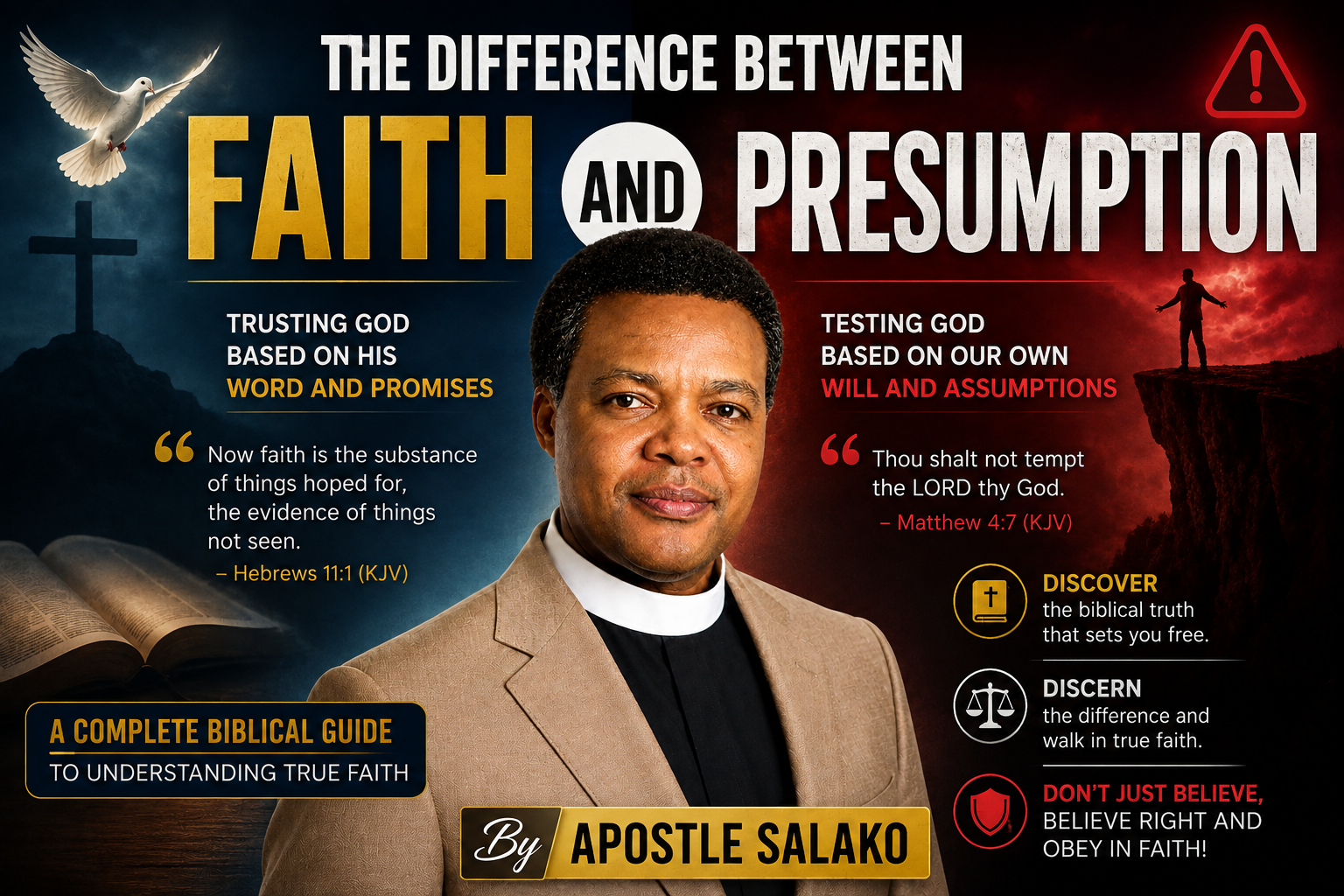
The Difference Between Faith and Presumption
How to Walk in Genuine Biblical Faith Without Testing God
By Apostle Salako Adedamola
The Difference Between Faith and Presumption: A Complete Biblical Guide to Understanding True Faith
Introduction: Understanding the Battle Between Faith and Presumption
What Is Biblical Faith?
What Is Presumption?
Why Many People Confuse Faith With Presumption
The Biblical Foundation of Genuine Faith
The Danger of Presumption in the Christian Life
Jesus Christ: The Perfect Example of True Faith
Faith Operates According to God’s Word and Will
Presumption Tries to Force God’s Hand
How to Test Whether Your Faith Is Genuine
Developing Mature Biblical Faith
Practical Steps to Walk in Faith and Avoid Presumption
Frequently Asked Questions
Conclusion: Trust God Completely, But Never Replace Faith With Presumption
Introduction: Understanding the Battle Between Faith and Presumption
Faith is one of the greatest foundations of the Christian life. Without faith, it is impossible to please God.
The Bible declares:
“But without faith it is impossible to please him: for he that cometh to God must believe that he is, and that he is a rewarder of them that diligently seek him.”
Hebrews 11:6 (KJV)
Faith connects humanity with the supernatural power of God. Through faith, believers receive salvation, walk in obedience, overcome challenges, experience divine provision, and fulfill God’s purposes.
However, there is another spiritual concept that often looks like faith but is completely different: presumption.
Presumption is one of the most dangerous traps in spiritual life because it often wears the appearance of confidence. A person operating in presumption may believe they are demonstrating strong faith, but they are actually acting independently of God’s will.
The difference between faith and presumption is the difference between trusting God and trying to control God.
Faith says:
“Lord, I trust You because You have spoken.”
Presumption says:
“Lord, I have decided what I want, and I expect You to approve it.”
Faith submits to God.
Presumption demands from God.
Faith follows God’s Word.
Presumption follows personal desire while attaching God’s name to it.
Understanding this difference is essential for every believer who desires spiritual maturity.
Many spiritual disappointments happen because people confuse their personal expectations with divine promises. They make decisions without seeking God, ignore biblical principles, and then call their actions “faith.”
True faith is not reckless confidence.
True faith is confidence built upon the character, promises, and direction of God.
What Is Biblical Faith?
The Definition of Faith According to Scripture
The Bible gives us one of the clearest definitions of faith:
“Now faith is the substance of things hoped for, the evidence of things not seen.”
Hebrews 11:1 (KJV)
Faith is spiritual confidence in God based on His revealed truth.
Biblical faith has three important foundations:
1. Faith Has an Object
Faith is not simply believing strongly in something.
Many people say:
“I have faith.”
But the important question is:
Faith in what?
Biblical faith is not faith in faith.
It is faith in God.
The Christian does not trust because circumstances are favorable. The Christian trusts because God is faithful.
“For we walk by faith, not by sight.”
2 Corinthians 5:7 (KJV)
Faith looks beyond natural circumstances and depends on God’s character.
2. Faith Comes Through Hearing God’s Word
True faith is produced by God’s revelation.
The Bible says:
“So then faith cometh by hearing, and hearing by the word of God.”
Romans 10:17 (KJV)
Faith is not manufactured by human imagination.
A person cannot simply desire something and declare:
“I have faith for it.”
Biblical faith begins when God speaks through His Word, His promises, His guidance, or His revealed purpose.
For example:
Abraham had faith because God gave him a promise.
“Now the LORD had said unto Abram, Get thee out of thy country, and from thy kindred, and from thy father's house, unto a land that I will shew thee.”
Genesis 12:1 (KJV)
Abraham did not leave because he randomly wanted an adventure.
He moved because God spoke.
Faith responds to divine instruction.
3. Faith Requires Trust and Obedience
Faith is not merely believing something intellectually.
Faith produces action.
James explains:
“Even so faith, if it hath not works, is dead, being alone.”
James 2:17 (KJV)
A person with genuine faith obeys God even when obedience requires sacrifice.
Noah demonstrated faith by building the ark when there was no evidence of rain.
“By faith Noah, being warned of God of things not seen as yet, moved with fear, prepared an ark to the saving of his house…”
Hebrews 11:7 (KJV)
Faith listens.
Faith obeys.
Faith waits.
Faith trusts God’s timing.
What Is Presumption?
Presumption is acting with confidence without divine authorization.
It is believing that God must support our decisions even though He never instructed us to make them.
Presumption often sounds spiritual:
“God understands.”
“God will make a way.”
“I know God will bless this.”
But the question is:
Did God actually say this?
Presumption replaces God’s voice with human assumption.
Biblical Meaning of Presumption
Presumption is closely connected with pride, self-confidence, and acting independently from God.
The Bible warns:
“There is a way which seemeth right unto a man, but the end thereof are the ways of death.”
Proverbs 14:12 (KJV)
Something can appear right and still be wrong.
Something can feel spiritual and still not be from God.
Something can sound like faith and still be presumption.
The Difference Between Faith and Presumption
Faith
Presumption
Comes from God’s Word
Comes from personal desire
Depends on God
Depends on self-confidence
Seeks God’s will
Assumes God’s approval
Waits for God’s timing
Rushes ahead
Produces humility
Produces pride
Obeys God’s instruction
Creates personal instructions
Trusts God’s wisdom
Trusts personal understanding
Biblical Example: Jesus and the Temptation in the Wilderness
One of the clearest examples of the difference between faith and presumption is found in the temptation of Jesus Christ.
After Jesus had fasted for forty days, Satan tempted Him:
“And saith unto him, If thou be the Son of God, cast thyself down…”
Matthew 4:6 (KJV)
Satan even quoted Scripture.
He said:
“For it is written, He shall give his angels charge concerning thee…”
Matthew 4:6 (KJV)
Notice something important:
The devil used a biblical promise incorrectly.
This reveals a powerful truth:
A Scripture taken out of God’s purpose can produce presumption instead of faith.
Jesus answered:
“Jesus said unto him, It is written again, Thou shalt not tempt the Lord thy God.”
Matthew 4:7 (KJV)
Jesus understood that jumping from the temple was not faith.
It was testing God.
Faith says:
“God has promised, therefore I trust Him.”
Presumption says:
“I will create a dangerous situation and expect God to rescue me.”
The Biblical Foundation of Genuine Faith
True biblical faith is not built upon emotions, personal opinions, or human confidence. It is built upon the unchanging character of God.
Faith begins with knowing who God is.
The more we understand God’s nature, the stronger our faith becomes.
The Bible says:
“For he that cometh to God must believe that he is…”
Hebrews 11:6 (KJV)
Before we can trust God’s promises, we must first trust God Himself.
Many people want the blessings of God without developing a relationship with the God of the blessings. However, genuine faith is not primarily about receiving things from God; it is about knowing and trusting God.
The Three Pillars of Biblical Faith
1. Faith Is Built on God’s Character
The foundation of faith is not circumstances.
Circumstances change.
People change.
Opportunities change.
But God does not change.
The Bible declares:
“For I am the LORD, I change not…”
Malachi 3:6 (KJV)
A believer’s confidence comes from knowing that God is faithful.
When Abraham received God’s promise of a son, the situation seemed impossible.
He was old.
Sarah was beyond the natural age of childbirth.
Yet Abraham believed because he understood the One who made the promise.
The Bible says:
“He staggered not at the promise of God through unbelief; but was strong in faith, giving glory to God.”
Romans 4:20 (KJV)
Abraham’s faith was not based on the strength of his circumstances.
It was based on the strength of God.
2. Faith Is Anchored in God’s Promises
Faith requires a promise.
A person cannot have biblical faith for something God has not promised.
This is where many believers become confused.
They mistake personal desire for divine promise.
For example:
A person may say:
“I believe God will give me this particular job.”
But has God promised that exact position?
Or has God promised to provide according to His will?
The Bible says:
“But my God shall supply all your need according to his riches in glory by Christ Jesus.”
Philippians 4:19 (KJV)
God promises provision.
However, faith does not always mean receiving exactly what we imagine.
Sometimes God provides differently from our expectations because He sees what we cannot see.
3. Faith Requires Submission to God’s Will
One of the greatest differences between faith and presumption is submission.
Faith says:
“Lord, I trust Your plan.”
Presumption says:
“Lord, bless my plan.”
Jesus demonstrated perfect faith in the Garden of Gethsemane.
Facing the cross, He prayed:
“Father, if thou be willing, remove this cup from me: nevertheless not my will, but thine, be done.”
Luke 22:42 (KJV)
Jesus had confidence in God, but He also submitted to God’s purpose.
True faith never separates confidence from surrender.
The Danger of Presumption in the Christian Life
Presumption is dangerous because it can appear spiritual while leading people away from God’s will.
A person operating in presumption may use biblical language, quote Scriptures, and appear confident, yet they are actually depending on their own understanding.
The Bible warns:
“Trust in the LORD with all thine heart; and lean not unto thine own understanding.”
Proverbs 3:5 (KJV)
Presumption begins when human understanding replaces divine guidance.
Signs That Someone May Be Operating in Presumption
1. Moving Without Seeking God
One major sign of presumption is making decisions without prayer or spiritual guidance.
A person may say:
“I know what I am doing.”
“I have already decided.”
“God will bless it.”
But faith seeks God before acting.
The Bible says:
“In all thy ways acknowledge him, and he shall direct thy paths.”
Proverbs 3:6 (KJV)
God desires involvement in every area of our lives.
2. Claiming Promises Without Understanding Context
The Bible contains thousands of promises, but they must be understood correctly.
Presumption often takes isolated verses and applies them selfishly.
For example:
Someone may quote:
“I can do all things through Christ which strengtheneth me.”
Philippians 4:13 (KJV)
But the context is not about achieving every personal ambition.
Paul was speaking about contentment in both abundance and suffering.
He had learned to trust God regardless of circumstances.
Correct interpretation produces faith.
Incorrect interpretation can produce presumption.
3. Ignoring Wisdom and Common Sense
Faith does not reject wisdom.
Some people believe that taking practical steps demonstrates a lack of faith.
However, biblical faith works together with wisdom.
Noah had faith in God’s warning, but he still had to build the ark.
Joseph had faith in God’s revelation, but he still prepared Egypt for famine.
Faith does not eliminate responsibility.
Faith empowers obedience.
4. Refusing Correction
Presumption often produces stubbornness.
A person may believe:
“Because I feel strongly about this, God must be behind it.”
However, mature believers remain teachable.
The Bible says:
“The way of a fool is right in his own eyes: but he that hearkeneth unto counsel is wise.”
Proverbs 12:15 (KJV)
God can use Scripture, godly leaders, wise counsel, and circumstances to guide us.
Jesus Christ: The Perfect Example of True Faith
Jesus Christ demonstrated the highest expression of faith.
His entire earthly ministry was marked by complete dependence on the Father.
He said:
“I can of mine own self do nothing: as I hear, I judge…”
John 5:30 (KJV)
Although Jesus was the Son of God, He operated in submission to the Father’s will.
This teaches us an important principle:
The greater our spiritual authority, the greater our dependence on God should become.
Jesus Refused Presumption
During His temptation, Satan attempted to convince Jesus to prove His identity by performing a spectacular act.
Satan said:
“If you are truly the Son of God, jump.”
But Jesus refused.
Why?
Because faith does not need unnecessary demonstrations.
Faith does not perform for attention.
Faith does not manipulate God.
Jesus already knew who He was.
He did not need a miracle to prove His identity.
Faith Works Through Obedience
Jesus said:
“If ye love me, keep my commandments.”
John 14:15 (KJV)
Obedience is the evidence of genuine faith.
A person cannot claim to trust God while consistently rejecting His instructions.
Faith produces obedience because love produces obedience.
The Difference Between Waiting on God and Testing God
This is one of the most important distinctions believers must understand.
Waiting on God
Waiting on God means trusting His timing.
It requires patience, humility, and confidence.
The Bible says:
“But they that wait upon the LORD shall renew their strength…”
Isaiah 40:31 (KJV)
Waiting does not mean doing nothing.
It means moving according to God’s direction.
Testing God
Testing God means creating unnecessary situations and demanding that God intervene.
The Israelites repeatedly tested God in the wilderness.
They complained.
They doubted.
They questioned His faithfulness.
The Bible says:
“Yea, they turned back and tempted God, and limited the Holy One of Israel.”
Psalm 78:41 (KJV)
God wants us to trust Him, not challenge Him to prove Himself repeatedly.
Faith Does Not Ignore Reality
A common misunderstanding is that faith means denying problems.
Biblical faith does not deny reality.
It sees reality through the greatness of God.
David did not deny that Goliath was a giant.
He recognized the challenge but believed God was greater.
David said:
“The LORD that delivered me out of the paw of the lion, and out of the paw of the bear, he will deliver me out of the hand of this Philistine.”
1 Samuel 17:37 (KJV)
Faith acknowledges the problem but trusts God’s power.
Presumption ignores wisdom and assumes outcomes without God’s direction.
Presumption Tries to Force God’s Hand
One of the clearest differences between faith and presumption is the attitude toward God.
Faith trusts God’s authority.
Presumption tries to control God’s actions.
Faith says:
“God, I trust Your wisdom, Your timing, and Your plan.”
Presumption says:
“God, I have decided what should happen, and I expect You to make it happen.”
This is a dangerous spiritual position because God is not our servant. He is our Lord.
The purpose of prayer is not to manipulate God into fulfilling our desires. Prayer is an invitation to align ourselves with God’s will.
Jesus taught His disciples to pray:
“Thy kingdom come. Thy will be done in earth, as it is in heaven.”
Matthew 6:10 (KJV)
Notice the order:
First, God’s kingdom.
First, God’s will.
First, God’s purpose.
A mature believer does not approach God saying:
“Lord, approve my plans.”
A mature believer says:
“Lord, reveal Your plans, and help me walk in them.”
Biblical Examples of Presumption
The Bible contains several examples of people who acted presumptuously and suffered consequences.
Understanding these examples helps us recognize the danger of replacing faith with human confidence.
Example 1: Saul’s Presumption Before Battle
King Saul received instructions from the prophet Samuel to wait.
Samuel told him:
“Seven days shalt thou tarry, till I come to thee, and shew thee what thou shalt do.”
1 Samuel 10:8 (KJV)
Saul waited, but when Samuel delayed, Saul became impatient.
Instead of continuing to trust God’s instruction, Saul offered the sacrifice himself.
When Samuel arrived, he confronted Saul:
“Thou hast done foolishly: thou hast not kept the commandment of the LORD thy God…”
1 Samuel 13:13 (KJV)
Saul probably thought:
“I am helping God’s plan.”
But God did not ask him to do that.
This is a powerful lesson:
Good intentions do not replace divine instructions.
A person can have a sincere heart and still act presumptuously.
Example 2: Israel Entering the Promised Land Without God’s Presence
In Numbers 14, the Israelites refused to enter the Promised Land when God instructed them.
Later, after receiving judgment, they changed their minds and attempted to enter without God’s approval.
Moses warned them:
“Go not up, for the LORD is not among you; that ye be not smitten before your enemies.”
Numbers 14:42 (KJV)
They went anyway.
The result was defeat.
Why?
Because they were no longer acting in faith.
They were acting independently from God.
The timing had changed.
The instruction had changed.
The presence of God was not with them.
This teaches us:
A previous instruction from God cannot become permission to ignore His present direction.
Example 3: The Sons of Sceva
In Acts 19, certain Jewish men attempted to use the name of Jesus without having a relationship with Him.
They said:
“We adjure you by Jesus whom Paul preacheth.”
Acts 19:13 (KJV)
They were trying to operate in spiritual authority they did not possess.
The result was humiliation.
They had religious language but lacked spiritual foundation.
This is another form of presumption:
Trying to claim authority without relationship, obedience, and spiritual preparation.
Faith Waits for God’s Timing
One of the hardest parts of walking in faith is learning to wait.
Human nature wants immediate results.
However, God often develops character through seasons of waiting.
Abraham waited years for Isaac.
Joseph waited years before seeing the fulfillment of his dreams.
David waited years before becoming king.
Waiting does not mean God has forgotten you.
Sometimes waiting is preparation.
Sometimes waiting is protection.
Sometimes waiting is God developing your character.
The Bible says:
“To every thing there is a season, and a time to every purpose under the heaven.”
Ecclesiastes 3:1 (KJV)
Faith trusts God’s calendar.
Presumption demands immediate results.
How to Test Whether Your Faith Is Genuine
Every believer should regularly examine their faith.
The Bible says:
“Examine yourselves, whether ye be in the faith; prove your own selves.”
2 Corinthians 13:5 (KJV)
Here are important questions that can help determine whether you are walking in faith or presumption.
1. Has God Actually Spoken?
The first question is:
What is the foundation of my confidence?
Is it:
God’s Word?
God’s direction?
Biblical principles?
The leading of the Holy Spirit?
Or is it:
Personal desire?
Emotion?
Fear?
Pressure from others?
Faith begins with God.
Presumption begins with self.
2. Am I Willing to Obey Even If God Says No?
This is a powerful test.
Many people say:
“Lord, I trust You.”
But what happens when God gives an answer they do not like?
True faith says:
“Lord, Your will is better than my preference.”
Jesus demonstrated this in Gethsemane.
He prayed:
“Nevertheless not my will, but thine, be done.”
Luke 22:42 (KJV)
Faith trusts God even when the answer is different from what we expected.
3. Does My Faith Produce Humility?
True faith produces humility because it recognizes dependence on God.
A person of faith says:
“I need God.”
Presumption says:
“I know what I am doing.”
The Bible says:
“God resisteth the proud, but giveth grace unto the humble.”
James 4:6 (KJV)
Spiritual confidence must always be accompanied by humility.
4. Does My Decision Agree With Scripture?
God will never contradict His written Word.
The Holy Spirit leads according to Scripture.
If a decision violates biblical principles, it is not faith.
For example:
A person cannot claim faith while practicing dishonesty.
A person cannot claim faith while refusing forgiveness.
A person cannot claim faith while walking in rebellion.
Faith and obedience belong together.
5. Am I Seeking God or Seeking Confirmation?
Sometimes people pray only to receive approval for what they already decided.
They are not seeking God’s will.
They are seeking confirmation.
A mature believer comes before God with an open heart:
“Lord, correct me. Redirect me. Teach me.”
The Bible says:
“Teach me to do thy will; for thou art my God…”
Psalm 143:10 (KJV)
Developing Mature Biblical Faith
Faith grows.
Nobody begins with perfect faith.
The disciples themselves asked Jesus:
“Lord, Increase our faith.”
Luke 17:5 (KJV)
Spiritual maturity involves developing deeper trust in God.
1. Grow Through the Word of God
Faith grows through consistent exposure to Scripture.
The Bible is not merely information.
It is spiritual nourishment.
Jesus said:
“Man shall not live by bread alone, but by every word that proceedeth out of the mouth of God.”
Matthew 4:4 (KJV)
A weak knowledge of Scripture often produces weak faith.
A strong understanding of Scripture produces stable faith.
2. Remember God’s Past Faithfulness
One of the greatest ways to strengthen faith is remembering what God has already done.
David remembered how God delivered him from the lion and the bear before facing Goliath.
Past victories become reminders of God’s faithfulness.
The Psalmist said:
“Bless the LORD, O my soul, and forget not all his benefits.”
Psalm 103:2 (KJV)
Never forget God’s faithfulness.
3. Develop a Prayer Life
Prayer is not only asking God for things.
Prayer develops relationship.
Through prayer, believers learn God’s heart, receive direction, and develop spiritual sensitivity.
Jesus regularly withdrew to pray.
“And he withdrew himself into the wilderness, and prayed.”
Luke 5:16 (KJV)
A prayerless believer is more likely to act on emotions and assumptions.
4. Walk in the Spirit
The Holy Spirit helps believers distinguish between faith and presumption.
The Bible says:
“For as many as are led by the Spirit of God, they are the sons of God.”
Romans 8:14 (KJV)
Spiritual maturity requires learning to recognize God’s leading.
5. Accept God’s Process
Faith understands that God often works through processes.
A seed does not become a tree overnight.
Growth requires time.
Many believers want instant results but resist spiritual development.
God is not only interested in giving us blessings.
He is interested in building our character.
Practical Steps to Walk in Faith and Avoid Presumption
Walking in genuine faith requires spiritual discipline. Faith is not merely a belief system; it is a lifestyle of trusting God, obeying His Word, and depending on His wisdom.
To avoid presumption, believers must develop a habit of submitting every decision, desire, and expectation to God.
1. Seek God Before Making Major Decisions
One of the greatest protections against presumption is learning to seek God before acting.
Many mistakes happen because people make decisions first and ask God to bless them afterward.
Biblical faith follows a different pattern:
Seek God → Receive direction → Act in obedience
The Bible says:
“Commit thy works unto the LORD, and thy thoughts shall be established.”
Proverbs 16:3 (KJV)
Before making major decisions about:
Marriage
Career
Ministry
Business
Investments
Relocation
Relationships
seek God’s wisdom.
Prayer does not mean God will always give every detail immediately, but it positions your heart to receive His guidance.
2. Study Scripture to Know God’s Ways
A believer who does not know Scripture will struggle to recognize the difference between faith and presumption.
The Word of God reveals:
God’s character
God’s promises
God’s principles
God’s boundaries
God’s purposes
The Bible says:
“Thy word is a lamp unto my feet, and a light unto my path.”
Psalm 119:105 (KJV)
God’s Word provides direction.
Presumption often grows where biblical understanding is weak.
3. Learn to Discern God’s Voice
Faith depends on hearing and responding to God.
Jesus said:
“My sheep hear my voice, and I know them, and they follow me.”
John 10:27 (KJV)
God speaks through:
Scripture
The Holy Spirit
Godly counsel
Spiritual understanding
Circumstances aligned with His purpose
However, every impression must be tested against Scripture.
Not every thought is God’s voice.
Not every desire is God’s will.
Not every opportunity is God’s assignment.
Spiritual discernment protects believers from presumption.
4. Do Not Let Emotions Replace Revelation
Emotions are part of human experience, but emotions cannot become the foundation of faith.
A person may feel strongly about something and still be wrong.
For example:
Someone may feel:
“I must do this immediately.”
But God may be saying:
“Wait.”
Someone may feel:
“This opportunity is perfect.”
But God may be saying:
“Not this one.”
Faith is not controlled by feelings.
Faith is guided by truth.
The Bible says:
“There is a way which seemeth right unto a man, but the end thereof are the ways of death.”
Proverbs 14:12 (KJV)
5. Combine Faith With Wisdom
Faith and wisdom are not enemies.
God expects believers to use wisdom.
Faith does not mean:
Ignoring preparation
Rejecting advice
Refusing planning
Acting carelessly
Faith means trusting God while applying biblical wisdom.
Jesus said:
“Which of you intending to build a tower, sitteth not down first, and counteth the cost…”
Luke 14:28 (KJV)
Jesus Himself taught the importance of planning.
A person who refuses wisdom and calls it faith may actually be operating in presumption.
6. Be Patient With God’s Process
One of the greatest tests of faith is patience.
Presumption wants instant results.
Faith trusts God’s timing.
God is never late.
He works according to perfect wisdom.
Joseph had a dream as a young man, but years passed before the dream was fulfilled.
David was anointed king, but he waited before sitting on the throne.
Abraham received a promise, but he waited many years before seeing its fulfillment.
God’s delay is not God’s denial.
7. Remain Humble Before God
Humility keeps faith pure.
A humble believer says:
“Lord, I trust You.”
A proud believer says:
“I know exactly what must happen.”
The Bible warns:
“Pride goeth before destruction, and an haughty spirit before a fall.”
Proverbs 16:18 (KJV)
Humility allows God to correct us.
Presumption resists correction because it assumes it is always right.
Faith and Presumption in Prayer
Prayer is one area where many believers confuse faith and presumption.
God wants us to pray with confidence.
The Bible says:
“Let us therefore come boldly unto the throne of grace…”
Hebrews 4:16 (KJV)
However, boldness is not the same as demanding.
Faith prays boldly.
Presumption commands arrogantly.
Biblical Prayer Says:
“Father, I trust You.”
“Your will be done.”
“Guide me according to Your purpose.”
“Give me what is best according to Your wisdom.”
Presumptuous Prayer Says:
“God, You must do this.”
“I have decided the outcome.”
“If You do not do this, You have failed me.”
The difference is the condition of the heart.
The Role of the Holy Spirit in Genuine Faith
The Holy Spirit plays a vital role in helping believers walk in true faith.
The Spirit gives:
Direction
Conviction
Wisdom
Spiritual understanding
Strength to obey
The Bible says:
“Howbeit when he, the Spirit of truth, is come, he will guide you into all truth…”
John 16:13 (KJV)
A Spirit-led believer does not simply ask:
“What do I want?”
A Spirit-led believer asks:
“What is God saying?”
Faith Does Not Guarantee a Trouble-Free Life
Another misunderstanding about faith is believing that faith removes every difficulty.
Biblical faith does not mean believers will never face challenges.
Instead, faith gives believers confidence that God is with them through challenges.
The three Hebrew children had faith, but they still entered the furnace.
Daniel had faith, but he still entered the lions’ den.
Paul had faith, but he still experienced persecution.
Faith does not always prevent storms.
Faith helps us stand during storms.
Jesus said:
“In the world ye shall have tribulation: but be of good cheer; I have overcome the world.”
John 16:33 (KJV)
Faith Produces Spiritual Stability
A person walking in faith is not controlled by every situation.
They are anchored in God.
The Bible says:
“He shall be like a tree planted by the rivers of water, that bringeth forth his fruit in his season…”
Psalm 1:3 (KJV)
Faith produces stability because confidence is placed in God rather than circumstances.
Frequently Asked Questions About Faith and Presumption
1. What is the main difference between faith and presumption?
The main difference is the source.
Faith comes from trusting God and His Word.
Presumption comes from human confidence, personal desires, or assumptions about what God will do.
Faith follows God.
Presumption tries to make God follow human plans.
2. Can someone sincerely believe something and still be presumptuous?
Yes.
Sincerity does not automatically mean correctness.
A person can sincerely believe they are acting in faith while actually acting according to emotions, impatience, or personal ambition.
This is why believers need Scripture, prayer, and spiritual discernment.
3. Is taking risks always presumption?
No.
Biblical faith often requires stepping out of comfort zones.
Peter stepped out of the boat because Jesus called him.
Abraham left his homeland because God instructed him.
The issue is not whether there is risk.
The issue is whether God gave direction.
Faith takes obedient risks.
Presumption takes unnecessary risks.
4. How can I know if God is leading me?
Ask yourself:
Does this agree with Scripture?
Have I prayed sincerely about it?
Am I willing to obey even if God says no?
Do mature believers recognize wisdom in this decision?
Does this bring glory to God?
God’s leading will never contradict His Word.
5. Does faith mean I should never doubt?
Faith does not mean believers never experience questions or struggles.
Many people in Scripture faced moments of uncertainty.
Faith means choosing to trust God despite temporary feelings or challenges.
Faith grows stronger through dependence on God.
6. Can presumption block God’s blessings?
Yes.
Presumption can lead people away from God’s timing and purpose.
A person may miss God’s direction because they are too confident in their own plans.
Humility positions believers to receive God’s guidance.
Conclusion: Trust God Completely, But Never Replace Faith With Presumption
The difference between faith and presumption is one of the most important lessons every believer must understand.
Faith is confidence in God.
Presumption is confidence in self.
Faith submits.
Presumption demands.
Faith waits.
Presumption rushes.
Faith obeys.
Presumption assumes.
Faith says:
“Lord, I trust You because You know what is best.”
Presumption says:
“Lord, I know what is best, and I want You to approve it.”
God has called His children to walk by faith.
But biblical faith is not blind optimism.
It is not reckless behavior.
It is not forcing outcomes.
True faith is built on God’s Word, guided by the Holy Spirit, strengthened through prayer, and demonstrated through obedience.
The greatest example of faith is Jesus Christ.
He trusted the Father completely.
He obeyed even when obedience led to the cross.
He surrendered His will to God’s perfect purpose.
As believers, our goal is not merely to believe for things.
Our greatest goal is to trust God Himself.
When we walk in genuine faith, we experience the peace of knowing that our lives are secure in the hands of an all-knowing and all-powerful God.
Final Prayer
Heavenly Father,
Thank You for Your faithfulness and Your unfailing love.
Teach me to walk in genuine biblical faith. Help me to trust Your Word, follow Your direction, and surrender my plans to Your will.
Deliver me from every form of presumption, pride, and self-reliance.
Give me wisdom to recognize Your voice and courage to obey You completely.
Let my faith be rooted in Your truth and not in my emotions.
Help me to trust You in every season of life.
May my decisions bring glory to Your name.
In Jesus’ name,
Amen.
About the Author
Apostle Salako Adedamola is a Christian teacher, pastor, author, and Kingdom leadership mentor dedicated to teaching biblical principles of faith, spiritual growth, prayer, leadership, stewardship, and Kingdom living. Through sermons, articles, mentorship programs, and digital media, he helps believers deepen their relationship with God and apply Scripture practically in everyday life.
Apostle Adedamola Salako
Founder of Apostle Salako Studios — pastor, recording artist, and teacher on faith, music, and stewardship.
Frequently Asked Questions
QWhat is the main difference between faith and presumption?
Faith comes from trusting God and His revealed Word. Presumption comes from human confidence, personal desires, or assumptions about what God will do.
QCan someone sincerely believe something and still be presumptuous?
Yes. Sincerity does not guarantee correctness. A person can sincerely believe they are acting in faith while actually acting on emotions, impatience, or personal ambition.
QIs taking risks always presumption?
No. Biblical faith often requires stepping out in obedience to God's clear direction. The issue is not risk, but whether God gave the instruction.
QHow can I know if God is leading me?
Check if the direction agrees with Scripture, is confirmed through prayer, is supported by wise counsel, brings glory to God, and leaves you willing to obey even if God says no.
QDoes faith mean I should never doubt?
No. Faith does not eliminate questions; it chooses to trust God despite temporary feelings or challenges. Faith grows stronger through dependence on God.
QCan presumption block God's blessings?
Yes. Presumption can lead people away from God's timing and purpose. Humility positions believers to receive God's guidance.
Enjoyed this article?
Get the next one straight to your inbox. One thoughtful email a week.
Comments (0)
Comments are stored locally in your browser. For published responses, email us via the Contact page.
You may also like
What Is Biblical Faith? The Complete Biblical Guide to Living by Faith According to Scripture (2026)
Discover what biblical faith really means according to Scripture. Learn how faith begins, grows, overcomes doubt, pleases God, and transforms your daily Christian life with powerful KJV Bible verses.
21 Biblical Habits That Transform Your Life: Daily Practices Every Christian Should Develop (KJV Guide)
Discover 21 Scripture-based habits — from prayer and obedience to generosity and perseverance — that shape Christlike character and transform daily life.

Living a Christ-Centered Life in a Modern World (2026): A Complete Biblical Guide to Faith, Purpose, and Daily Victory
Discover how to live a Christ-centered life in today's world with this complete biblical guide. Learn practical steps to grow spiritually, overcome distractions, and glorify God every day.