
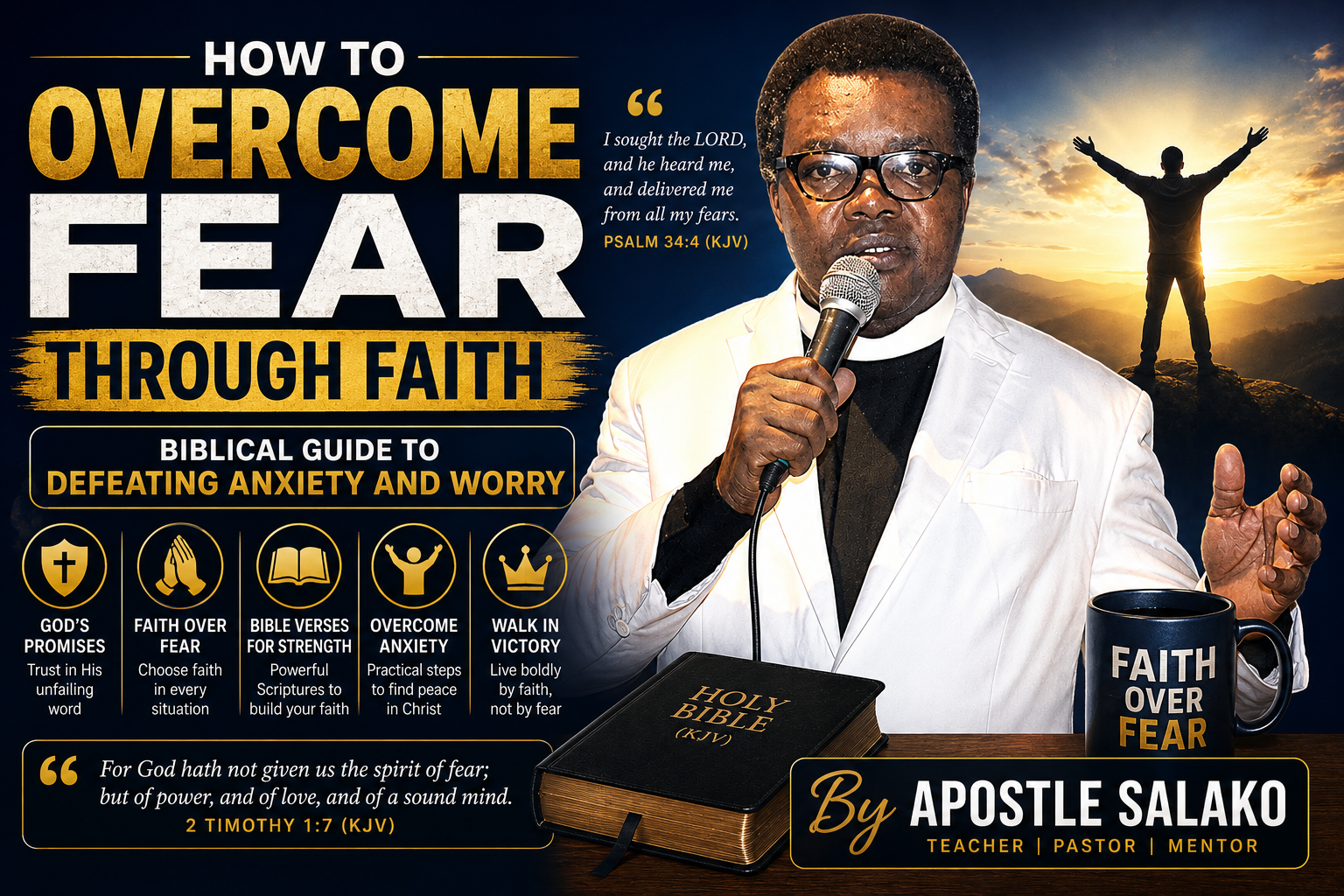
Fear is one of the greatest battles every believer must face. It does not discriminate between the rich and the poor, the young and the old, or the mature believer and the new convert. Every Christian has encountered moments when fear attempted to dominate their thoughts, weaken their faith, and hinder their obedience to God.
Fear often whispers: "What if you fail?" "What if God doesn't answer?" "What if something terrible happens?" "What if you lose everything?"
Faith, however, speaks a different language: "God is with me." "His promises cannot fail." "He will never leave me." "The Lord is my helper."
Throughout Scripture, God repeatedly tells His people: "Fear not." This command appears in many forms because God knows that fear is one of humanity's greatest spiritual enemies.
Fear has stopped countless people from fulfilling God's purpose. It has destroyed dreams, delayed destinies, weakened churches, and discouraged ministers. Yet the Bible presents a powerful solution—not positive thinking, self-confidence, or human strength—but unwavering faith in the living God.
This guide explores what the Bible teaches about fear, why it is so destructive, and how genuine faith enables believers to live courageously in every season of life.
What Is Fear According to the Bible?
Fear is an emotional response to perceived danger or uncertainty. While fear can sometimes serve as a healthy warning against genuine danger, the Bible distinguishes between natural caution and a persistent spirit of fear that undermines trust in God.
Fear becomes sinful when it causes us to: doubt God's promises; refuse to obey His commands; believe circumstances more than His Word; allow anxiety to rule our hearts; or live in continual bondage.
Fear often begins in the mind. A single anxious thought can grow into worry, panic, and eventually unbelief if left unchecked.
The Origin of Fear
The first mention of fear appears after Adam and Eve sinned. "I heard thy voice in the garden, and I was afraid..." (Genesis 3:10, KJV). Before sin entered the world, Adam experienced perfect fellowship with God. After disobedience, fear entered the human experience. Since then, fear has been one of the consequences of living in a fallen world.
Fear Is Not God's Gift
One of the clearest biblical declarations about fear is found in Paul's letter to Timothy. "For God hath not given us the spirit of fear; but of power, and of love, and of a sound mind." (2 Timothy 1:7, KJV).
Notice what God gives His children: power, love, and a sound mind. Fear is absent from this list because it does not originate from God. The spirit of fear seeks to paralyze, confuse, intimidate, and discourage believers, whereas the Holy Spirit empowers, comforts, and strengthens them.
Understanding the Difference Between Godly Fear and Sinful Fear
The Bible uses the word "fear" in two very different ways. Understanding this distinction is essential.
1. Godly Fear
Godly fear refers to reverence, awe, honor, and deep respect for the Lord. It is the beginning of wisdom. "The fear of the LORD is the beginning of wisdom." (Psalm 111:10, KJV).
Godly fear produces: obedience, humility, holiness, worship, and wisdom. It draws believers closer to God rather than pushing them away.
2. Sinful Fear
Sinful fear is the fear that causes believers to distrust God's character or promises. It magnifies problems while minimizing God's power. Examples include: fear of failure, fear of rejection, fear of death, fear of people, fear of tomorrow, fear of lack, and fear of sickness. This type of fear hinders faith and obedience.
Why Fear Is One of Satan's Greatest Weapons
The devil understands that he cannot defeat God, so he attempts to intimidate God's people. Fear is one of his primary weapons because fear stops obedience, weakens prayer, produces anxiety, causes compromise, leads to unbelief, and robs believers of peace.
When Peter walked on the water, he demonstrated extraordinary faith. However, "But when he saw the wind boisterous, he was afraid..." (Matthew 14:30, KJV). The moment Peter shifted his focus from Christ to the storm, fear replaced faith.
The lesson is timeless. Faith looks at Jesus. Fear looks at circumstances.
Fear Distorts Reality
The twelve spies sent into Canaan illustrate this truth. Ten spies focused on giants. Two spies focused on God. The circumstances were identical. The difference was perspective. Fear exaggerates obstacles. Faith magnifies God.
The Biblical Meaning of Faith
Faith is far more than optimism or wishful thinking. It is confident trust in the character, promises, and power of God. Hebrews defines faith beautifully: "Now faith is the substance of things hoped for, the evidence of things not seen." (Hebrews 11:1, KJV).
Faith is confidence before circumstances change. Faith believes God's Word even when emotions suggest otherwise. Faith declares: "I trust God's promise more than my present situation."
Faith Depends on God's Character
Biblical faith is not faith in faith. It is faith in God. Because God is faithful, holy, unchanging, all-powerful, all-knowing, loving, and sovereign, His promises can be trusted completely.
How Faith Destroys Fear
Faith and fear cannot dominate the heart simultaneously. The greater your confidence in God, the weaker fear becomes. This does not mean believers never experience fearful emotions. Even David admitted moments of fear. Yet he declared: "What time I am afraid, I will trust in thee." (Psalm 56:3, KJV).
Notice David did not say "I never become afraid." Instead he chose trust over fear. Faith is often a decision before it becomes a feeling.
Faith Changes Your Perspective
Faith reminds believers that God is bigger than sickness, financial problems, persecution, uncertainty, and even death itself. When faith grows, fear shrinks.
Perfect Love Casts Out Fear
John writes: "There is no fear in love; but perfect love casteth out fear..." (1 John 4:18, KJV). As believers grow in their understanding of God's love, fear loses its grip. Knowing that God loves you, cares for you, and works all things together for your good provides profound security, even in difficult circumstances.
Seven Common Fears Christians Face
Although every believer's experience is unique, most fears fall into a few common categories. God's Word provides answers for each of them.
1. Fear of Failure
One of the greatest reasons many believers never fulfill their God-given calling is the fear of failure. They ask themselves: What if I fail? What if people criticize me? What if I disappoint God? What if I make the wrong decision? Fear of failure often causes people to delay obedience.
Moses experienced this fear when God called him to deliver Israel. Instead of accepting God's commission, Moses offered excuse after excuse. "Who am I, that I should go unto Pharaoh..." (Exodus 3:11, KJV). God did not rebuke Moses for his weakness. Instead, He reminded Moses of His presence. "Certainly I will be with thee." (Exodus 3:12, KJV). The success of God's work never depends solely on human ability but on God's enabling grace.
Faith's Response: Faith says, "If God has called me, He will equip me."
2. Fear of the Future
Many people are consumed by questions about tomorrow. Will I have enough? What will happen to my family? Will my ministry survive? Jesus directly addressed this fear. "Take therefore no thought for the morrow..." (Matthew 6:34, KJV). God already knows tomorrow because He is already there. Faith rests in God's providence.
3. Fear of Financial Lack
Economic uncertainty often creates anxiety. Yet Scripture repeatedly reminds believers that God is their Provider. David testified: "I have been young, and now am old; yet have I not seen the righteous forsaken, nor his seed begging bread." (Psalm 37:25, KJV). Paul likewise assures believers: "But my God shall supply all your need according to his riches in glory by Christ Jesus." (Philippians 4:19, KJV). Faith does not ignore wise stewardship; it rejects panic and trusts God's faithful provision.
4. Fear of People
Many believers struggle more with the opinions of people than with the commands of God. This fear leads to compromise. Scripture warns: "The fear of man bringeth a snare..." (Proverbs 29:25, KJV). When we seek human approval above God's approval, fear becomes a trap. Faith frees us to obey God regardless of public opinion.
5. Fear of Death
Death is one of humanity's greatest fears. Yet Jesus transformed death for every believer. Paul confidently declared: "For to me to live is Christ, and to die is gain." (Philippians 1:21, KJV). Christ has conquered death through His resurrection. Believers grieve, but not without hope. Our confidence rests in the promise of eternal life through Jesus Christ.
6. Fear During Trials
Difficult seasons often produce uncertainty. When storms arise, fear whispers: "God has forgotten you." The disciples experienced this while crossing the Sea of Galilee. Although Jesus was in the boat, they panicked. "Master, carest thou not that we perish?" (Mark 4:38, KJV). Jesus calmed both the storm and their fearful hearts. The presence of storms does not mean the absence of God.
7. Fear of Spiritual Opposition
Many Christians fear spiritual attacks. While believers should never underestimate Satan's schemes, neither should they exaggerate his power. Scripture reminds us: "Greater is he that is in you, than he that is in the world." (1 John 4:4, KJV). Christ has already won the decisive victory through His death and resurrection. Believers stand in that victory by faith.
Bible Characters Who Overcame Fear Through Faith
Throughout Scripture, God repeatedly transformed fearful people into courageous servants. Their stories remind us that faith grows through dependence on God.
Abraham: Trusting God Beyond Understanding
When God instructed Abraham to leave his homeland, He did not reveal every detail. Instead, He simply said: "Get thee out..." Abraham obeyed. Faith often requires obedience before understanding.
Later, Abraham faced the unimaginable command to offer Isaac. Although the command seemed impossible, Abraham trusted God's promise. Hebrews explains that Abraham believed God could even raise Isaac from the dead. True faith trusts God's character when His plans seem mysterious.
Moses: From Fearful Shepherd to National Leader
Moses initially doubted himself. He argued: I am not qualified. I cannot speak well. Someone else should go. Yet God patiently strengthened him. The man who once feared Pharaoh eventually stood before him with divine authority. Faith does not eliminate weakness. It allows God's strength to shine through human weakness.
Joshua: Courage Through God's Presence
Joshua inherited enormous responsibility after Moses' death. Leading Israel into Canaan seemed overwhelming. Three times God encouraged Joshua: "Be strong and of a good courage." Why? Because: "The LORD thy God is with thee whithersoever thou goest." (Joshua 1:9, KJV). Our courage comes from God's presence rather than personal confidence.
David: Facing Giants by Faith
When David confronted Goliath, everyone else saw an unbeatable warrior. David saw an opportunity for God to display His power. He declared: "The battle is the LORD'S." David's confidence rested not in his sling but in the living God. Faith changes how we evaluate obstacles.
Esther: Courage for Such a Time as This
Queen Esther faced an impossible choice. Speak—and risk death. Remain silent—and watch her people perish. Mordecai challenged her: "Who knoweth whether thou art come to the kingdom for such a time as this?" Esther responded with remarkable faith: "If I perish, I perish." Her courage became the means of God's deliverance. Faith often requires costly obedience.
Daniel: Faith in the Lions' Den
Daniel's unwavering commitment to prayer placed him in mortal danger. He refused to compromise. God shut the mouths of the lions. Daniel's story teaches that faithfulness does not always prevent trials. Instead, God often demonstrates His power within them.
Peter: Walking Above the Storm
Peter accomplished the impossible while keeping his eyes on Jesus. He only began sinking after focusing on the waves. Many believers experience the same struggle. When our attention shifts from Christ to circumstances, fear grows. Jesus immediately reached out to Peter. Likewise, Christ remains faithful to sustain those who call upon Him.
Paul: Courage Despite Persecution
Paul endured imprisonment, beatings, shipwrecks, rejection, hunger, and opposition. Yet he confidently declared: "None of these things move me..." Paul's faith rested on the certainty that God's purposes could not be thwarted by earthly suffering. His life demonstrates that courage is not the absence of hardship but steadfast confidence in Christ.
Lessons from These Biblical Examples
These faithful servants came from different backgrounds and faced different challenges, but they shared several common convictions: they trusted God's promises above their circumstances; they obeyed even when they did not have every answer; they relied on God's strength rather than their own abilities; they viewed trials as opportunities for God to demonstrate His power; and they persevered because they believed God would remain faithful.
Practical Steps to Overcome Fear Through Faith
Knowing what the Bible says about fear is essential, but applying those truths is what transforms our lives. Faith is not merely intellectual agreement with Scripture; it is active trust expressed through obedience.
1. Know God's Word
The greatest weapon against fear is the Word of God. Fear thrives where there is ignorance of God's promises. Faith grows where Scripture fills the heart. Paul wrote: "So then faith cometh by hearing, and hearing by the word of God." (Romans 10:17, KJV).
Notice that faith does not come primarily through emotions or circumstances. It comes through consistently hearing, reading, studying, and meditating on God's Word. When Jesus was tempted by Satan in the wilderness, He answered every temptation with Scripture. Likewise, believers must confront fearful thoughts with biblical truth.
Practical Application: Read the Bible daily. Memorize verses that address fear and faith. Keep a journal of God's promises. Listen to sound biblical teaching. Meditate on Scripture throughout the day. The more your mind is saturated with God's Word, the less room fear has to grow.
2. Pray Instead of Worrying
Prayer is the believer's first response, not a last resort. Many Christians spend more time worrying about problems than praying about them. Paul instructs believers: "Be careful for nothing; but in every thing by prayer and supplication with thanksgiving let your requests be made known unto God." (Philippians 4:6, KJV).
Notice the progression: refuse anxious worry, pray specifically, give thanks, and trust God with the outcome. Verse 7 then promises that God's peace will guard our hearts and minds through Christ Jesus.
Practical Application: Whenever fear arises, immediately turn it into prayer. Instead of saying, "What if this goes wrong?" Pray, "Father, I trust You with this situation. Give me wisdom, courage, and peace."
3. Focus on God's Character
Fear magnifies problems. Faith magnifies God. The Bible repeatedly reveals God's character: He is faithful, sovereign, all-powerful, loving, wise, and unchanging. Malachi 3:6 declares: "For I am the LORD, I change not..." Because God's character never changes, His promises remain trustworthy. When circumstances become uncertain, remind yourself of who God is.
4. Remember God's Faithfulness
David often strengthened his faith by remembering what God had done in the past. Before facing Goliath, he recalled how God had delivered him from the lion and the bear. Past victories build present confidence. Keep a record of answered prayers and God's faithfulness. During difficult seasons, revisit those testimonies to remind yourself that the God who helped you before is still at work today.
5. Choose Faith Over Feelings
Faith is not the denial of emotions. The Psalms reveal that godly people experienced fear, sorrow, and discouragement. The difference is that they chose to trust God despite those feelings. David declared: "What time I am afraid, I will trust in thee." (Psalm 56:3, KJV). Notice that David acknowledged his fear but refused to let it rule him. Faith is a decision to trust God's Word above changing emotions.
6. Walk in Obedience
Fear often tempts believers to delay or avoid obedience. Abraham could have remained in Ur. Joshua could have hesitated to enter Canaan. Esther could have remained silent. Peter could have stayed in the boat. Faith acts upon God's Word even when the outcome is uncertain. Each step of obedience strengthens faith and weakens fear. Ask yourself: What has God already told me to do? Am I delaying because of fear? Obey the light God has already given.
7. Surround Yourself with Godly Encouragement
Faith grows best in biblical community. Hebrews 10:24–25 encourages believers to stir one another up to love and good works and not neglect meeting together. Isolation often amplifies fear. Godly fellowship provides prayer support, wise counsel, accountability, encouragement, and perspective. Choose relationships that strengthen your faith rather than reinforce your fears.
8. Speak God's Promises
The words we speak influence the direction of our thoughts. Instead of repeating fearful possibilities, declare biblical truths. For example: instead of saying, "I'm alone," declare: "I will never leave thee, nor forsake thee." (Hebrews 13:5, KJV). Instead of saying, "I cannot do this," declare: "I can do all things through Christ which strengtheneth me." (Philippians 4:13, KJV). Speaking Scripture does not manipulate God, but it renews our minds and aligns our hearts with His truth.
9. Depend on the Holy Spirit
Victory over fear is not achieved by human determination alone. Believers have the indwelling Holy Spirit, who empowers them to live courageously. Paul reminds Timothy: "For God hath not given us the spirit of fear; but of power, and of love, and of a sound mind." (2 Timothy 1:7, KJV). The Holy Spirit produces courage, wisdom, peace, self-control, and endurance. Ask Him daily for strength to walk by faith.
10. Keep Your Eyes on Christ
The Christian life is not sustained by self-confidence but by Christ-centered confidence. Hebrews 12:2 exhorts believers to look unto Jesus, the Author and Finisher of our faith. Like Peter on the water, we begin to sink when our attention shifts from Christ to the storm. Fix your eyes on His power, His promises, and His faithfulness.
Common Mistakes Christians Make When Battling Fear
Even sincere believers can adopt habits that strengthen fear rather than faith. Avoid these common pitfalls.
Mistake 1: Feeding Fear Instead of Faith
Constant exposure to discouraging news, negative conversations, or fearful speculation can overwhelm the heart. Be discerning about what shapes your thinking.
Mistake 2: Ignoring God's Promises
Fear grows when we focus exclusively on circumstances. Regular meditation on Scripture keeps our perspective anchored in God's truth.
Mistake 3: Waiting to Feel Courageous
Many people think they must first feel brave before acting. Biblical courage is often obedience in the presence of fear. Feelings frequently follow faithful action.
Mistake 4: Depending Solely on Personal Strength
Self-reliance eventually leads to discouragement. God calls believers to rely upon His strength. As Paul testified: "When I am weak, then am I strong." (2 Corinthians 12:10, KJV).
Mistake 5: Neglecting Prayer
Fear often fills the space where prayer is absent. A consistent prayer life cultivates peace and confidence in God's care.
Building a Lifestyle of Faith
Overcoming fear is not a one-time event but a lifelong journey of spiritual growth. Daily habits that strengthen faith include: reading Scripture with consistency, maintaining a vibrant prayer life, worshiping God regularly, participating in the fellowship of believers, serving others with humility, remembering God's past faithfulness, and responding to challenges with trust rather than panic. As these practices become part of your daily life, fear gradually loses its influence.
Reflection Questions
Take time to prayerfully consider the following: What fear has been most persistent in my life? Which promises of God directly address that fear? Am I focusing more on my circumstances or on God's character? Is fear preventing me from obeying God in any area? What practical step of faith can I take today? Honest reflection, combined with prayer and obedience, allows God's truth to reshape our thinking and strengthen our faith.
Powerful Bible Verses About Overcoming Fear
One of the most effective ways to strengthen your faith is to meditate on God's promises. The following Scriptures remind us that the Lord is our refuge, strength, and ever-present help.
"Fear thou not; for I am with thee: be not dismayed; for I am thy God: I will strengthen thee; yea, I will help thee; yea, I will uphold thee with the right hand of my righteousness." — Isaiah 41:10 (KJV)
"Have not I commanded thee? Be strong and of a good courage; be not afraid, neither be thou dismayed: for the LORD thy God is with thee whithersoever thou goest." — Joshua 1:9 (KJV)
"Yea, though I walk through the valley of the shadow of death, I will fear no evil: for thou art with me..." — Psalm 23:4 (KJV)
"The LORD is my light and my salvation; whom shall I fear? the LORD is the strength of my life; of whom shall I be afraid?" — Psalm 27:1 (KJV)
"What time I am afraid, I will trust in thee." — Psalm 56:3 (KJV)
"If God be for us, who can be against us?" — Romans 8:31 (KJV)
"Be careful for nothing; but in every thing by prayer and supplication with thanksgiving let your requests be made known unto God." — Philippians 4:6 (KJV)
"I will never leave thee, nor forsake thee." — Hebrews 13:5 (KJV)
"For God hath not given us the spirit of fear; but of power, and of love, and of a sound mind." — 2 Timothy 1:7 (KJV)
"There is no fear in love; but perfect love casteth out fear..." — 1 John 4:18 (KJV)
Daily Declarations of Faith
Speaking biblical truth can help renew your mind and keep your focus on God's promises. Declare these in faith each day: God is with me wherever I go. The Lord is my refuge and my strength. I choose faith over fear. God's promises are trustworthy. Christ is greater than every challenge I face. I will not be ruled by anxiety. The Holy Spirit gives me power, love, and a sound mind. My future is secure in God's hands. I will obey God even when I cannot see the whole path. My faith is growing stronger every day.
Frequently Asked Questions
Is fear always a sin? Not every experience of fear is sinful. Fear is a natural human emotion. It becomes spiritually harmful when it causes us to distrust God, refuse His will, or live in continual anxiety instead of relying on His promises.
How can I strengthen my faith every day? Faith grows through consistent exposure to God's Word, prayer, worship, fellowship with other believers, and practical obedience to Scripture (Romans 10:17).
Why do faithful Christians still experience fear? Even mature believers encounter moments of fear because they live in a fallen world. The difference is not the absence of fear but the decision to trust God despite it.
Can prayer remove fear? Prayer often changes our perspective before it changes our circumstances. As we bring our concerns to God with thanksgiving, He grants peace that guards our hearts and minds (Philippians 4:6–7).
What should I do when fearful thoughts return? Return to God's Word. Pray. Remember His faithfulness. Seek encouragement from mature believers, and continue walking in obedience. Faith is strengthened through consistent dependence on God.
Key Takeaways
Fear entered the world because of sin, but believers are not called to live in bondage to it. God distinguishes between reverent fear of the Lord and sinful fear that produces unbelief. Faith grows through God's Word, prayer, worship, and obedience. Biblical courage is trusting God even when circumstances remain uncertain. God's presence is the believer's greatest source of confidence. Scripture consistently points us away from fear and toward faith in Christ. Every challenge becomes an opportunity to witness God's faithfulness.
Conclusion
Fear is one of the oldest and most persistent struggles known to humanity, yet it does not have to define the life of a Christian. Throughout Scripture, we see ordinary men and women transformed into courageous servants because they placed their confidence in an extraordinary God.
Faith does not promise a life free from storms. Instead, it assures us that Christ is present in every storm. Whether you face uncertainty about your future, financial pressures, illness, opposition, or personal challenges, God's promises remain unchanged.
The call of Scripture is not simply to "try harder" or "be brave." It is to know God more deeply, trust Him more fully, and obey Him more faithfully. As your relationship with Him grows, fear gradually loses its power because your confidence is anchored in His unchanging character.
Today, choose to fix your eyes on Jesus rather than your circumstances. Let His Word shape your thoughts, His Spirit strengthen your heart, and His promises guide your steps. The God who was faithful to Abraham, Moses, Joshua, David, Esther, Daniel, Peter, and Paul is the same God who walks with you today.
Walk by faith. Stand in His promises. Refuse to let fear dictate your decisions. The Lord is with you, and in Him you have every reason to live with courage and hope.
A Prayer for Overcoming Fear Through Faith
Heavenly Father, I come before You in the name of Jesus Christ, acknowledging that You alone are my refuge and my strength. Forgive me for the times I have allowed fear to overshadow my faith. Thank You for Your promise that You will never leave me nor forsake me. Fill my heart with the peace that comes from trusting You completely. Help me to remember Your faithfulness in every season of life. Strengthen me through Your Holy Spirit. Renew my mind with Your Word. Give me courage to obey You even when I cannot see the entire path ahead. I surrender every fear, worry, anxiety, and burden into Your hands. Teach me to walk by faith and not by sight. Let my life reflect unwavering confidence in Your goodness, Your wisdom, and Your sovereign care. May Your perfect love cast out every fear within me, and may my life bring glory to Your name. In Jesus' mighty name, Amen.
Invitation to Receive Jesus Christ
If you have never trusted Jesus Christ as your Lord and Savior, the greatest step you can take toward lasting peace is to receive Him by faith. The Bible declares that all have sinned and fall short of God's glory, but God demonstrated His love by sending His Son, Jesus Christ, to die for our sins and rise again. Through repentance and faith in Him, we receive forgiveness, new life, and the hope of eternity.
If you desire to follow Christ, pray sincerely: "Lord Jesus, I confess that I am a sinner. I believe You died for my sins and rose again. Forgive me, cleanse me, and become the Lord of my life. Help me to follow You faithfully from this day forward. Thank You for saving me. Amen."
If you have prayed this prayer with genuine faith, begin reading the Bible daily, join a Bible-believing church, and grow in your relationship with Christ.
Author Bio
Apostle Salako Adedamola is a Bible teacher, pastor, and Christian writer committed to equipping believers with sound, Scripture-centered teaching. Through his ministry and digital platforms, he helps Christians deepen their understanding of God's Word, grow in spiritual maturity, and live lives that glorify Jesus Christ. His passion is to proclaim the Gospel, strengthen the Church, and encourage believers to walk in faith, holiness, and the power of the Holy Spirit.
Article written by Apostle Salako Adedamola.
Apostle Adedamola Salako
Founder of Apostle Salako Studios — pastor, recording artist, and teacher on faith, music, and stewardship.
Frequently Asked Questions
QIs fear always a sin?
Not every experience of fear is sinful. Fear becomes spiritually harmful when it causes us to distrust God, refuse His will, or live in continual anxiety instead of relying on His promises.
QHow can I strengthen my faith every day?
Faith grows through consistent exposure to God's Word, prayer, worship, fellowship with other believers, and practical obedience to Scripture (Romans 10:17).
QWhy do faithful Christians still experience fear?
Even mature believers encounter moments of fear because they live in a fallen world. The difference is not the absence of fear but the decision to trust God despite it.
QCan prayer remove fear?
Prayer often changes our perspective before it changes our circumstances. As we bring our concerns to God with thanksgiving, He grants peace that guards our hearts and minds (Philippians 4:6–7).
QWhat should I do when fearful thoughts return?
Return to God's Word. Pray. Remember His faithfulness. Seek encouragement from mature believers, and continue walking in obedience. Faith is strengthened through consistent dependence on God.
Enjoyed this article?
Get the next one straight to your inbox. One thoughtful email a week.
Comments (0)
Comments are stored locally in your browser. For published responses, email us via the Contact page.
You may also like
21 Biblical Habits That Transform Your Life: Daily Practices Every Christian Should Develop (KJV Guide)
28 min read
What Is Biblical Faith? The Complete Biblical Guide to Living by Faith According to Scripture (2026)
16 min read
Who Is the Holy Spirit? A Complete Biblical Guide to Knowing the Person, Power, and Work of the Holy Spirit
30 min read