
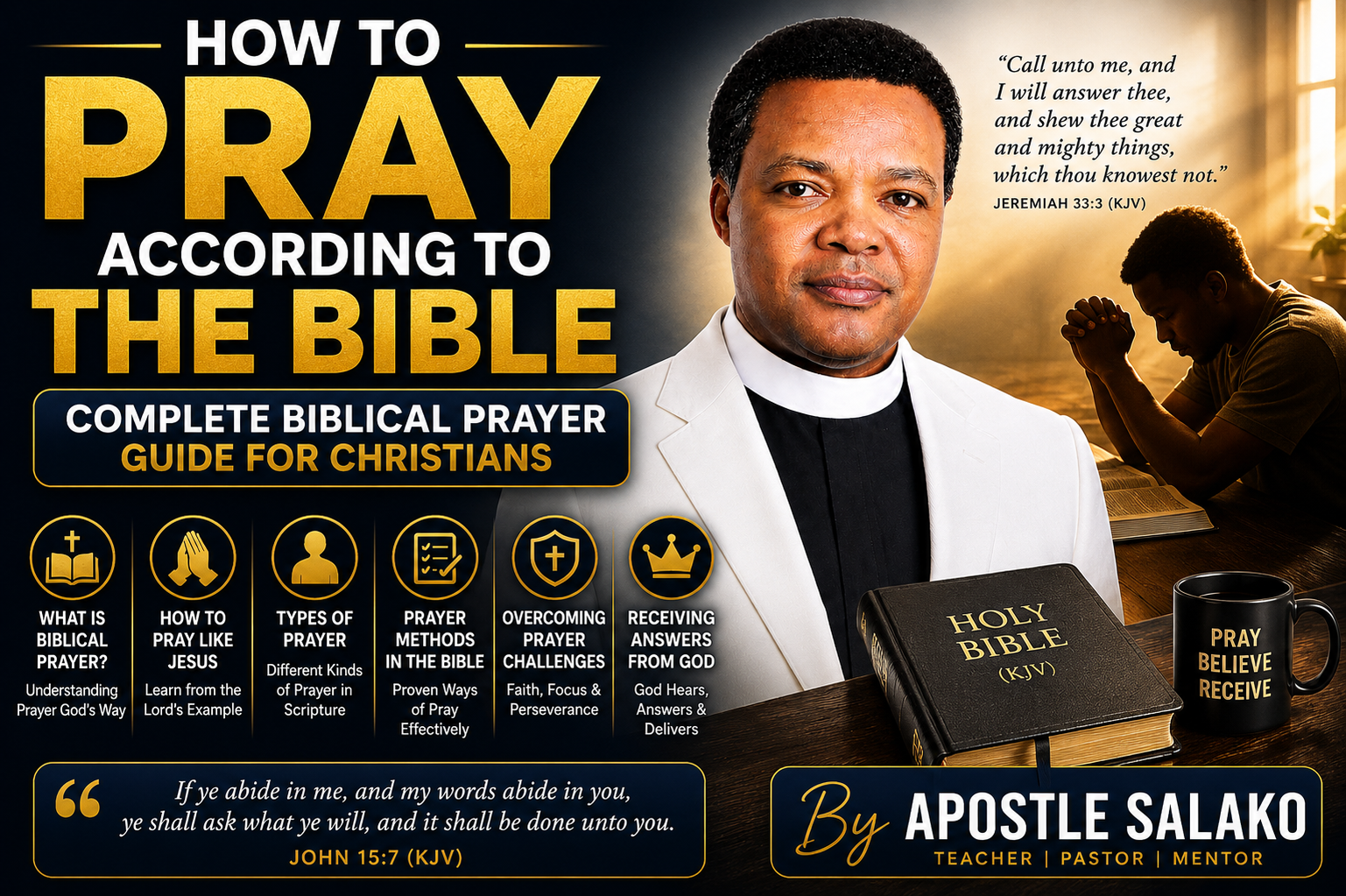
Prayer is one of the greatest privileges God has given His children. Through prayer, believers communicate with their Heavenly Father, receive guidance, experience His peace, and grow in intimacy with Him. Yet many Christians struggle with questions such as: How should I pray? Does God hear every prayer? Why are some prayers unanswered? Is there a correct way to pray? What did Jesus actually teach about prayer?
The good news is that the Bible does not leave us guessing. Scripture provides clear instructions, inspiring examples, and timeless principles that help every believer develop a vibrant and effective prayer life. Whether you are a new believer learning to pray for the first time or a mature Christian seeking to deepen your communion with God, this guide will help you understand how to pray according to the Bible.
What Is Prayer?
Prayer is much more than speaking religious words. It is a living conversation with the Creator of heaven and earth. Simply defined, prayer is communicating with God through worship, thanksgiving, confession, petition, intercession, and listening. Prayer involves both speaking and listening — it is not a one-sided monologue but a relationship built on trust, love, and obedience.
The Bible portrays prayer as the heartbeat of a believer's relationship with God. From Genesis to Revelation, faithful men and women sought God's face through prayer. Prayer includes worshiping God, praising His greatness, thanking Him for His blessings, confessing sins, asking for wisdom, seeking guidance, interceding for others, and surrendering to God's will.
"For your Father knoweth what things ye have need of, before ye ask him." — Matthew 6:8 (KJV)
Prayer is not about informing God of something He does not know. Instead, prayer expresses dependence, faith, humility, and love.
Why Every Christian Must Pray
Prayer is not optional for believers — it is essential to the Christian life. Just as breathing sustains physical life, prayer sustains spiritual life. Without prayer, believers become spiritually weak, vulnerable to temptation, and disconnected from God's guidance.
1. Prayer builds fellowship with God. Christianity is not merely a religion — it is a relationship. James 4:8 says, "Draw nigh to God, and he will draw nigh to you." Prayer nurtures intimacy; the more time you spend with Him, the more you recognize His voice.
2. Prayer strengthens faith. Every answered prayer becomes a testimony that builds confidence in God's promises. As Romans 10:17 reminds us, faith comes by hearing the Word of God — prayer and Scripture work together.
3. Prayer brings peace. Philippians 4:6–7 teaches us to exchange anxiety for God's peace by presenting every request with thanksgiving. God's peace is not dependent on circumstances but on His presence.
4. Prayer invites God's guidance. Proverbs 3:5–6 calls us to trust the Lord with all our heart and acknowledge Him in all our ways — prayer positions us to receive divine wisdom.
5. Prayer helps us resist temptation. Jesus instructed His disciples, "Watch and pray, that ye enter not into temptation" (Matthew 26:41). Prayer strengthens believers spiritually to overcome the attacks of the enemy.
What Jesus Taught About Prayer
No one understood prayer better than Jesus Christ. His earthly ministry was marked by consistent communion with the Father. Even though He was the Son of God, Jesus frequently withdrew to pray. If He prioritized prayer, we certainly should.
Jesus prayed regularly. The Gospels repeatedly show Jesus seeking solitary places for prayer — before major decisions, before miracles, before choosing the disciples, and before His crucifixion. Prayer was the source of His strength.
Jesus taught private prayer. Matthew 6:6 says, "But thou, when thou prayest, enter into thy closet." He warned against praying merely to impress people. Prayer should flow from a sincere heart rather than a desire for public recognition.
Jesus warned against empty repetition. Matthew 6:7 says, "But when ye pray, use not vain repetitions." Prayer is not about repeating phrases mechanically — God desires heartfelt communication.
Jesus gave the model prayer. When the disciples asked, "Lord, teach us to pray," He gave a pattern — not merely words to memorize — that includes worship, submission, dependence, forgiveness, spiritual protection, and Kingdom focus.
The Biblical Foundation of Prayer
Prayer rests upon foundational truths revealed throughout Scripture. God invites us to pray — Jeremiah 33:3 declares, "Call unto me, and I will answer thee, and shew thee great and mighty things, which thou knowest not."
We pray through Jesus Christ. Jesus declared, "I am the way, the truth, and the life: no man cometh unto the Father, but by me." Our confidence comes not from our righteousness but from Christ's finished work on the cross.
The Holy Spirit helps us pray. Romans 8:26 assures us that when we do not know what to pray, the Spirit intercedes for believers according to God's will. We are never alone in prayer.
Prayer must be offered in faith. Hebrews 11:6 teaches that without faith it is impossible to please God. Biblical faith confidently believes that God hears, knows, and responds according to His perfect will.
Prayer aligns us with God's will. Jesus demonstrated this perfectly in Gethsemane: "Nevertheless not my will, but thine, be done." True prayer seeks God's purposes above personal preferences and is rooted in God's promises — wisdom (James 1:5), peace (Philippians 4:6–7), and God's nearness to those who seek Him sincerely (Jeremiah 29:12–13).
How to Prepare Your Heart Before Prayer
Throughout Scripture, God emphasizes the condition of the heart over the beauty of the language. Before we bring requests before the Lord, we should prepare our hearts to approach Him with reverence, humility, and faith.
1. Come with reverence. Psalm 95:6 says, "O come, let us worship and bow down: let us kneel before the LORD our maker." Quiet your mind, focus on God's greatness, and thank Him for His holiness before asking for anything.
2. Confess your sins. Psalm 66:18 warns, "If I regard iniquity in my heart, the Lord will not hear me." 1 John 1:9 assures us that God is faithful to forgive when we confess. Confession restores fellowship.
3. Forgive others. Mark 11:25 teaches, "And when ye stand praying, forgive." An unforgiving heart creates spiritual barriers — forgiveness releases personal vengeance into God's hands.
4. Pray with faith. Faith rests on three truths: God hears, God cares, God knows what is best. Even when answers are delayed, faith continues to trust God's wisdom.
5. Be filled with gratitude. Psalm 100:4 says, "Enter into his gates with thanksgiving." A thankful believer becomes more aware of God's blessings than life's disappointments.
How to Pray Step by Step According to the Bible
The clearest model is the prayer Jesus taught His disciples in Matthew 6:9–13, often called the Lord's Prayer — better understood as a pattern for our prayers.
Step 1: Begin with worship. "Our Father which art in heaven, Hallowed be thy name." Prayer begins by recognizing who God is — sovereign, faithful, loving, and worthy.
Step 2: Seek God's kingdom. "Thy kingdom come. Thy will be done." Prayer aligns us with God's purposes. Ask what pleases Him, how you can serve His kingdom, and lead you according to His will.
Step 3: Present your needs. "Give us this day our daily bread." God invites His children to bring every need before Him — financial, family, health, career, ministry, wisdom, protection, and strength. Philippians 4:6 teaches us to present everything to God.
Step 4: Confess and receive forgiveness. "Forgive us our debts." Every believer still needs daily cleansing through honest repentance whenever the Holy Spirit reveals sin.
Step 5: Forgive others. Jesus immediately connects receiving forgiveness with extending forgiveness. Prayer softens our hearts toward people who have hurt us.
Step 6: Ask for spiritual protection. "Lead us not into temptation, but deliver us from evil." Prayer recognizes our dependence upon God's protection against temptation and the enemy's schemes.
Step 7: End with praise. "For thine is the kingdom." Our prayers should end where they began — with God. Praise reminds us that regardless of circumstances, God remains King.
A simple daily framework: Praise, Thanksgiving, Confession, Scripture, Petition, Intercession, Listening, and Praise again. Praying according to God's will (1 John 5:14) gives us confidence: when we ask according to His will, He hears us.
Types of Prayer in Scripture
1. Prayer of worship focuses entirely on God — His holiness, majesty, and goodness (Psalm 29:2). 2. Prayer of thanksgiving acknowledges God's faithfulness (1 Thessalonians 5:18). 3. Prayer of confession restores fellowship, modeled by David in Psalm 51.
4. Prayer of petition presents personal needs — Jesus said, "Ask, and it shall be given you" (Matthew 7:7). 5. Prayer of intercession stands in the gap for others — family, pastors, missionaries, leaders, the persecuted church, and unbelievers.
6. Prayer of faith trusts God completely — James 5:15 says, "And the prayer of faith shall save the sick." 7. Prayer of surrender embraces God's will: "Not my will, but thine, be done" (Luke 22:42).
Great Examples of Prayer in the Bible
Abraham interceded for Sodom with humility and compassion (Genesis 18) — effective prayer combines boldness with humility. Moses interceded for Israel when they sinned — spiritual leaders carry people before God, not merely criticize them.
Hannah poured out her soul before the Lord and God answered with Samuel — God welcomes sincere, heartfelt prayer. David prayed in every season — joy, fear, victory, repentance, and sorrow — authenticity is a mark of biblical prayer.
Elijah, "a man subject to like passions as we are," prayed earnestly and God answered in extraordinary ways. Daniel prayed faithfully three times each day, even at the risk of his life — consistency prepares believers for trials.
Jesus regularly withdrew to pray before decisions, miracles, choosing apostles, and the cross. The early church (Acts) gathered for prayer before decisions, during persecution, for boldness, and for one another — united prayer fueled the church's growth.
Common Mistakes Christians Make in Prayer
1. Treating prayer like a religious duty — God desires relationship, not empty rituals. 2. Only praying during crises — healthy growth includes daily communion in every season. 3. Praying without faith — doubting God's character hinders confident prayer.
4. Ignoring God's Word — Scripture gives shape and direction to our prayers. 5. Seeking personal glory — prayer is directed to God, not to an audience. 6. Harboring unforgiveness — mercy received must be mercy extended.
7. Expecting immediate answers every time — God answers Yes, No, Wait, or in a better way than we imagined. Delayed answers are not evidence of God's absence.
Why Some Prayers Are Not Answered
1. Wrong motives — James 4:3 teaches that selfish motives hinder prayer. 2. Unconfessed sin — persistent, unrepentant sin affects fellowship with God. 3. Lack of faith — Scripture calls believers to trust God wholeheartedly.
4. God's timing — many biblical figures waited months or years before seeing God's promises fulfilled. 5. God's greater purpose — Romans 8:28 reminds us that God works all things together for good for those who love Him. His wisdom exceeds our understanding.
Developing a Daily Prayer Life
1 Thessalonians 5:17 tells us to "Pray without ceasing" — a continual awareness of God's presence and ongoing dependence on Him. Choose a regular time. Jesus rose early to pray (Mark 1:35). Choose a quiet place. Read Scripture before praying. Keep a prayer journal. Balance worship, thanksgiving, confession, petition, intercession, and surrender.
Sample outline: Morning — praise God, thank Him for a new day, commit your plans, ask for wisdom and strength. Midday — thank God for provision, seek guidance, pray for coworkers and family. Evening — reflect on the day's blessings, confess known sins, thank God for His faithfulness, and rest in His peace.
Families flourish when prayer becomes a shared practice — parents praying with children for wisdom, protection, and spiritual growth; couples praying together for unity, love, stewardship, and parenting. The book of Acts shows that prayer was central to the early church — a praying church is a spiritually healthy church.
Key Takeaways
Prayer is a relationship with God, not merely a religious duty. Jesus provided a biblical pattern through the Lord's Prayer. Worship, thanksgiving, confession, petition, intercession, and surrender are all important aspects of prayer. Effective prayer is grounded in faith and aligned with God's will. God's Word should shape and guide our prayers. Consistency is more valuable than occasional intensity. God hears the sincere prayers of His children and answers according to His wisdom and timing.
Final Encouragement
Prayer is one of God's greatest gifts to His people. It is not a performance to impress others or a formula for obtaining everything we desire. It is a loving conversation with our Heavenly Father, made possible through Jesus Christ and empowered by the Holy Spirit. If your prayer life has become inconsistent, begin again today. You do not need perfect words — only a sincere heart that seeks God.
"Draw nigh to God, and he will draw nigh to you." — James 4:8 (KJV)
"Continue in prayer, and watch in the same with thanksgiving." — Colossians 4:2 (KJV)
Article by Apostle Salako Adedamola.
Apostle Adedamola Salako
Founder of Apostle Salako Studios — pastor, recording artist, and teacher on faith, music, and stewardship.
Frequently Asked Questions
QHow long should I pray?
The Bible does not prescribe a specific duration. Jesus warned against thinking that long prayers are automatically more effective (Matthew 6:7). Pray sincerely rather than for a certain length of time.
QMust I kneel to pray?
No. Scripture records believers praying while standing, kneeling, sitting, walking, with hands lifted, or heads bowed. The posture of the heart is more important than the posture of the body.
QCan I pray silently?
Yes. God knows our thoughts and hears silent prayers as well as spoken ones. Nehemiah silently prayed before answering the king (Nehemiah 2:4).
QDoes God always answer prayer?
Yes — but not always in the way we expect. God may answer Yes, No, Wait, or in a better way according to His wisdom. His answers are always consistent with His character and perfect will.
QCan new believers pray effectively?
Absolutely. Prayer is based on God's grace through Jesus Christ, not on spiritual maturity. Every believer has direct access to the Father through Christ.
QWhat if I don't know what to pray?
Romans 8:26 teaches that the Holy Spirit helps believers in their weakness. Begin with simple, honest prayers and allow Scripture to guide your words.
Enjoyed this article?
Get the next one straight to your inbox. One thoughtful email a week.
Comments (0)
Comments are stored locally in your browser. For published responses, email us via the Contact page.
You may also like
Walking with God Every Day: The Complete Biblical Guide to Daily Christian Living (2026)
24 min read
21 Biblical Habits That Transform Your Life: Daily Practices Every Christian Should Develop (KJV Guide)
28 min read
Who Is the Holy Spirit? A Complete Biblical Guide to Knowing the Person, Power, and Work of the Holy Spirit
30 min read